 Joseba Alvarez (L) and Haizpea Abrisketa (C), members of the outlawed Basque party Batasuna's National Committee, answer questions during a news conference in Bilbao June 9, 2006.
.... ... .
Joseba Alvarez (L) and Haizpea Abrisketa (C), members of the outlawed Basque party Batasuna's National Committee, answer questions during a news conference in Bilbao June 9, 2006. Arnaldo Otegi, left, leader the outlawed Basque pro-independence party, Batasuna, prepares to start a press conference at the Martin Ugalde Forum in the Basque village of Andoain, Thursday June 8, 2006.
06/08/2006The banned Batasuna representative, Joseba Álvarez, has affirmed that National Court judge Fernando Grande-Marlaska has not avoided previous Batasuna's press conferences, and he has done so now with yesterday's event as he might be wanting to hinder the peace process. Spanish Police halted a press conference by the leftwing nationalist party yesterday in Pamplona/Iruña.
In his opinion, "these events after the ceasefire, after the verification of the ceasefire, when everybody announces the setting up of the process, are incomprehensible and must be avoided."
Furthermore, he has stated that the meeting between Basque socialists' leader, Patxi López, and Batasuna's Arnaldo Otegi, can't be dependent on the legality of the party, although that is an issue to be solved in the future.
"Batasuna is a speaker that talks with everybody, even with the Socialist Party, throughout all these months and years, but eventually this issue must be also solved, but Batasuna's legalisation can't be used as an excuse to hinder those meetings," he has noted.
Álvarez has pointed out that Batasuna "can't be dependent on a judicial intervention or the whims of a judge who thinks an event was not a crime for five months, and once everything is verified and seems to be kicking off, he takes such a measure as banning a press conference."
Gerry Adams
Álvarez has said that the visit by Sinn Féin leader, Gerry Adams, has contributed "the message" based on the Irish experience, message of not arbitrating a process with an outlawed political force because that has no sense."
Furthermore, he has affirmed that Adams' message for leftwing nationalism was to be patient, because there can be many provocations, like yesterday's in Pamplona/Iruña.
 Sinn Fein leader Gerry Adams listens to a question during a news conference at the Ritz Hotel in Madrid, Wednesday June 7, 2006. Adams, who met with Basque separatist Batasuna party leader Arnaldo Otegi Y Basque separatist Batasuna party Arnaldo Otegi Tuesday, is in Spain to support the peace process. (AP Photo/Paul White)
As predicted, not exclusively, on this blog, the Partido Popular (PP) has now broken any possible consensus with the government over the next steps following the ceasefire by ETA. The reason given for the break was the announcement that the Basque section of the Spanish Socialist Party was going to begin contacts with the political wing of ETA, Batasuna. In reality it was always going to be a question of when, rather than if, the break would come. Ever since the ceasefire was announced the PP has been steadily chipping away at public confidence in the validity of the process, the difference is that now they have opted for frontal confrontation on the issue.
The break with the government also follows a disappointing performance by PP leader Mariano Rajoy in the “State of the Nation” debate last week, in the latest opinion poll only 14% of those interviewed think he won the debate. The peace process was not debated, more or less by agreement between both major parties, but then at the very last minute the PP put forward a motion which they knew would be rejected, because its approval would have made any serious negotiation with ETA or Batasuna impossible. The decision is also timed to coincide this weekend with a demonstration called by the Asociación de Victimas de Terrorismo (AVT), a terrorist victims organisation whose leadership works very closely together with the PP. They are marching against any negotiations of any kind with ETA, and combine this with a demand to be ‘told the truth’ over the train bombings on March 11th 2004. Despite the name, the AVT is far from being the only grouping to work with victims of terrorism, nor it does it make even the slightest effort to represent the diversity of opinions that exist amongst the victims.
The idea that the truth has not been told over March 11th is the product of a two year campaign by the right wing in Spain to try and justify the actions of the then governing PP in the three days between the bombings and the elections that removed them from office. The PP attempted to focus all attention on ETA as being responsible, even when the evidence of Islamist involvement was becoming overwhelming. Since losing power they have snatched at even the tiniest hint of an ETA connection to try and suggest that somehow they must have been involved, and an elaborate conspiracy theory has been constructed around this objective. It is now relatively easy to find web pages where it is seriously suggested that the bombings were the result of pro-Socialist police officers working in collaboration with ETA and Islamist terrorists, with some also involving the French or the Moroccan secret services in the mixture of conspirators. All of these combining, of course, to overthrow the government of Jose Maria Aznar. There is no serious evidence for any of these theories; usually they rely solely on the absence of evidence that disproves them – as all good conspiracy theories should. The judicial investigation has concluded, and none of these imaginative theories of ETA involvement have been taken on board by the investigating judge; nevertheless the campaign continues because it is enough for those who believe in it simply to sow doubt and absolve “their” government.
Fortunately, there are people who are prepared to defend the memory of those who died in what was Spain’s deadliest terrorist attack, and who are prepared to devote time to refuting the conspiracy theorists. I have included links on this site to two blogs which take on this task, “Desiertos Lejanos” and “3 Días en Marzo”. Both are in Spanish although the latter has a web translation function. The name “Desiertos Lejanos” (faraway deserts) comes from a notorious Jose Maria Aznar quote, that the perpetrators of the train attacks were not going to be found in “faraway deserts or remote mountains” – attempting to suggest that they came from close to Bilbao. There is an awful lot more that could be written about this, to be continued.....
Wed Jun 7, 2006 02:36 PM BST
By Jason WebbMADRID (Reuters) - Spain's Socialist government will persevere with plans for peace talks with Basque separatist guerrillas ETA although the job of ending 38 years of violence has been made more difficult by an opposition boycott.
"The government has the best opportunity for a peace process for more than 30 years," Prime Minister Jose Luis Rodriguez Zapatero said on Wednesday, referring to a cease-fire announced by the Basque guerrilla group in March.
"The government is going to take this opportunity because the Spanish people deserve it," Zapatero said during a heated exchange in parliament the morning after the conservative Popular Party withdrew its backing for talks with ETA.
Zapatero said he would keep trying to persuade the PP to support negotiations and join a political consensus which analysts say is key to reaching a successful peace deal.
He plans to announce the start of talks in a speech to parliament later in June.
PP leader Mariano Rajoy announced he was withdrawing his support for talks on Tuesday night in protest at a planned meeting between Socialist officials and Batasuna -- a Basque separatist party banned for links to ETA.
The PP has also been angered by what it considers the secretive way in which the government has handled contacts with the separatists who want independence for the Basque Country in northern Spain and south-western France.
The PP has traditionally taken a harder line against ETA than the Socialists, although it too carried out secret contacts with the guerrillas when in government in the late 1990s.
Police broke up a press conference announced by Batasuna in the town of Pamplona on Wednesday. A Batasuna official said the police had committed an act of "sabotage" that undermined conditions for peace talks.
The Basque conflict has claimed 850 lives and rouses deep emotions in Spain, where the media describes ETA as "terrorists". The European Union and United States also class ETA as terrorists.
Polls show a majority of Spaniards doubt the sincerity of the guerrillas' desire for peace.
Without PP backing, it will be much harder for Zapatero to win public support for a peace deal, said Carlos Barrera, who teaches modern history at the University of Navarre.
"If the two main parties can't agree on the basics, whatever they do, they won't have that necessary support," he said.
Even before its cease-fire, ETA had not staged a fatal attack for three years and analysts say its clandestine network has been badly damaged by police action in Spain and France.
Its political allies in Batasuna have only about 15 percent support in the Basque Country and both groups have dropped demands for immediate independence.
(Additional reporting by Blanca Rodriguez)
 Sinn Fein leader Gerry Adams, right, shakes hands with the leader of the Basque separatist Batasuna party Arnaldo Otegi, on his arrival at the airport in Bilbao, northern Spain, Tuesday June 6, 2006. Adams is in the Basque area of Spain to support the peace process. (AP Photo/Alvaro Barrientos)
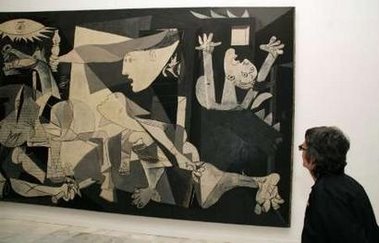 A woman looks at Spanish artist Pablo Picasso's 'Guernica' at the Reina Sofia Museum in Madrid June 2, 2006. A new exhibition opens Tuesday in Madrid, marking 25 years since the masterpiece arrived in Spain, and the 130th anniversary of the painter's birth. Picture taken on June 2, 2006. REUTERS/Marta Jara
 Aimar Olaizola (L) hits a shot during his Basque Handball 'Manomanista' championship final match against Juan Martinez de Irujo in San Sebastian June 4, 2006. REUTERS/Pablo Sanchez
David Herrero, rider of Euskaltel-Euskadi, won the fifth and last stage of the Basque Cycling Contest Euskal Bizikleta 2006. Teams departed from the Basque public TV headquarters in Iurreta, in the province of Bizkaia, to finish in Arrasate, in the province of Gipuzkoa, over 157.5km with seven mountain passes on the way.
Saunier Duval's Koldo Gil, who was first in the two previous stages, was second in the final stage at six seconds, becoming the overall champion in the general classification. Herrero himself and Jesús Del Nero (3 Molinos) won the second and third positions in the podium. Peio Arreitunandia (Barloworld) was two seconds late to get the third position in the general classification.
.... ... .


