Monday, July 31, 2006

New at Buber's

I'm glad to see that Blas Uberuaga added a link to this blog from his well known Buber's Basque Page.

This is what he says:

Basque Blogs: David Cox sent me a couple of blogs dealing with politics in the Basque Country. He notes that, after the seeming closure of Berria's English site, it is hard to get Basque-related news in English (though, EITB24 is one good source). The two blogs are Irish Solidarity Committees with the Basque Country and Euskal Blog : Ingeleraz. Thanks David!


Eskerrik asko to David from me too.

.... ... .

Sunday, July 30, 2006

Basques: Peace and Cuisine

This is quite an unique article by the Los Angeles Times.

The mix just about everything that comes up in a Google search for Basques, for a moment I thought they were going to inclue the sassy lingerie item too.

Here it is:

Basques Try Recipe for Peace

As ETA ends its battle with Spain, hope brews in a land winning fame for a unique cuisine.

By Tracy Wilkinson, Times Staff Writer
July 30, 2006

SAN SEBASTIAN, Spain — Chef Martin Berasategui inhales the aroma from a stewing pot of squab and beef marrow. Around him, his kitchen is in a whir. One assistant dips a ladle into large tubs of creme fraiche. Another uses a tiny ruler to cut pieces of melon just so. Still another is stirring 40 gallons of monkfish.

The telephone is ringing constantly, coffee machines are grinding, steam is rising from a dozen cooktops.

These are promising moments here in the Basque Country, a hot, Michelin-starred epicurean frontier where palates are as adventuresome as politics are contentious. After nearly four decades of armed conflict between Basque separatists and the Spanish government, the region is closer to lasting peace than at any time in its history.

Western Europe's last war is, it seems, over.

And that is good news for Berasategui and others who crave normality, not to mention a renewed influx of intrepid Spanish tourists and foreign visitors to this region of northern Spain, where they might sample the dishes, such as caramelized smoked eel or squid in pepper foam, that make Basque cooking legendary.

The Basque Country was always an incongruous place for revolution. Its gently rolling hills, quaint fishing villages and spectacular sea views belie deep-seated political and ethnic anger. It is one of Spain's most prosperous areas, a place of unique gourmet cuisine, but one where the intelligentsia need bodyguards, where bombs go off at universities, and where outlawed rebel partisans give news conferences in fashionable hotels.

These days, however, people have started giving their bodyguards days off. Checking under the car for explosives is no longer a necessary habit.

Most important, the separatist group ETA has not killed anyone in three years. ETA, whose decades-long campaign of bombings, assassinations and terrorism claimed more than 800 lives, declared a permanent cease-fire nearly six months ago, and the government in Madrid is now willing to talk with it.

Berasategui, a stocky man dressed in chef's whites, yearns for a peace that is not as ephemeral as his red cabbage gelatin with liquefied chard.

"Let's hope there is no turning back," he said at the three-star restaurant that bears his name, tucked into the green hills outside San Sebastian. "This is like a tasting menu, and everyone has to do his share of the cooking."

Berasategui's reservations come from bitter experience. He and three other of the Basque region's world-renowned chefs were dragged through one of the more unsavory chapters of the conflict: the extortion of thousands of local businesspeople, allegedly by ETA members.

Law enforcement authorities contend that long after the killing ceased, demands for and payments of protection money continued. A new criminal inquiry recently led to the arrests of major Basque politicians and entrepreneurs.

Berasategui and the other chefs were questioned in late 2004 by judicial officials in Madrid about whether they had paid ETA to leave their restaurants alone. Spanish authorities maintain that extortion was ETA's most lucrative source of income, along with kidnappings. Up to a billion dollars may have been collected over the years, used to finance attacks, support fugitives and aid prisoners.

Berasategui vehemently denies the charge, saying he never paid protection money, nor did anyone ever demand it of him.

The Madrid authorities "simply went after famous people from the Basque Country," Berasategui said dismissively. "They questioned me because I was born here. It was very unjust." No charges were filed against the chefs, and the whole episode might have been put aside if the new case had not reopened old wounds.

Berasategui says the authorities are making a mistake by dredging up such cases. "We are a land that has suffered a lot," he said. "There were victims on both sides. No one is free of sin."

His unease goes straight to the kinds of questions that vex a postwar society — what should be forgotten, what should be exposed? Where does justice end and revenge begin? What is the best way to ensure peace and promote reconciliation?

Many Basques are far more forgiving than the authorities in Madrid, saying outsiders cannot understand the things people here had to do to survive through the decades of conflict.

Negotiations between ETA and the Socialist government of Prime Minister Jose Luis Rodriguez Zapatero will focus initially on disarming the guerrillas and on the conditions of ETA prisoners in Spanish jails. ETA, which stands for Euskadi Ta Askatasuna in the Basque language, or Basque Homeland and Freedom, has long complained bitterly about the Spanish government's policy of dispersing prisoners to jails around the country, far from their hometowns and families.

Next, the parties will have to decide whether, and how, to dig into a full plate of fundamental issues, any one of which could scupper the entire process. These include determining the political role of ETA sympathizers and overcoming mistrust.

A bigger task will be envisioning the structure of a Basque state. How much self-determination should be granted? How much loyalty to Madrid should be demanded?

There are numerous reasons for ETA's decision to quit armed conflict now. The separatist movement, launched during the harsh years of the Franco dictatorship, when regional and ethnic differences were brutally repressed, now faces a modern, vibrant Spain that is a full member of international organizations such as NATO and the European Union, and allows considerable regional autonomy.

People were exhausted by the warfare, ETA was not making political gains and the new government in Madrid was flexible enough to negotiate. Furthermore, the guerrillas were seriously weakened by police crackdowns under the previous conservative government that had the cooperation of France, a traditional refuge of ETA forces.

And perhaps most important, on March 11, 2004, deadly attacks on Madrid's train system by Islamic militants left 191 people dead, ending much tolerance for armed struggle.

The attacks "put them in front of a mirror and showed them what violence can provoke," said Paul Rios, general coordinator of Lokarri, a civil rights organization active in the Basque region. "It made them open their eyes."

The Basques are considered the oldest community in Europe, a people of somewhat mysterious origin who fiercely guard their traditions, and, among some, a kind of ethnic purity. Verdant hills are dotted with remote stone farmhouses. In the cities, insular neighborhoods fly the red-and-green Basque flag, and the cluckety sound of the unique Basque language, Euskera, drifts from homes and cafes.

But after decades of conflict, the Basque Country is divided, with viewpoints including pro- and anti-nationalism and total pacifism. Some of its 2.5 million residents identify themselves as Basque first, Spanish second — or vice versa. Or one wholly and not the other.

Increasingly, however, a hard-edged pragmatism is taking hold. Basques enjoy a good amount of autonomy; they have their own police force, teach Euskera in schools and are allowed to levy taxes.

"We identify ourselves as Basques," said Txema Montero, a nationalist attorney in Bilbao who once served as an advisor to ETA but broke with the group over its insistence on violence. "But we also want to be part of Europe."


On the March afternoon that ETA declared its truce, Ignacio Latierro, a writer and book dealer, asked the authorities whether he could finally shed his bodyguards. "They told me, not yet — just in case," he recalled.

A veteran activist, Latierro runs the popular Lagun Bookstore here in San Sebastian and has long fought what he describes as the tyrannies of the Franco dictatorship and ETA terrorism. The former landed him in prison in the 1960s and 70s. And he blames the latter for repeated vandalism of his bookstore, an attack on his business partner's husband and the slaying of a longtime associate, Jose Luis Lopez de Lacalle, an outspoken newspaper columnist.

And that's why two armed men accompany Latierro on his way to and from work and as he makes his rounds in this city on the Bay of Biscay. For all the trouble, however, Latierro, 63, with wavy silver hair, is hopeful that the war may finally be over.

"Objectively speaking, we are living in a different season," he said at his bookstore, under the shadow of San Sebastian's Good Shepherd Cathedral. "But I still do not dare to be categorical. Even among those most convinced that we are at a historic moment, there is a reservoir of bitterness."

And among youths who grew up on revolution and on the dream of achieving an independent homeland through armed struggle, integration into a peaceful society will be especially problematic. Older generations of fighters underwent political and military training, but younger ones have learned only how to use guns and bombs, accentuating their potential to become even more radical, analysts say.

"It is one thing to paralyze the violence and another thing to change the mentality and the culture," said Jose Manuel Mata, dean of social sciences at the University of the Basque Country near Bilbao, a school that has lost a dozen or so professors fleeing violence in recent years. Near Mata's office is an elevator where a bomb failed to detonate a few years ago, one of a number of incidents that led to police protection for the dean.

Pro-ETA youths "are used to acting as though pressure on the street counts above all institutions," Mata said. "This is a serious problem of socialization that cannot change overnight."

Few Basques are holding out much hope for reconciliation among opponents, the differences too great and the proximity too intimate. In this relatively small corner of the world, people know one another, and they remember the slights and injustices. They remember who was killed where and when.

That intimacy served as a kind of social control and helped prevent all-out civil war, Montero, the Bilbao attorney, said. But deep memories also impede reconciliation.

Still, changes are brewing.

The tough bars in San Sebastian's Old Quarter, where money is being openly raised for ETA, still display pictures of prisoners. But they are friendlier places, on a recent evening full of families and crowds who shared drinks and watched a World Cup soccer semifinals match.

At his restaurant, Berasategui and his staff are preparing for a bumper year. Authorities say tourism is up substantially since the truce was announced, and there are plans to expand San Sebastian's tiny airport.

Berasategui is placing a couple of new items on his menu: a grilled foie gras and a dessert of coffee ice cream with whiskey ice.

"In the Basque Country, before we learn to walk, we learn to cook," he said, with a rare smile.

"We are a country with spark, living historic moments. If all sides would just leave us alone."

*

(INFOBOX BELOW)

A long war

After a nearly 40-year battle with the Spanish government that took the lives of more than 800 people, the Basque separatist group ETA has declared a permanent cease-fire.

Who are the Basques?

* Basques are an ancient ethnic group in Spain and France.

* The majority, about 2.5 million, live in Spain.

* Most are Roman Catholic.

* Basques were traditionally fishermen, farmers and shepherds, but industrialization has altered their way of life.

* A referendum in 1979 established the Basque autonomous region, with its own police force and education and healthcare systems.


--

Sources: Encyclopedia Britannica, BBC, CBC


.... ... .

About the Tree Carvings

This is an article about recent information regarding the tree carvings by Basque sheepherders.

It was published by The New York Times, here it is:

Published: July 30, 2006

FEATHERVILLE, Idaho, July 29 (AP) — For decades, anthropologists have combed the red rock landscape of the Southwest for petroglyphs, the prehistoric scrawlings of American Indians. Now researchers in the Northwest are beginning to discover a trove of arborglyphs: 19th- and 20th-century tree carvings tattooed on the bark of aspens and cedars by Basque sheepherders.

Some are rousing political slogans from the Basque homeland, and others depict sexual exploits. Like modern graffiti, a great many carvings note for posterity that Joe, Jose or, most likely, Joxe “was here.”

Scholars say the drawings provide a blueprint for Basque immigration patterns across the Western United States and give a look into the psyche of the solitary sheepherder.

“These give us insight into a group that largely did not leave behind a written word,” said John Bieter, the executive director of the Cenarrusa Center for Basque Studies at Boise State University.

Basques hail from a semiautonomous region joining the Pyrenees of northern Spain and a slice of coastal territory in southern France. Their culture and language are of mysterious origins, but Basques are believed to be some of the oldest inhabitants of Europe.

After the California Gold Rush in the 1850’s, Basques who had already emigrated to South America followed the ore’s elusive path across the West in what historians call a “secondary migration.”

Basques quickly branched out to sheepherding. Tree etchings soon began appearing in the alpine hollows of California, then Nevada, Idaho, Wyoming and other Western states.

For more than a century, the nomadic routine of corralling sheep in the sagebrush lowlands of the Great Basin in winter and trekking the animals through the mountains by summer was a Basque rite of passage.

Throughout the forest, the legacies of men like Julio Ramon are etched into bark. In an undated inscription from the Crosscut Trail aspen grove in the Boise National Forest, Ramon trumpets a patriotic cheer into the empty wilderness: “Gora ETA.”

Roughly “Long Live ETA,” it was the rallying cry of the armed Basque separatist group. It is most common in engravings from a second wave of sheepherders who probably lived in Spain under the Nationalist dictator Francisco Franco, Dr. Bieter said.

“He could carve it into a tree in Idaho,” Dr. Bieter said, “but if he said it in Spain, he’d be imprisoned.”

Susie Osgood, a Forest Service archaeologist, said the aspen’s 80-year lifespan made it an ideal canvas for preserving the early Basque legacy. Ms. Osgood said she had identified about 300 with Basque carvings.

“It’s a realistic window into what you think and do out here when you’re all alone,” she said of the carvings. “Now, the herders have headsets and things, but in the 19th century you were your own entertainment.”

Basque sheepherders livened the hours by drawing, and many tree carvings are crude sketches. But often dotting the scribblings are finer artistic expressions.

Joxe Mallea-Olaetxe, the author of “Speaking Through the Aspens: Basque Tree Carvings in California and Nevada,” has documented portraits of churches and battleships, as well as the lonely bachelor’s doodling mainstay: naked women.

Some carvings reveal the dormant angst harbored by many Basques against the herder’s lowly social standing. A few poetic verses on an Idaho aspen declare, in a loose translation: “Together, but not neighbors. Brothers, but not family. In Spain, they consider us great men, but here we are nothing.”

Today, the Basque herder has largely been replaced by Peruvian or Chilean immigrants. Later generations of Basques — like Dr. Bieter’s brother, David H. Bieter, the mayor of Boise — have planted roots in cities across the West.

But Kurt Caswell, who has written several magazine articles on modern sheepherders near McCall, Idaho, said the practice of inscribing trees continued.

“One of the things that fascinates me is how little has changed,” Mr. Caswell said. “What it brings home to me is a universal story of immigration, that early generations really occupy a very lonely existence.”

.... ... .

Saturday, July 29, 2006

Bring Them Home

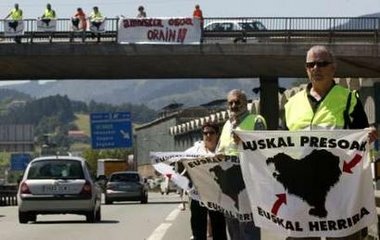
Family members of ETA prisoners hold a protest along the N-1 highway demanding the transfer of their relatives to jails closer to the Basque Country, near Beasain, northern Spain, July 29, 2006. Spain's government announced last week that some benefits to around 500 ETA prisoners will be applied as a conciliatory gesture in response to a ceasefire called by the armed group last March, El Mundo newspaper said. Banners read in Basque 'Bring the Basque prisoners home' and 'Total amnesty now' (top). REUTERS/Pablo Sanchez

.... ... .

The Basques from La Puente

Here you have an article about a piece of Americana with a splash of Basque.

It was published by Whittier Daily News:

Basque-ing in a Little Bit of La Puente History

By Christina L. Esparza Staff Writer

LA PUENTE - A tableful of men inside Le Chalet Basque nosh by candlelight on carrots and celery, drink wine and sprinkle their conversation with Basque - a language unrelated to any other.

They are members of the Southern California Basque Club, and on a hot, sticky Thursday afternoon, they discussed upcoming plans to attend the 60th anniversary celebration of the club's creation.

"You're going to have a great time," one man bellowed with a hard, rolling 'r' to a pair of ladies sitting at a table in the back of the restaurant.

The club's roots, like those of so many Basque Americans, are in the city of La Puente.

The Basque country of the western Pyrenees - Euskal Herria in Basque - is seven provinces straddling Spain and France.

And at its founding in 1885, La Puente and its sheep- friendly pastureland was the perfect home for the Basque. They, like so many European immigrants, made their way to the United States with a vast agriculture knowledge, according to "French and Spanish Basque in the La Puente Area," a book researched and written by students at La Puente High School in 1983.

The city's rolling green hills and sweeping open spaces made it possible for the Basque herders to move their sheep without impediment, according to the book.

"They came here, initially, as sheep herders, farmers, among other things," said Patricia McIntosh, president of the La Puente Historical Society. "This was definitely a good pasture."

Cecilia Wictor, a member of the Historical Society and great-great-granddaughter of John Rowland, one of the city's founders, said she remembers as a child watching flocks of sheep clip-clopping up and down Hill and Main streets. She recalls going with a neighbor to take lunch to a Basque shepherd in the hills.

"It was such a thrill," Wictor said.

News of the city's pastures and the need for farmhands spread through Basque country, and more families descended on the Land of Opportunity.

"In those days, there used to be a lot of dairies," said Laurent Arretche, president of the Southern California Basque Club.

Soon, the Basque became a fixture in the city.

"They acclimated very well, so their success brought other people," McIntosh said.

In 1929, a handball court was built near where Le Chalet Basque at 119 Second St. stands to accommodate the growing immigrant population.

Handball - "pelota" in Basque - is the country's national sport, according to the book.

"This place here, you had a place where everybody finds somewhere to play handball, socialize, and that stayed 'til today," said Louis Fernane, vice president of the club.

The Basque community in La Puente, however, is not as large as it once was, said Danielle Arretche, owner of Le Chalet Basque.

"The City of Industry used to be more agricultural and everybody had to move out of here," she said. "They keep moving. ... Agriculture is the main activity of the Basque people."

But, McIntosh and Wictor said their legacy still lives in the city, with the handball club, the restaurant and a history of hard-working people that helped build it.

"Their work ethic was enormous," Wictor said.

christina.esparza@sgvn.com

(626) 962-8811, Ext. 2472

.... ... .

Friday, July 28, 2006

Lokarri's Report

EITb published a note about a report created by Lokarri.

Here it is:

The citizen network for agreement and consultation Lokarri, an organization working for a solution of the Basque conflict, sent Friday to some of the most important organizations and governments in the world a report on the Basque conflict.

Titled "Key to understanding the ETA's permanent ceasefire", the document goes over the situation in the Basque Country after the announcement of a permanent cease-fire by the armed Basque group ETA and seeks the involvement of some governments and associations worldwide in the solution to the Basque conflict.

The document concludes that social movements in the Basque Country have voiced the deep needs of the Basque people for peace and have proven a catalyst for the transformation of the conflict—from a position of intransigence on the part of the Spanish government and the ETA to a strong will for resolution of the conflict on all sides.


This is the link to their website:


.... ... .

Wednesday, July 26, 2006

Basque Science

Is not all about politics.

Check this out:

Scientists at the University of the Basque Country succeed in cooling solid material with laser

Contact: Garazi Andonegi
garazi@elhuyar.com
34-94-336-3040
Elhuyar Fundazioa

A team of researchers at the University of the Basque Country (UPV/EHU) have experimentally demonstrated something that other scientists have been trying to achieve for decades: the cooling of erbium-doped materials with laser light. Joaquín Fernández, Chair at the Department of Applied Physics at the Bilbao School of Engineering, is leading the team consisting of Professor Rolindes Balda and the Ramón y Cajal researcher, Ángel García Adeva. The findings have been published in Physical Review Letters, the most important magazine in its speciality. Atomic, Molecular, and Optical Physics can be viewed at in digital edition and the printed edition (volume 97, 3rd part) will be published next Friday, 21 July.

Optical cooling is a phenomenon that has sparked great interest over the last couple of decades, particularly in the field of the optical cooling of atomic gases (Bose-Einstein condensed (1)). Cooling solids using laser radiation is much more difficult and, in fact, a very small number of doped materials have been cooled, i.e. materials to which a tiny amount of ions of another element have been added. What has never been achieved to date is the cooling of materials doped with erbium.

Erbium is a metal element belonging to the Rare Earth group (2). Its ions have the property whereby when light of a certain wavelength falls on them, they are capable of amplifying them. This effect is used, for example, to construct light amplifiers in the field of optical telecommunications. To this end, in order to compensate for the weakening of the light signal as it journeys down an optic fibre, the fibre is doped with erbium ions.

In the case of the research undertaken by the UPV/EHU team, the luminous emission of erbium has been used to achieve the cooling of material in which these ions are housed by exciting these ions with laser light. This discovery is not only important for the technical difficulties involved, but also because the optical refrigeration of devices doped with erbium occur at wavelengths and potentials similar to those with which conventional diode lasers operate, thus making these materials ideal candidates for possible applications, unlike other doped materials that have previously been cooled. Amongst these applications are high-power optical fibre lasers, medical diagnostic techniques using laser (optical tomography) and phototherapy. These devices would function by means of dual laser pumping in which the light wavelengths would be used for the laser pumping and the other wavelength (close to the previous one) to produce optical cooling that would counteract the heating produced by the laser action. This heating causes a number of adverse effects. It can alter the properties and even burn the material being worked with.

The main reasons why this team of researchers have managed to obtain a net optical cooling of these erbium-doped materials are the extraordinary optical quality of the materials employed and the fact that the losses due to thermal vibrations in these are very small.

.... ... .

Sunday, July 23, 2006

Sea Turtles and Their Basque Friend

Time to time is good to post here a note or an article about a Basque person who makes a difference.

This time the accolades go to José Echeverría.

This is what the South Florida Sun-Sentinel published about him:

Highland Beach honors sea turtle nest monitor for his volunteer work

By Rhonda J. Miller
South Florida Sun-Sentinel
Posted July 23 2006
Highland Beach · The footprints of Jose Echeverria are ingrained in the sand along this town's three-mile coastline.

His fingerprints are invisibly etched on the wooden stakes that mark the nests of hundreds of sea turtles that have crawled ashore in the darkness.

The Town Commission recently recognized Echeverria for establishing and nurturing a volunteer sea turtle program for more than 20 years.

Echeverria is moved by the town's appreciation for his "dedicated and steadfast efforts to protect God's creatures -- loggerheads, greenies and leatherbacks -- from harm's way," as it says on the plaque presented by Mayor Harold Hagelmann at a commission meeting on June 6.

But mostly, Echeverria is moved by the mystery of the 300-pound creatures that return to the same shore year after year, to nest and lay 100 eggs at a time.

Echeverria, 86, is a native of Bilbao in the Basque region of Spain. He and his wife, D.J., their son, Dale, and daughter, Suzanne Trombino, became fascinated with sea turtles on the Pacific coast of Nicaragua in the early 1960s, where Echeverria was working as a general manager for Chevron Oil Co.

They bought their Highland Beach home in 1976 and became acquainted with the town's sea turtles during vacations. They became full-time residents in 1984.

Echeverria has held the town's state permit for sea turtle monitoring since 1985, which requires him to collect data for the Fish and Wildlife Conservation Commission.

"It's amazing what nature has given us. The turtle clan is great," Echeverria said, stopping by the front desk at Town Hall to pick up maps he designed for his crew of 30 turtle volunteers.

He divides the coastline into five zones, noting condo names and house addresses. Sunrise monitors mark each place on the beach and the map where turtle tracks are seen. That way, if there's a storm, or if someone unknowingly picks up a wooden stake, monitors can find the nest.

His volunteer work goes beyond town and state borders.

Boca Raton marine conservationist Kirt Rusenko worked with Echeverria to prepare for an international sea turtle symposium in 1998, and their paths sometimes merge in their common mission.

"I have a lot of respect for Jose. His program is one of the more organized that I've seen," Rusenko said. "He delegates the responsibility to people in different zones. In a volunteer organization, it's pretty remarkable to get all those people and to make sure it all gets done. He's put a lot of sweat and effort into it."

Most municipalities in south Palm Beach County have permit holders who are paid contractors, said Megan Conti, environmental specialist for the Florida Fish and Wildlife Conservation Commission. Towns that have beach nourishment projects or beach cleaning must have someone contracted to monitor turtle nests, Conti said.

Highland Beach is not likely to have a beach nourishment project, because it doesn't have a public beach. In the northern part of the county, such as on Singer Island, some areas are monitored by volunteer crews, Conti said.

It isn't easy building a consistent and enthusiastic volunteer corps, even though awe-inspiring adult turtles and adorable baby ones might make it appear that way.

"People want to volunteer, so we tell them to meet us on the beach at 6 a.m.," said Jose's son, Dale Echeverria, 58, a volunteer for 12 years, who coordinates zone one. "They show up with their doughnuts and coffee. They think it's going to be a party.

"Then they're down on their hands and knees," Dale Echeverria said. "Next thing you know, they're a no-show."

Marking nests and digging to help baby turtles get out can take one to three hours. It's seven days a week during turtle season, from March to October.

"After a year, they prove themselves if they've come out every morning at 6 a.m.," he said.

Patti Hansen has come out almost every morning of turtle season that her job as a flight attendant didn't take her out of town.

"I don't go away for vacations in the summer. I have my turtles in the summer," said Hansen, 50, who started as a monitor in 1991 while she lived in Highland Beach.

Even though she moved to Delray Beach 13 years ago, she stayed on as a monitor in Highland Beach and is a zone leader. She has been a volunteer since she heard Echeverria talk about turtles at Gumbo Limbo Nature Center in Boca Raton.

"Jose's enthusiasm was contagious. He was very welcoming to me, even though I knew nothing about marine turtles," Hansen said. "He's very humble, and I've never heard him say a bad word about anyone. Jose values every volunteer."

Jose, D.J. and Dale Echeverria trace their interest back to Nicaragua, when poachers gathered turtle eggs and sold them in the market.

The family watched Jose and his friend carry a 300- to 400-pound turtle back into the ocean to keep poachers from finding the nest.

"That way, no one would see the tracks," D.J. Echeverria said. "Even back then, we were saving baby turtles."

Rhonda J. Miller can be reached at rjmiller@sun-sentinel.com or 561-243-6605.


.... ... .

Manu Chao

A couple of years ago I published a lot of information about the censorship suffered by Manu Chao during his tour in Spain due to the fact that he was featuring fellow Basque artist Fermin Muguruza.

Well, back then I was not paying a lot of attention to the fact that I never told my readers who Manu Chao was. Well, as it happens, The San Francisco Chronicle published a pretty cool article about how a guy who moved to Lima in Peru got to learn about Manu.

Here you have it:

Addicted to Manu

Delfin Vigil

Sunday, July 23, 2006

Manu Chao saved my life.

The story begins in early 1999 in Peru, when I moved there to go to school and be near my family. Life in Lima was easy to adjust to. I had been there before, knew the city, loved the food and spoke the language. But there was one thing I couldn't quite understand: the music.

When my father emigrated from South America to San Francisco in 1962, he brought with him lots of music. By the time I was born, our living room was filled with stacks and stacks of scratched 45s and LPs bent at the edges because they had been smuggled in the corners of fake leather luggage. Thanks to my father, the soulful voices of Jesus Vasquez, Lucha Reyes and the gut-wrenchingly beautiful guitar work of Los Embajadores Criollos made their way through customs and into my heart. These people weren't just musicians; they were teachers. They taught me poetry, Spanish and all about a land that, at that point, I had felt little connection with.

While packing for my move to Peru, I purposely avoided bringing a single CD of my own and instead left lots of room to bring back modern versions of what my father had found.

But by the end of the first week I nearly went crazy.

I had spread the word to my cousins and friends that I was looking for the best new Peruvian music. Invariably, they'd play back songs sung in English. Much of it was from the '80s -- Simple Minds, the Cure, Duran Duran. None of it was Peruvian.

After I insisted that I wanted something in Spanish, they finally delivered a stack of CDs and tapes of "rock en Español." It was good stuff -- Los Fabulosos Cadillacs, Babasonicos and Andres Calamaro. But it was all music I already knew. And it was all from Argentina.

I tried the live route, but Lima is a city that lives and dies in the dance clubs. What little live music I found usually featured bands covering songs by ... Simple Minds, the Cure or Duran Duran.

Seeing that I was clearly suffering from serious music withdrawal, a friend at my school knew I needed help -- fast.

"I know a guy," my friend said, using words that even in Spanish usually lead to a dark alley. "He's got what you're looking for."

Two hours later, after school, I met this friend at our city bus stop. It wasn't dark and it wasn't in an alley. It was hot as hell, and we were at the front entrance of the university.

"This is your man," he said, handing over a bootlegged 60-minute cassette with one side labeled "Manu Chao," the other "Clandestino."

I took the tape, thanked my friend and hopped on the bus. Popping the cassette into my Walkman, I expected to hear either a sappy love song or maybe a salsa version of "Girls on Film." But within the first few seconds of Chao's choppy acoustic guitar and poetic lyrics about an immigrant suffering from shame, condemnation and shouting "Peruano!" and "Clandestino!" I knew I had found what I was looking for.

For the rest of that year I lived in Peru, Chao's "Clandestino" was all I listened to because it was all I needed. Not having any artwork or pictures on the tape to know for sure, I pictured Chao as a combination of all my heroes -- Che Guevara, John Lennon, Frank Zappa, Emiliano Zapata and my father. His songs, sung in Spanish, English, French and Portuguese, were the perfect soundtrack for what I was seeing and feeling on that bus ride from school -- from the hot Latin American sun burning the vinyl seats, to the guy next to me smelling of tequila and seafood. Chao sang about my frustrated friends who had no idea if they could ever find a good job but knew how to forget about it at night and have a good time anyway. He perfectly described the lady from the Andes who lived her life on the floor of my bus stop. And Chao sang about all of this within two or three songs.

Because the first song on "Clandestino" has Chao shouting something about Peru and perfectly describing the country I was living in, I assumed he was from South America. But after checking the Internet, I found out he had been born in Paris, where he was raised by a Basque mother and a Spanish father, both of whom had fled Franco's dictatorship.

Chao spent much of his youth hanging around the subways of Paris, where he met other musicians and formed bands influenced by punk rock, North African music and Bob Marley. They started a band in the '80s called Mano Negra, which had some success in Europe and Latin America. I checked out some of the music, and it was cool -- but it didn't speak to me the way "Clandestino" did.

What made "Clandestino" so special was the way Chao recorded it. After Mano Negra split up, Chao meandered around the world for about eight years carrying just a small four-track recording machine and acoustic guitar with him. He spent much of the time in Latin America and recorded sound effects such as city buses and conversations in the street and sampled them into his solo songs, making it sound as if the song were being sung from the back of a bus in Latin American traffic.

"Traveling is my school of life," he said in the only interview I've ever seen of him. "And that was the best school you can have."

After recording "Clandestino," he released the solo album in 1998 and said he expected "only his Mommy" would buy it. By the end of 1999, more than 4 million copies had been sold, and Chao was getting ready to play concerts to more than 150,000 people in Mexico City.

But in early 1999, when I was first becoming addicted to his music, it felt as if only a few people cared as much as I did. Convinced that Chao would be embraced by my Peruvian friends as their Bob Dylan, I always played "Clandestino" at our weekend parties. But instead of looks of approval, I'd usually get frowns from my friends, who would insist I put Metallica back on, or at least some salsa.

Outside my small circle of friends, the people I could tell did dig Chao were taxi drivers. Living in Lima means living in a taxi much of the time. Because of my addiction to "Clandestino," I would only board taxis (usually old Volkswagen Beetles) that had cassette players. My drivers would usually be irritated that I insisted on playing my music, but if I offered a little extra cash, they'd deal with it. Within 30 seconds of Chao shouting "Peruano!" and "Clandestino!" each new taxi driver would suddenly get a rush of adrenaline and start driving faster. Sometimes they'd pretend they knew the song, even when I could tell that they were hearing it for the first time. That's what good music is supposed to do to people.

Invariably, the taxi driver and I would be so engulfed in Chao's music we'd forget where we were going. On one occasion, we missed the turn to my home and ended up lost in a very sketchy barrio. As the driver attempted to make a U-turn around a dead end, three thuggish dudes holding sticks and rocks in their hands approached the car and forced us to stop. The windows were down, and Chao's music blared out, describing the dirt roads, poverty and frustration that was staring us in the face.

With a rock still in his hand, the leader of the pack approached the passenger side of the car where I was sitting and said in Spanish, "Hey, isn't this a Manu Chao song?"

I nervously nodded my head.

"I love this song," he said, smiling and singing along. Then he let us go.

Chao, who lives mostly in Spain these days, has since recorded two other full-length CDs and one live album, each critically acclaimed by my soul. Last year, in his spare time, he helped produce and record an album for the blind couple from Mali known as Amadou and Mariam. The album, "Diamanche a Bamako," is another lifesaver.


.... ... .

Friday, July 21, 2006

EITb: Basque Gastronomy

EITb published an article on Basque gastronomy, here it is:

Basque Gastronomy: a way to understand Basque people

A must for visitors

07/20/2006

The gastronomic habits of a people are, as are so many other customs, a good clue in order to approach its culture, and any understanding of the history and the daily life of Euskadi must necessarily filter through the gastronomy of Euskadi.

It is vital to acknowledge that the traditional and popular diet of the Basques has been a sparing and frugal one. However, Basque people have learned how to convert the simple harvest that is extracted so laboriously from the sea and the earth into works of culinary art, respecting the character of some choice materials that rarely endure complicated preparations, and prudently assimilating external influences upon our cuisine.

What is understood as traditional Basque cuisine has remained practically unaltered through time, its secrets passed along in the domestic hearth by the women, and in gastronomic societies by the men.

In the mid-seventies, aware of the risk of this tradition becoming decrepit and abandoned, the generation of young chefs undertook the renovation of the Basque cuisine, combining its traditional values with the more universal culinary and dietary trends. Today, the traditional cuisine and the restored Basque cuisine coexist in harmony, and they share the purpose that gastronomy in Euskadi has always held, that of becoming a pleasure that the Basque people offer to all our visitors.

However, we cannot describe traditional Basque gastronomy without mentioning a unique phenomenon, the gastronomic societies, which can be found throughout the entire country and which keep alive the Basque culinary orthodoxy and without which it would be difficult to understand the widespread social embracement of the present-day Basque cooking. By tradition exclusively male, in these masculine clubs men who at home would never come near the cooking hearth come together to cook for friends and for each other, making gastronomy the foundation for their relationships while they keep alive the most traditional recipes.


.... ... .