Wednesday, October 08, 2008


Saturday, October 07, 2006
Supporting the Basque Political Prisoners
Today, thousands marched to show their support towards the collective of Basque political prisoners in a demonstration called by the Ibaeta Forum, here is the note according to EITb:
Thousands of people have demonstrated in Donostia-San Sebastian in favour of Basque prisoners. Many leaders of banned Batasuna, leftist Aralar and Basque trade unions LAB and ELA have attended the rally summoned by the Ibaeta Forum.
The demonstration has begun at 05:00 pm at the tunnel of the Antiguo neighbourhood. The protest was opened by a banner demanding "Euskal presoak Euskal Herrira. Dagokien eskubide guztiek jabe" (Basque Prisoners to the Basque Country. In Control of all Their Rights), which was carried among others by secretary general of Basque trade union ELA Jose Elorrieta; Batasuna leaders Joseba Permach, Pernando Barrena and Joseba Alvarez; secretary general of Basque trade union LAB Rafa Diez; and leader of leftist Aralar Mikel Basabe. Juan Mari Olano, spokesman of political prisoner and exile support organisation Askatasuna; and lawyer Iñigo Iruin have also taken part at the event.
Relatives of Basque prisoners were at the head of the rally carrying photos of the inmates while the banner followed them. The attendants have chanted several slogans, such as "De Juana askatu" (Release De Juana), "Presoak Etxera" (Bring Prisoners Home), "Pakerik ez amnistiarik gabe" (No Peace without Amnesty) and "Independentzia" (Independence). A photo of Basque prisoner De Juana Chaos recalled his 62 days on hunger strike. Signatures to request his release have been collected at the event.
At the end of the rally, the spokesman of the Basque prisoners’ platform Ibaeta Forum has read a communiqué in Boulevard Street, demanding Spanish and French governments to move Basque prisoners to Basque country jails and to release “six ill prisoners and other 126 that have already served sentence”.
Batasuna
Leader of Batasuna Jone Goirizelaia has requested Spain’s government to end with its policy regarding ETA prisoners, because it is “unacceptable, even more when we are dealing with a peace process”.
Tuesday, April 04, 2006
Too Late Patxi
Here you have it as EITb published it:
Bringing inmate to Basque jails may help process - socialist leader
The secretary general of socialist PSE-EE, Patxi López, has affirmed that when the absence of violence is verified, "there could be measures that favour dumping arms" by ETA. Likewise, he thinks that bringing Basque prisoners to Basque jails "could be one of them." He has affirmed that claiming "remembrance, dignity and justice" for terrorism victims "is not incompatible" with "a dialogue with the terrorist band to reach a peace scenario."
In an interview for ETB, López has said that transferring Basque prisoners to Basque jails is not a "political price" the Government pays for peace.
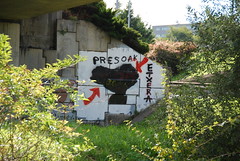
Now Patxi, you can start by demanding that Madrid stops considering groups like Presoak, Gurasoak and Etxerat as part of ETA's entorno.
.... ... .
Saturday, March 25, 2006
Ikurriña and Presoak
 A man walks by a mural of the Basque flag, left, and a pro-ETA mural reading 'Basque prisoners back home', in Alsasua, Spain, Saturday, March 25, 2006. ETA, blamed for more than 800 killings since launching a campaign for Basque independence in 1968, on Wednesday announced a permanent cease-fire that took effect midnight Thursday. (AP Photo/Daniel Ochoa de Olza)
Sunday, February 26, 2006
Presoak Is Not ETA
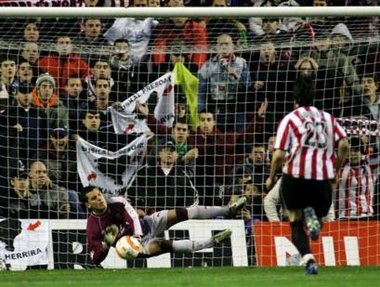
Villarreal's goalkeeper Javier Lopez Vallejo saves a penalty during a Spanish league soccer match against Athletic Bilbao at the San Mames stadium in Bilbao, Spain, Sunday Feb. 26, 2006. The game ended 1-1. Athletic Bilbao fans in background can be seen with banners supporting the Basque separatist group ETA, urging the return of all ETA prisoners to the Basque country. (AP Photo/Juan Manuel Serrano)
Wednesday, December 28, 2005
Not Just a Game
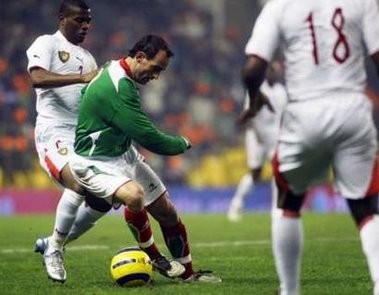

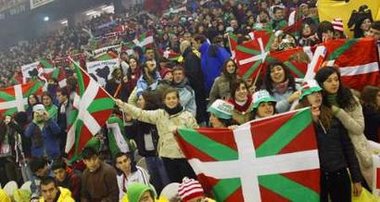

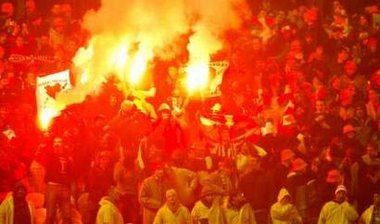

Fans wave flags and banners, demanding the re-grouping of Basque prisoners to jails in the region, before a friendly soccer match between Euskadi and Cameroon, at the San Mames stadium in Bilbao, northern Spain, December 28, 2005. Cameroon won 1-0. REUTERS/Vincent West

Monday, January 03, 2005
The Hidden Violence
Usually the victims of domestic violence keep quiet, and unless one of them ends up killed, what happens to them usually goes unnoticed.
Same with the grinding violence against the Basques in Spain (and to certain degree in France).
That is the violence that no one talks about, gallons of ink are spilled by people that claims that "they refuse to ackowledge the right of the Basques to their self determination as long as they allow ETA to conduct attacks".
As if ETA would go from home to home in the Basque Country to ask for permition to plant a bomb or kill someone.
I said it before, ETA is on the run, and that includes being on the run in the Basque Country because its been a long time since the majority of Basques have turn their backs on them, condemning their violent ways.
But do you ever see all those rivers of ink being spilled over issues like the torture against Basque prisoners held under incommunicado detention?
Do you ever read about the policy of dispersion that has killed and wounded hundreds of Basques, draining their economic resources on top of it?
Do you ever read something about the preventive prison terms where Basques have gone up to 5 years without going to trial just to walk free after paying a bail just to have the charges dropped?
Do you ever read anything about the paramilitary groups operating in the Basque Country, harassing, kidnapping and killing Basques that dare to say that they love their fatherland?
No, you don't, that would require serious journalist work, and now a days to be a journalist or a reporter doesn't require much, just ask Jayson Blair.
That hidden brand of violence is the one the Basques have endured since 1936, but no one talks about it. On top, today, they have to endure the violence of ETA, the terrorist organization that allegedly wants their independence but that in reality, is a self serving group that lost all contact with the will of the Basque people a long time ago.
Here is a note that appeared today at Berria regarding the efforts to end that murderous practice called "the dispersion":
8,000 people remember prisoners at the end of the year
Rallies were held in about 60 towns throughout the Basque Country; a demo is planned for January 8 in Bilbo
Editorial Staff – BAIONA (Bayonne)
Rallies took place in support of Basque prisoners the day before yesterday in the afternoon in response to a call made by Etxerat. They coincided with the last Friday of the month, which was New Year’s Eve, so that the prisoners would be remembered at the end of the year, too. 8,000 people gathered in about 60 towns in Gipuzkoa, Bizkaia, Navarre, Araba and Lapurdi. About 50 people gathered outside the prison of Soto del Real (Madrid). The biggest rallies took place in Bilbo and Azkoitia, with the attendance of 700 and 500 people, respectively.
A demonstration is scheduled for this coming Saturday in Bilbao. The slogan will be: Euskal Presoak Euskal Herrira orain (Bring the Basque prisoners to the Basque Country now!). During the rallies the day before yesterday Etxerat appealed to people to take part in the march scheduled to set out from La Casilla in Bilbo at 17.00 hours.
Etxerat believes 2004 has been the year which has seen a worsening in the situation of the prisoners. “There are more Basque prisoners than ever, 716 family members and friends are more dispersed than ever in 88 prisons in 6 countries,” Etxerat pointed out. The association went on to declare that “both the French and Spanish States have announced that they will be maintaining these cruel measures” to send the prisoners further away from the Basque Country than ever, and to “isolate and leave them without any protection”.
Criticism was also directed at the Basque Country’s political parties. “They have had neither the courage nor the will to put an end to all this suffering”. The parties were accused of regarding the prisoners and their relatives as “second class citizens”. “As far as those who call themselves democratic are concerned, our lives are worth less than automatic cash dispensers”.
.... ... .
Tuesday, December 07, 2004
Victims of the Dispersion
Mother of Basque prisoner Ekain Gerra dies in road accident on route to prison visit
Editorial Staff – IRUÑEA (Pamplona)The parents of Ekain Gerra of Barañain (close to Iruñea-Pamplona) were involved in a road accident yesterday while on their way to visit their son. The prisoner’s 57-year-old mother, Karmele Solaguren, died in the accident that took place in the morning in the town of Noviercas in Soria (Spain). His father, Jose Luis Gerra, is in a very serious condition at the Intensive Care Unit of the Santa Barbara Hospital in Soria. The prisoners’ relatives support group Etxerat blamed the death on the policy of dispersion [of Basque prisoners].According to the information provided by the Spanish Civil Guard headquarters in Soria, the accident happened at about 08.15 hours. The car in which Ekain Gerra’s parents, Karmele Solaguren and Jose Luis Gerra, were travelling stopped on the road. Karmele Solaguren got out of the car and was run over by a vehicle travelling in the same direction while she was speaking on her mobile phone. The woman died instantly. The vehicle crashed into the stationary car belonging to Ekain Gerra’s parents, seriously injuring his father. Jose Luis Gerra was taken to the Santa Barbara Hospital in Soria and is in the Intensive Care Unit “in a very serious condition”.
Monday, January 05, 2004
Basque Prisoners to Euskal Herria!
Thousands in Bilbo call for transfer of prisoners to Basque Country
In the rain they proclaimed the right of the Basque prisoners to participate in the political process
Aitziber Laskibar – BILBO
In Bilbao yesterday thousands of people demanded the transfer of Basque political prisoners to the Basque Country in response to the demonstration called by the “Amnistiaren Aldeko Mugimendua” (Pro-Amnesty Movement). Numerous people put up with the rain and appeared on the streets of Bilbo in support of the slogan: “Euskal Herriaren alde eraginez euskal presoak Euskal Herrira” (Basque prisoners to the Basque Country in favour of the Basque Country).
Carrying a huge version of the symbol demanding the transfer of Basque prisoners to the Basque Country (*) dancers opened the way for the marchers just after five in the afternoon from the Aita Donostia square. Behind the symbol came the logo of the “Euskal Preso Politikoen Kolektiboa” (Basque Political Prisoners’ Group) followed by photos of 700 political prisoners held by as many prisoners’ relatives. Then came the banner with the slogan of the demonstration. This was carried by members of the Pro-Amnesty Movement, relatives of Basque political prisoners, lawyers and former prisoners. Behind came thousands of people in the rain taking refuge under umbrellas and repeating the demands being given out over the public address system. Shouts mainly in favour of amnesty could be heard, there were also some in favour of the return of Basque political refugees and against the dispersion of prisoners. There were also shouts in memory of Sara Fernandez, who was killed in a car accident last November while on her way to visit the Irunea (Pamplona)-born prisoner Inaki Etxeberria. As is customary, the photographers took most of the photos in the Zabalburu square, where the big rallies held in Bilbo tend to be measured; in the photo of this protest it was not possible to make out the back of the demonstration. The organisers were therefore happy with the number of people who had turned out.
(*) The symbol consists of a number of red arrows converging on a map of the Basque Country.

Wednesday, August 27, 2003
June Thomas : Basqueland II
Adventures in Basqueland
from: June Thomas
Basque Battle Raps and Stealth Sloganeering
Posted Tuesday, Aug. 26, 2003
The Basque Country is a land of Navajo code-talkers. Unlike Spain's other minority languages, Catalan and Gallego, a knowledge of other Romance languages won't help you decipher Euskara, the Basques' ancient tongue. Packed with K's and X's, the only language it resembles is Klingon, the lingua franca of Star Trek's wrinkly headed warrior race. (Since one of the Star Trek franchise's longtime writer-producers has the classic Basque name Echevarria, I wondered if the resemblance was intentional, but a Web search reveals a disappointing lack of evidence for my theory.)
Their impenetrable language means Basque separatists don't have to dissemble in front of outsiders—by stating their message in Euskara, they keep it in the family. On a day trip to San Sebastián, I had a pre-lunch aperitif in a separatist bar. The posters plastered all over the walls were in Euskara, and only a few stray words—presoak (prisoners), amnistia (amnesty)—betrayed Latin roots. Still, the Cuban flag hanging on the wall, the Che Guevara mirror behind the bar, and the extensive real estate devoted to collection jars (one, I swear, in the shape of a bomb) signaled that this was a gathering place for like-minded souls, not a service-with-a-smile hospitality center for tourists. It works out well for the tourist authorities, too: Since Basque nationalists tend to use Euskara in their political graffiti, it doesn't scare the vacationers. It isn't immediately obvious to visitors if that "Gora E.T.A." scrawled on the walls of the Casco Viejo supports or condemns the banned Basque separatists. (It's pro.)
Euskara may be Europe's most ancient language, but it's very much alive. A Basque-language TV channel transmits dubbed kiddy cartoons (Rocko, Kanguru Modernoa), movies ("Yankiak, zuz John Schlesinger"), and trashy live coverage of the Aste Nagusia festivities. (The language itself may be a mystery, but judging from the guests' body language, the interlocutors ask questions like, "Did you enjoy the fireworks?" "Were you really drunk last night?" and "Do my ears look big in this beret?")
Every morning during Aste Nagusia, bertsolariak, Basque bards, perform in the Plaza Nueva. It's a very low-key presentation: As if to confound the bardly image of long robes and flowing beards, the bertsolariak and the MC who runs the show seem to make an effort to wear aggressively casual clothing—grubby T-shirts and disreputable-looking shorts are particularly de rigueur. These aren't old geezers, either—two of the four bertsolariak in Monday's show looked like high-schoolers; sitting up on stage between turns, they looked like naughty boys waiting to see the principal.
The bertsolariak's performance is an amalgam of improv comedy, poetry slam, and battle rap. The MC presents a topic—based on the two or three words I could make out, subject matter included star-crossed toreros and ill-fated kickoffs to the Aste Nagusia celebrations—and the bertsolariak improvise melody and Euskara lyrics on the theme. They usually work in pairs, trading verses, but there were also solo turns, and in the show's big finish, all four bertsolariak took to the mike. Other than a little teasing about one bertsolari's scratchy voice, there didn't appear to be much dissing going on—though I suppose that if your gift in life is composing ephemeral songs that only about 600,000 people in the entire world can understand, it's not a good idea to use your one chance to blow to alienate colleagues.
When I first spent time in Spain in the early 1980s, my main exposure to Euskaldunak, speakers of Euskara, was on the train ride from Paris to Madrid, a route that runs through Irun, Pamplona, and other points Basque. The passengers who boarded the train at the various stops in what Mark Kurlansky calls "Spanish Basqueland" looked very different from both the foreign tourists and the returning Spaniards. Somehow, the Basque-language newspapers they paged through seemed like political theater props—the equivalent of a lone woman in a carriage full of men bringing out a sharp knife and slowly peeling an apple—and a "screw you" to the news-hungry travelers who'd spent the night in transit; their impenetrable headlines designed to frustrate the curious.
Back then, I thought Euskara was toast—the isolated rural communities where the Basque language had persisted were opening up to the world; the language had effectively been banned during Gen. Francisco Franco's 38 years in power through 1975; and its complexity—20 declensions, 12 cases, and no prepositions or articles—made a revival seem unlikely. Today, Basque TV transmissions of Donkey Kong eta Bere Herrialdea and the youthful bertsolariak prove that it survives and thrives. Although castellano—Spanish—is still Bilbao's first language (when counting and answering the telephone, locals almost always use Spanish, and young people seem to flirt exclusively in castellano), the 100,000 or so Euskaldunberri (new speakers of Euskara) of the last decade suggest that a minority language can survive in an age of globalization.
Shortcut to the first chapter.
Wednesday, August 20, 2003
EZLN, Garzon and Fox
There is one paragraph completely out of place, but other than that, the article captures what's going on, here you have it:
While Zapatistas Shout: "Gora Euskadi!" Fox Government Rounds Up Mexican Basques and Ships Them to Aznar's Torture Chambers
By JOHN ROSS
August 19, 2003
A traveler motoring through southeastern Chiapas these days is apt to encounter neatly-lettered road signs advising that one is now entering "Autonomous Zapatista Rebel Territory". Several such notices are posted along the two-lane black-top that winds through the highlands up to Oventic, the site of one of five recently inaugurated "caracoles" (literally "spirals") from which the Zapatista Army of National Liberation (EZLN) is building regional autonomy.
But as one nears Oventic, other road signs pop up in the nearby cornfields. "EUSKAL PRESOAK! EUSKAL HERRIRA!" reads one announcement, against which a Tzotzil-speaking Zapatista militia man leans, casually puffing on a cigarette. The sign, however, is not written in Tzotzil but in an equally esoteric lingo, Euskara, or the language of the Basques, and when translated demands "Let the Basque prisoners return to their homeland!" The road sign in Euskara is a forceful reminder of the odd bond between the largely Mayan EZLN and those who struggle for the independence of the Basque Country ("Pais Vasco" or "Euskadi.")
"Gora Euskadi!" (Long Live the Basque Homeland!) greeted a ski-masked Indian comandante, Zebedeo, at the recent Oventic inauguration festivities, "that this cry will never be extinguished even in the prisons and torture chambers of the Spanish government!" The comandante then explained that the EZLN supports "the political and cultural struggle" for Basque independence but not the terror tactics of the notorious ETA ("Euskara Ta Askatasuna" or Basque Homeland and Liberty.)
Indeed, a bitter epistolary conflict has erupted between the EZLN's quixotic spokesperson Subcomandante Marcos and that homicidal terrorist band--at one point in the angry colloquy, Marcos even feared that he could be ETA's next victim.
Last November, after 18 months of frozen silence, the Subcomandante broke his word fast with a rambling, cheeky comunique addressed to Zapatista supporters at a Madrid conclave. The screed lacerated Spanish king Juan Carlos ("a constipated old man") and right-wing prime minister Jose Maria Aznar (a "pipsqueak" and a "donkey") but reserved special vitriol for National Audience judge Baltazar Garzon for his persecution of supporters of Basque independence.
Garzon, often mentioned as a candidate for the Nobel Peace Prize, is best known for his flawed attempts to extradite ex-Chilean dictator Augusto Pinochet to Spain to answer charges of human rights atrocities during his tyrannical regime (1973-89.) The Judge has been more successful in obtaining the extradition of accused Argentinean torturer Ricardo Cavallo from Mexico--Cavallo is charged with the disappearance of at least 5000 Leftists during the "dirty war" (1976-83) in that southern cone nation.
Garzon, whose judicial position allows him ample investigative powers, first won public attention in Spain when he revealed that former Socialist prime minister Felipe Gonzalez had sponsored a counter-terrorism unit, the GAL, deemed responsible for the killings of 27 Basque independence fighters in Spain and France, a disclosure that helped bring down the Gonzalez government.
But Judge Garzon soon turned his legal guns upon the Basque independence movement itself. Hundreds were taken prisoner and tortured (as substantiated each year by Amnesty International), newspapers have been shuttered, and political parties proscribed--Batasuna, outlawed late last year as alleged "apologists for terrorism", won 11% of the Basque vote in the last elections and held seats in both the national and local parliaments.
In his stinging November note, Marcos labeled Garzon "a grotesque clown" who demonstrates "his true fascist avocation" by persecuting the Basques. The Judge, the dyed white streak in his ample head of hair bristling like a bantee rooster, immediately fired back. The rebel leader was "a ridiculous figure with his pipe", and "a miserable coward who insults" the nearly 900 victims of ETA terrorism by bad-mouthing Garzon's crusade. Baltazar Garzon also threw down the gauntlet, challenging the Subcomandante to a debate "without masks or disguises where and whenever you like."
Not to be daunted, the unflappable Zapatista mouthpiece immediately set a date and a place, April at Lanzarote in the Canary Islands near the home of Nobel Prize-winning author Jose Saramago, a great fan of the rebels. Marcos also summoned ETA and Batasuna and the Aznar government to Lanzarote for a "Festival of the Word" and implored the ETArras to declare a 177-day truce until the talks could be entabled.
Suggesting that the Subcomandante was "mentally unbalanced" and suffering from delusions of grandeur, Spanish authorities turned the invite hands down. ETA was even less diplomatic, tagging the proposed talks "a pantomime" and expressing the suspicion that Marcos was just trying to get his picture back "on the front pages of the newspapers and the popular tee-shirts." Moreover, by asking for a truce, the Zapatistas were intervening in the internal dynamic of the Basque independence movement. The aspersions put a quick damper on "The Fiesta of the Word" and the fracaso soon faded from public visibility.
Then this past August 8th, as the EZLN was preparing to inaugurate the new "caracoles" with their regional autonomous authorities, who should show up in Chiapas but Judge Baltazar Garzon himself. He was on vacation, Hizzoner insisted to reporters at the airport in Tuxtla Gutierrez, the state capitol, but did not miss the opportunity to diss the Zapatistas' "caracoles" as being "Illegal" because they do not conform to the Mexican Constitution. Marcos was a charlatan who was bamboozling the Indians the Judge insisted, and soon disappeared into the foliage "on vacation."
The unexplained absence of Subcomandante Marcos at the Oventic ceremonies August 8th-10th has led to wild speculation that the two adversaries had finally conducted their long-awaited debate--in private.
More probably, Garzon's mystery trip to Chiapas obeyed his obsession with ETA and not the EZLN--although he may well have had an eye ou the ties between the two groups. The Judge's touch-downs in Mexico City and Tuxtla came at a moment when President Vicente Fox--with whom Garzon met in July--has ordered a crack-down on suspected ETA terrorists and sympathizers living in Mexico. In most cases, detention and extradition orders have been crafted by Garzon's office.
Since 1996, when then-presidents Ernesto Zedillo and Felipe Gonzalez inked an extradition treaty that was finalized under Aznar (the agreement opened the door to Spanish support for a free trade pact with the European Union), 36 Basques have been detained and expelled from Mexico into the waiting arms of the Spanish police. One deportee died under suspicious circumstances during a 1997 round-up in which Spanish police officials directly participated in violation of Mexican law.
Now Fox is eager to demonstrate to Aznar and the diminutive prime minister's big boss, George Bush, that he too can be tough on terrorism.
Item: in late April, Lorenzo Llona, a naturalized citizen, was detained on his way to work in the central Mexican city of Zacatecas and held for extradition to Spain on allegations that he had participated in a triple murder in the Basque province of Guipuzcoa on June 24th, 1981 (Basques picked up in Mexico are increasingly charged with crimes dating back to the 1980s.) The only problem with this scenario is that Llona had already emigrated to Mexico when the murders were committed and had the paperwork to prove it. Nonetheless, Garzon pushes ahead with the extradition claim, a process that could take years while Llona remains behind bars.
Item--On July 4th, Miguel Ebxanda, a Basque who may have been in Mexico illegally, was nabbed by immigration agents, driven to the Mexico City airport, and deported to Madrid where Spanish police took immediate custody, before anyone even knew he was missing. Such summary deportations of Basques have become common practice here when the suspect's papers are adjudged to be not in order.
Item: On July 18th, in a muscular show of force with Judge Garzon in country, Federal Investigation Agency (AFI) robo-cops broke down doors in four Mexican cities and arrested sic Basques and three Mexicans for allegedly laundering ETA moneys (another Garzon investigation.)
All of the Basques arrested were prosperous middle-aged business men and women, some of them naturalized or married to Mexicans. At least one of the arrestees was so confident of his legal status in Spain that he had bought a ticket to move back to Pais Vasco. He and his wife were reportedly waiting for the moving van in front of their Monterrey home when he was collared by the AFI.
The morning after the July 18th raids, code-named "Operation Donasti", Aznar phoned Fox to congratulate the Mexican president for his tough stance in the War on Terror.
Basques first came to Mexico with the Conquest--Hernan Cortez carried eight Vascos in his crew. The Franciscan missionary Vasco de Quiroga evangelized western Mexico. Basques and their descendants have assembled immense fortunes here and are captains of industry and commerce (one example: the Azcarriaga family, principle owners of the Televisa conglomerate.) Basque names are ubiquitous--an Echeverria has been president and an Arizmendi a bishop.
Basque refugees from the Spanish civil war (1936-39) were welcomed to Mexico by a sympathetic president Lazaro Cardenas. They established businesses and social centers like the Centro Vasco in the old quarter of the capital, for decades a venue noted for conviviality and fine dining. But now the Centro Vasco has fallen on dark days. The AFI and Spanish police are thought to surveil its elegant quarters--the six accused money launderers often met there.
"Being Basque in Mexico these days is a lot like being an Arab in the U.S. right after 9/11" observes Javier Elorriaga, a Mexican of Basque descent and a civil Zapatista leader.
Why Garzon was dirt-digging in Chiapas has not yet emerged from the mud but there is little doubt that he kept tabs on the Zapatista celebrations up at Oventic. Despite its astringent relations with ETA, the EZLN is routinely attacked by his detractors for backing the terrorists. In a paroxysm of xenophobia, ex-president Zedillo once accused the rebels of harboring ETArras in peace camps established by the civil society in the jungles and mountains of Chiapas, and immigration agents in the region continue to zealously pursue possible Basque visitors.
But the coincidences between the Indians and Basque country has less to do with terrorist plots than it does with the essential nature of their struggles. Both are nations within nations--fourth world nations if you will--and both fight for meaningful autonomy from what they regard as the "mal gobierno: (bad government.)
John Ross was a resident of Pais Vasco during the late 1970s, the
most explosive years of the struggle for Basque independence..... ... .