36 Hours in Biarritz
By KABIR CHIBBER
Published: August 31, 2008
THE glitz may have migrated to the French Riviera, but Biarritz doesn’t need it. The posh seaside town in southwest France is enjoying a renaissance, as people discover the appeal of this aristocratic resort on the Bay of Biscay where worlds collide and expectations are upended. Once the reigning vacation spot for Europe’s noble and gentry classes, Biarritz’s golden shores are now shared by everyone from bronze beauties in designer sandals to drop-out surfers in frayed flip-flops. Even the languages are mixed up. Walk into any of the town’s creaky old bars, and the patrons might strike up a conservation by saying a few words in rapid-fire French, Spanish, English or even Basque, the local language that, like the resort, is in a class by itself.
Friday
5 p.m.
1) THE BEAUTIFUL PEOPLE
Biarritz is a tale of two beaches, so start by getting acquainted with the Grande Plage, a curved stretch of golden sand dotted with brightly colored parasols. Buy a gelato from La Passion des Fruits and watch the impossibly pretty young things in oversized Christian Dior shades flirt for hours in the blazing sun. Farther down the beach, the crowd splits between chic-looking families frolicking in the water, and wealthy 50-year-olds enjoying their early retirement.
9 p.m.
2) DUCK!
Linguists have long been stumped by Basque, a language that bears no relation to Latin or any other European tongue. Hear it shouted at a pelote match, a game similar to handball that’s reputed to be the fastest sport in the world and is played in almost every village. Watch a competitive match, sometime using a curved wooden glove called a xistera, at the Fronton Couvert Plaza Berri.
10:30 p.m
3) LA CôTE BASQUE
Avoid the tourist-trap fish restaurants and head straight for L’Instant in the Port Vieux area, the throbbing historic old town. Be prepared to pass some time: the small restaurant is run entirely by the husband-and-wife team of Jean-Marc and Sylvie Leonhard-Salva. The menu, which changes monthly, features seasonal dishes like baked Basque trout with a light artichoke purée and an almond tart with an ice cream made of cheese. A meal for two, about 70 euros.
Saturday
10 a.m.
4) CAKE WALK
Pick up a gâteau Basque, a small cake filled with a delicious eggy custard, from the posh pâtisserie Loubère. Then head down to the Côte des Basques, a plain beach with rowdy waves where Peter Viertel, a Hollywood screenwriter, introduced surfing to the stunned French more than 50 years ago. Expect to find rows of beat-up vans with makeshift clotheslines parked along the road leading to the sea. There are no changing rooms, so be prepared to shed your modesty or practice changing underneath a towel.
11 a.m.
5) ÉCOLE DU SURF
If you’re prone to wiping out, track down Jean-Baptiste, the true-blue dude at the beach’s sole surf shop, BTZ Clothing. He’ll set you up with a lesson at Hastea, a professional surfing school, and BTZ’s owner. Ninety-minute lessons with the gruff-but-friendly instructors run 35 euros per person for a group session. And don’t worry about all the small jellyfish in the water. They don’t sting ...much.
1 p.m.
6) RECHARGE
Walk straight up from the shore to Le Surfing, the coziest of the two bars on this undeveloped stretch of coast. It may be the most casual place in Biarritz, with groovy boards, black-and-white surf posters and friendly employees who don’t mind if you’re dripping water everywhere. Order the brandade de morue, a sort of purée of salt cod, or the hefty rib-eye steak.
4 p.m.
7) FASHION VICTIM
As the day progresses, the unspoken dress code goes from beach bum to Diddy and Donatella. Pay a visit to 64, a fashion label that has several stylish stores on Biarritz’s most fashionable street, including ones for beachwear and children, and was set up by local designers. Named for the area code of this département of France, 64 is famous for making T-shirts with the eponymous number in every color. Devotees of the brand collect them all.
8 p.m.
8) FOOD AS ART
With his long hair and air of cockiness, the Ducasse-trained chef Philippe Lafargue may come across as a pretentious rock star. But his restaurant, Chez Philippe serves some of the most exciting nouveau Basque cuisine in the region. Start with an aperitif of Txakoli, a sparkling wine from the Spanish Basque country, and then sample the degustation menu, which features delights like roasted pork loin and sea bass with herbs from the restaurant’s own garden.
11 p.m.
9) BEER-ITZ
People in Biarritz don’t booze, but they certainly know how to unwind. Start with drinks at the Côte Vestiaire. This unassuming little bar, which feels a world away from the masses in the Port Vieux, is packed with rugby shirts hanging from hooks and other memorabilia, a reminder of how proud (and borderline fanatical) everyone here is about the local team, Biarritz Olympique Pays Basque. Strike up a conversation and rest your feet on the quintessential French stool: overturned wine crates.
1 a.m.
10) CLUB WITH A VIEW
Park the Ferrari with the valet and slide into Le Carré Coast, a sleek club that looks out over the beach. Sip vodka cocktails with the sons and daughters of Europe’s elite until the wee hours. Not ready to go home? Just cross the road and sit on the Grande Plage with the other diehards until the sun rises.
Sunday
11 a.m.
11) ONE-STOP SHOP
Pick up goodies at the Halles, a large covered market just off the Rue Gambetta, where getting elbowed by a grandmother who jumps the line is part of the fun. Overwhelmed? Pick up a few slices of the famed Bayonne ham from Didier Carrére’s stall. Then, walk down the road to Mille et Un Fromages, where the moustachioed, fourth-generation owner Henri Bilé sells only the finest in Basque cheeses and wines. Try a Bostmendi, a bright-red liquor made from prunes and sealed in bottles with melted wax.
1 p.m.
12) HISTORY LESSON
It would be heresy to leave Biarritz without meeting Jêrôme Dimitri. He’s an institution, a Serbian who gained fame by photographing celebrities and European royalty in Biarritz’s heyday in the 1960s. His store, Biarritz Photo, is in a back alley, and covered with old photos for sale, as well as pictures and articles about himself. Dimitri doesn’t speak much English, but that won’t stop him from talking about his past, his travels or his children — until you’re called back out to the sea.
Sunday, August 31, 2008
This Time, Biarritz
Thursday, July 03, 2008
Visit Biarritz
Here you have extracts of it:
From Times Online
July 2, 2008
Biarritz: the complete guide
France’s once-regal resort is now a shabby-chic surf spot – but it still oozes glamour
Sean Thomas
It’s come a long way, Biarritz. In the 15th century it was a grubby little whaling port in the heart of the Basque country, where local fishermen gutted whales on the beach.
By the 1600s it was already known for its sea-bathing – although locals remained suspicious: in 1609 a councillor complained that local women were swimming ‘naked under their bathing costumes’.
By the 1830s, Victor Hugo could still describe this French-Spanish-Basque-Gascon backwater as a rural place ‘with red roofs and green shutters’ –although he reckoned the town’s glorious setting, with its silvery beaches and backdrop of green mountains, would also be its ruin, as the place became fashionable.
He was right about the ‘fashionable’ bit. In the Victorian era, Biarritz took off, attracting potentates from across the Continent.
Emperor Napoleon III and his wife Eugenie were the most famous, building a villa in salmon-pink Second Empire style – an architectural genre still echoed through the town. Various kings, premiers and White Russian princelings quickly followed.
But the 20th century was not so kind to Biarritz. The jet set decamped to the Côte d’Azur; the Russians spent their roubles and died. Concrete buildings sprang up along the foreshore, giving it an air of East Berlin-on-sea (an air that still lingers in places).
So why go to Biarritz now? Because it’s great fun. With that gorgeous seafront and intriguing hinterland – as well as some of the finest surfing and seafood in Europe, Biarritz is rightly regaining its confidence, without reassuming its more pretentious airs. Whether you want sport or siestas, if you’re after French seaside chic without St Tropez silliness, this is the place to be.
BUSY WEEKENDER
Surfing began in Biarritz in 1957, when Hollywood starlet Deborah Kerr was filming here with her husband – a dude from sunny California who brought his surfboard along. Mister Deborah Kerr took one look at those Biscay waves, and an industry was born. Try the Grande Plage for great rip curls; boards can be hired and lessons booked at the Quiksilver Boardriders Club.
If you like to spoil a good walk, you have 10 superb golf courses to choose from. The city also has Europe’s only golf training centre, which would explain why Biarritz is twinned with Augusta, Georgia, the world-famous host of the US Masters. The best course is the sandy and undulating Le Phare.
It’s not the cutest building in France – in fact, it’s an unhappy mixture of Art Deco and Soviet Constructivism. But the Municipal Casino Barrière de Biarritz has an illustrious history: Kings Farouk, Michael and Peter (of Egypt, Romania and Yugoslavia respectively) have all sat at the baccarat tables. Today the casino is more populist, but well worth a punt, nonetheless. Open all hours.
You can’t stroll very far in Biarritz without realising that rugby, the game of barbarians played by gentlemen, is a grande passion among Gascons and Basques. As well as players, there are shops and pubs honouring the game everywhere. Olympique Biarritz are regular national champions – quite a feat for a town of 30,000 inhabitants – and they play at the Parc des Sports Aguilera.
LAZY WEEKENDER
In the middle of the Biarrois seafront is the tiny-but-dramatic cove known as Port des Pêcheurs, where whales were once clubbed. Now a smart marina, it’s less gory these days but still pretty busy, packed with posh pleasure craft, harbourside bars and colourful crampottes (fishermen’s huts).
The architecture of Biarritz comprises a strange mix of Victorian townhouses, concrete monstrosities and giddy pink stucco palaces. But amidst this striking ensemble, a hundred or so ‘villas’ still stand out. These bizarre brick edifices were built around 1900. Said to be haunted, the Villa Belza (‘Villa of Darkness’) above the old port is especially compelling for the way it broods, gloomily, above the waterfront. Ask for a map at the Tourist Office.
Biarritz has two centres: the first is the 10km seafront; the second is Les Halles (Rue des Halles; open 7am – 1.30pm daily), a small but winsome market at the heart of ‘old Biarritz’, roughly a kilometre inland. It has stalls selling seafood, sheep’s cheese, cut flowers, bewildering arrays of olive oils and gleaming fruit and veg. Look out for flamboyantly calorific Basque specialities such as kanougas, an unctuous chocolate toffee.
Take a breezy stroll to Biarritz’s Rock of the Virgin, jutting out between two of the best surfing beaches at the end of the Pointe Atalaye, then look south to the receding blue coastline of northern Spain. You can see just how small Biarritz is from here, how hemmed in it is by hills and mountains, the snow-capped Pyrenees shimmering in the distance. Those uplands are the real Basque country: alluring, rugged, enigmatic and full of bars selling local cider. Get in a car, or maybe a bus, and go.
Thalassotherapy, or seawater therapy, was invented by a French physician from just up the coast in Arcachon. So it’s fitting that Biarritz has a fair sprinkling of excellent spas, where you can be rubbed with mud, have tonifying showers and get seaweed in your bellybutton. Try the luxurious Miramar Spa.
Sharks and stingrays, mantas and mako sharks – you’ll find them in shoals at the Musée de la Mer. They feed the seals at 10.30am and 5pm; the excellent cafe feeds tourists all day. Check the surreal collection of stuffed birds on the top floor.
YOU CAN’T SAY YOU’VE BEEN TO BIARRITZ UNTIL: You’ve seen the locals play the fastest game in the world, pelota. Watch those goatskin balls fly. Don’t say: What’s wrong with your ears? (Basques may not appreciate you pointing out the fact they have unusually large earlobes.) £10 BUYS YOU: An authentic Makila – a traditional Basque shepherd’s stick – decorated with copper and engraved with your motto (if you have one). BIARRITZ’S FAVOURITE RECORD: Anything by Imanol, the famous Basque singer-storyteller. LOCAL JOKE: The Basques say that their unique and impenetrable language is ‘God’s joke against the Spanish’. (If you do want to learn a word, make it ‘topa!’ – ‘cheers!’)
Continues...
Wednesday, December 19, 2007
Athletic : The Basque Team
Athletic Bilbao live out the Basque ideal
By Tony Francis
Last Updated: 1:07am GMT 20/12/2007
Arsene Wenger will need smelling salts if he reads this - one of Europe's more successful clubs won't accept foreign players at any price. It gets worse. They only recruit from their own parish and prefer footballers who can get their tongues around an unfathomable language spoken by a mere 650,000 people. Bixente Lizarazu and Andoni Goikoetxea sailed through the auditions, but they had the alphabet on their side.
The club in question is Athletic Bilbao. The language is Euskera, or Basque. The model is unique. It's also unshakeable. I make no apologies for being 109 years late with the story because recent events at home demand that we take a closer look at alternative systems. Should our senior clubs be persuaded to produce more of their own players instead of raiding Africa's pantry? Would England benefit as a result? Italian officials studied the Bilbao example last season when Serie A was in a mess. Their conclusions are still under wraps.
Athletic are the most exclusive club in world football and proud of it. If you're not Basque, you can't join. Their favourite saying is: Con cantera y aficion, no hace falta importacion. It translates as: With home-grown talent and local support, you don't need foreigners. Can you see Arsenal buying that? Or Sir Alex Ferguson, despite his talk of quotas? Howard Kendall felt a trifle strangulated by it when he was Athletic's coach in the 80s. Their Basque neighbours, Real Sociedad, matched them for half a century but officially abandoned the policy by signing John Aldridge in 1989. They reckoned the Basque Country was too small to sustain two top clubs.
The only sporting parallel was Yorkshire County Cricket Club. Much to many a Yorky's disgust, they relaxed their qualification rules when motorway verges became cluttered with the progeny of cricket nuts from Pontefract to Wensleydale racing home to deposit their wives over the county boundary before their waters broke.
Not once in more than a century have Athletic's 35,000 members even discussed the possibility of opening their doors to the rest of Spain, never mind the world at large. "Why should they?" asked Andoni Zubizarreta, the goalkeeper in Javier Clemente's league and cup-winning side of 1984. "Some think it's a limitation, but I see it as a strength. It unites us. It's our reference point."
The club showed me an extraordinary photograph of the 'double' celebrations which occupied both banks and every bridge over the River Nervion as the players' barge led a fleet of vessels reminiscent of the Armada. It would never happen on the Manchester Ship Canal.
Athletic have been trophyless since that day. Even 'Zubi' concedes that it gets harder and harder to win things. Last season they were almost relegated for the first time in 109 years but survived on the final day. This season they are also too close to the bottom for comfort. I recently watched them surrender a 2-0 lead to their fellow strugglers, Deportivo La Coruna. In spite of that, the atmosphere in San Mames, their crumbling bowl of a stadium, was different from anything I'd experienced in the Bernabeu, the Maracana or the San Siro. Thirty-seven thousand Basques felt like a nation. To paraphrase C?S Lewis, the disappointment they suffered then was part of the joy they felt after beating Valencia 3-0 in the Mestalla a week later.
So why do Bilbao insist on home-grown talent when there are only about three million Basques to choose from and the French side of the Pyrenees prefers rugby anyway? More to the point, can they ever be truly competitive again? After all, there was no Bosman ruling when they won eight league titles and 24 Copas del Rey.
Their president, Fernando Garcia Macua, seemed surprised by the question. "It's not written into our constitution that the team has to be all-Basque. It's just a philosophy we've had from the start and we see no reason to change."
What if Athletic are in the second division next season? "We'd rather go down than change our habits," he said. "I know the supporters feel the same." Paradoxically, Athletic are a foreign creation, started by British workers who left Sunderland and Southampton to work in the steel and shipbuilding industries.
I was introduced to Jose Angel Iribar, the club's legendary goalkeeper in the Sixties and Seventies who achieved notoriety by carrying the illegal Basque flag on to the pitch as soon as General Franco died. He was bullish about the future: "Our cantera (youth academy) is still one of the strongest in Spain. The spirit among young men who grow up together playing for the club they supported as boys is something every club envies."
When Athletic are losing, their crowds grow bigger. It's almost biblical. Followers tell me they connect with the players in a way that Arsenal fans can't hope to connect with Emmanuel Adebayor or Liverpool fans with Fernando Torres. They've watched them come through the academy; been to their confirmations; bumped into them in the shopping mall. If it sounds parochial, it shouldn't. At my local club, Leicester City, we were delighted when Keith Weller and Frank Worthington joined us but it gave us the most pleasure when Graham Cross, David Nish, Peter Shilton and Gary Lineker came through the ranks.
On the broader question of whether Athletic Bilbao's no-foreigners policy benefits the national team, the answer is a resounding yes - in the past. However, there are few Basques in the present Spanish squad and when it comes to underperforming, Spain have consistently left England in the shade.
Sunday, December 02, 2007
Rugby's Basque Derby
Biarritz beat Bayonne in Basque derby
Sunday 02nd December 2007
Biarritz went up the coast and just beat Bayonne in a house-full Basque derby. But the big winners over the weekend in Round 4 of France's Top 14 were probably Clermont Auvergne.
The Auvergnats went east from the Massif Central to Bourgoin-Jallieu, a satellite town southeast of Lyon in the Rhône Valley On Friday Bourgoin, who always have a strong pack of forwards, were second on the Top 14 table, Clermont Auvergne fifth. On Saturday night the Auvergnats had moved up to third, Bourgoin down to 6th.
Stade Français move into second spot after their "lucky" win over Dax at home when lowly Dax scored two tries to an intercept try and destroyed the Parisian scrum.
Montpellier's old-fashioned 9-6 win over Brive has meant that the southern side is now fourth while Brive, rumoured to be about to receive Ben Cohen, are winless and at the bottom of the table.
Bayonne's defeat has meant that they have gone from 1st to 6th and now to 8th in two weeks.
The Catalans have not been having the best of seasons but their away win over Castres may just be the start of fairer fortunes.
Biarritz vs Bayonne, 14-10
Scorers:
For Bayonne:
Try: Heguy
Con: Dourthe
Pen: Dourthe
For Biarritz:
Try: Masi
Pens: Dupuy 2
Drop: Brusque
The teams:
Bayonne: 15 Jean-Baptiste Peyras, 14 Sam Gerber, 13 Richard Dourthe, 12 Henri-Pierre Vermis, 11 Xavier Garbajosa, 10 Manny Edmonds, 9 Julien Tilloles, 8 Dwayne Haare, 7 Louis Massabeau, 6 Jacque Deen, 5 Cédric Bergez, 4 Andrew Springgay, 3 Augustin Lopresti, 2 David Roumieu, 1 Julian Fiorini.
Replacements: 16 Avtandil Kopaliani, 17 Arnaud Heguy, 18 Aretz Iguiniz, 19 Benjamin Lhande, 20 Shaun Hegarty, 21 Nicolas Lafitte, 22 Guillaume Bernad
Biarritz: 15 Nicolas Brusque, 14 Ashwin Willemse, 13 Henry Fa'afili, 12 Andrea Masi, 11 Benjamin Thiéry, 10 Marcelo Bosch, 9 Julien Dupuy, 8 Samiu Vahafolau, 7 Imanol Harinordoquy, 6 Jacques Cronje, 5 Trevor Hall, 4 Jérôme Thion, 3 Benoît Lecouls, 2 Benoît August, 1 Mosese Moala.
Replacements: 16 Benjamin Noirot, 17 Eduard Coetzee, 18, 19 Augustin Creevy, 20, 21, 22.
Friday, October 05, 2007
One Basque Anthem
Here you have his last pearl of wisdom:
Many of you will be unaware the Rugby World Cup is currently taking place, mostly in France. So far, it’s been a terrific event, with the ‘minnows’ of Georgia, Portugal, Fiji and Namibia putting in spectacular performances against the big-name teams. But at one match the other night the commentator said something rather odd, viz. “The crowd has begun to sing the Basque national anthem, which has become something of an unofficial song for this tournament.” Did he mean the anthem of the French Basque region? Or is there something shared between the French Basques and their brethren across the Pyrenees?
There is only one Basque anthem dear Colin, and the reason why it has become the unofficial anthem to the tournament is because the stars of the French rugby team are either Basques or play for Basque teams.
One people, one nation, one anthem.
And one day those Basque players will play the Rugby World Cup as part of their own team, mark my words.
Sunday, June 11, 2006
Biarritz Welcomes the Champions
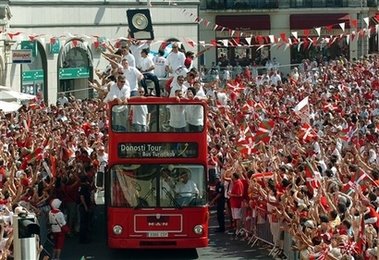
Biarritz Olympique rugby players display the 'Bouclier de Brennus' trophy to cheering and welcoming fans, as they tour the city of Biarritz, southwestern France, aboard a double decker, Sunday, June 11, 2006. Biarritz won the trophy after defeating Stade Toulousain 40-13 in the French rugby league final at the Stade de France in Paris on Saturday. (AP Photo/Bob Edme)Saturday, June 10, 2006
Biarritz Olympique Champions of France!
Biarritz rugby team players celebrate with the trophy after winning the final of the French rugby championship at the Stade de France in Saint Denis, north of Paris, Saturday June 10, 2006. Biarritz defeated Toulouse on a 30 to 11 score.(AP Photo/Remy de la Mauviniere)Monday, May 15, 2006
Biarritz Olympique Comes of Age
Thomas Castaignède
Monday May 15, 2006
The Guardian
For the English Biarritz equals the beach. To the French it means Serge Blanco. Sun, sand, sea - to holidaymakers it seems like a little paradise; for visiting rugby teams, however, it's a pretty hellish place and it's all down to the vision of one man: Blanco.The French championship-winning team, who will try to win their first European final on Saturday in Cardiff, is largely his baby.
A few years ago he told me he was trying to build something big in the Basque country and he felt the team were getting there. I wasn't too much of a believer and I have been eating humble pie for some time since. Blanco has created a phenomenal team and in getting to the European Cup final they have gone up another rung on the ladder.
There are things about Biarritz that will be familiar to any English rugby fan. Firstly the sense of local identity, which is stronger in that particular corner of France than in any other. Biarritz and their neighbouring club in the Championnat, Bayonne, have a rivalry that puts Bath and Gloucester, for example, well in the shade. Let's just say that when Bayonne beat Biarritz last year the club coach drove around Biarritz with its horn blaring, just to rub it in.
The two clubs are barely a mile apart but are both fighting for the honour of representing the Basque Country and they are chalk and cheese. Bayonne is the heart of the area, more working class; Biarritz has the nice suburbs with a more illustrious aura. But dare to say that Blanco is a Bayonnais and see what answer you get.
Another English parallel in Biarritz is that they have a sugar daddy, which is not common in France: Serge Kampf is one of the 10 richest men in France, boss of Cap Gemini, whose business is selling human intelligence such as computer support.
With his money and Blanco's vision Biarritz have travelled way above the level they reached when the great man was playing for them. To whip up local feelings even more, Biarritz's rise has been headed by a Bayonnais, the great former wing Patrice Lagisquet, as coach while another of their old rivals, Jean-Michel Gonzalez,was an iconic figure in their pack as captain and hooker.
Where Biarritz have really got it right in recent years is in their recruitment. Kampf's millions have been wisely spent. They have a knack of spotting hidden gems such as the fly-half Julien Peyrelongue, the lock Jérôme Thion and most notably Dimitri Yachvili, who blossomed only after he moved to the Basque Country.
He will, as ever, be the key man for them. You can expect Munster to target him mercilessly, knowing he is pretty much the Biarritz equivalent of their own Ronan O'Gara - one talented player among many who just gives that little bit extra.
Occasionally Biarritz have hired big names such as Imanol Harinordoquy or Damien Traille but by and large they have tended to let players go if their financial demands are too big, and they have brought in some handy Argentinians such as Martin Gaitan and Federico Martin Aramburu - not to mention Philippe Bidabé, the flying winger who has come from nowhere.
Biarritz are a handy mix of passionate support and careful recruitment that does not deserve the criticism some British papers have dished out. They did not play a great deal of attacking rugby in the knock-out stages but they are perfectly capable of it and we could see it on Saturday if the Millennium Stadium roof is closed.
Whether that will be enough to beat Munster is another question. Yachvili does somehow seem inspired whenever he appears on this side of the Channel and his club have had the experience of appearing in French finals but I would reluctantly back Munster, even though the Irish club will be under huge pressure because they have come close so many times and even though Biarritz beat them last year.
That win, most significantly, was in the Basque Country in San Sebastián and it was at a time when Munster were not as strong as they are now. Cardiff will be more of a "home" venue for the Irish than for the French, who will feel like the away team.
Biarritz are pretty much impregnable at home but we at Saracens saw they can be vulnerable away when they visited us at Vicarage Road. It's a French thing and it could count against them.
.... ... .
Saturday, March 04, 2006
Biarritz Olympique's Defeat

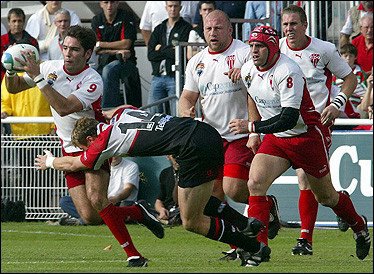
L-R: Stade Francais' flanker Remy Martin and Biarritz's prop Census Johnston and lock Olivier Olibeau try to grab the ball after a line-out during their French Rugby Union Match at the Stade de France in Saint-Denis, northern of Paris. Stade Francais mounted a second-half fightback to beat defending champions Biarritz 21-16.(AFP/Damien Meyer)
Sunday, October 30, 2005
Biarritz Obliterates Ulster


Biarritz's scrum-half Dimitri Yachvili(L) vies with Ulster's Irish winger Kevin Maggs(C) during their European Cup Rugby Union match at the Aguilera stadium in Biarritz. Biarritz won 33-19.(AFP/Daniel Velez)
Saturday, June 11, 2005
Gora Biarritz!
The Biarritz Olympique went to the City of Light, and avenged their previous loss by defeating the Parisian rugby team Stade Francais to earn yet one more French rugby championship.
Zorionak!
Sunday, April 03, 2005
Not Just Another Rugby Match
To the uneducated eye and to the uninformed this may seem like just another sporting event.
But the whole thing conveys something bigger, something that runs deep.
Biarritz it's a touristic town in Lapurdi, one of the three provinces that are today known as Iparralde, the Northern Basque Country, sometimes refered to as the French Basque Country.
Donostia, on the other hand, is a touristic town in Gipuzkoa, one of the four provinces that are today known as Hegoalde, the Southern Basque country, sometimes refered to as the Spanish Basque Country.
Biarritz it's on a run to win the European Rugby Championship, as the team makes it to the next stage of the competition, it becomes more and more evident that their stadium is not big enough to hold an event of this importance.
So, they decided to look for a new location to call home.
What about a nearby town in France?
Well, think again.
Those who called the shots decided to move the home games to another Basque town, and since for the Basques the artificial borders imposed on them do not really exist, they decided to go to nearby Donostia, on the other side of the Pyrinees, but still within Euskal Herria.
The Irish cousins had to face the Basque squad nestled among 20,000 supporters. They put up a fight, they took to the field with courage and dignity, but in the end, more than a simple rugby match was at play.
Today the Basques from both sides of the Pyrinees told the world a simple message:
Zazpiak Bat.
The Seven are One.
Saturday, February 12, 2005
From Biarritz to Donostia
Sunday, November 21, 2004
In the Basque Heartland
In the Basque heartland
In the Basque country of southwest France David May found a picture-postcard landscape
September 26, 2004
AFTER four days driving through pelting rain, the sun-drenched curve of Biarritz beach appeared like a mirage. It was early spring and a couple of dog-lovers strolled the almost deserted sands as a solitary surfer skimmed across the gentle blue-green swell of the Gulf of Gascony.
In southwest France, in the foothills of the western Pyrenees, Biarritz is the crown jewel of the Pays Basque, homeland of the Basque people since the 6th century. But away from the glitzy, celebrity-studded coast, the Basque heartland is a postcard-Pyrenean landscape of sinuous hills and valleys where rivers run fast and passions run deep.
Famous for their fiery food and music, Basques are a spiritedly self-sufficient people stubbornly wedded to their culture and a mysterious ancient tongue full of perplexing words beginning with Xs, Ks, and TTs.
In the rural interior, beech forests and farms speckled with sheep separated little villages, each with its traditional trio – town hall, church and pelote court.
Pelote is similar to squash except the ball is flung at the wall with a curved basket.
The villages with their red-shuttered, whitewashed houses seemed similar but there were subtle differences. Espelette has given its name to a unique Basque chilli pepper and celebrates the local chilli harvest with a two-day annual festival. Itxassou has cherry orchards and a lovely rustic church while Hasparren snoozes at the foot of the Pyrenees, stirring only for the annual Pamplona-style running of the cows. In Louhossoa, a grim stone church towers over a graveyard of crosses and disc-shaped Basque headstones and pretty red and white buildings on the tree-lined streets beyond.
But all roads lead to St Jean Pied de Port, the most beautiful of the Basque towns, founded in the 13th century by the last Basque king, Sancho the Strong.
Since the Middle Ages, St Jean Pied de Port has been the main staging post for pilgrims trekking to the Tomb of St James at Santiago de Compostela across the Spanish border. They still do.
In the late afternoon the sun played on the citadel that dominates the town while stirring Basque music played quietly from speakers.
From the citadel, Rue de la Citadelle descended steeply to the river, a cobbled street lined with ancient rose-tinted granite houses dating back to 1510.
At the bottom, at the end of a stone bridge, was the neo-Gothic and sensibly named Church of Our Lady at the End of the Bridge.
At Cafe le Trinquet a sturdy waitress brought a bottle of Irouleguy, a Basque red wine, for the spiced chicken basquaise, casseroled with capsicum, garlic, tomatoes and Espelette peppers. That and the Iraty fromage de brebis (sheep's cheese) with a dollop of blackberry jam were superb.
Saturday afternoon in St Jean Pied de Port was drenched in a deluge. Locals retreated to the Ttipia Bar to sing and dance to accordions and drums and to quaff Akerbeltz beer, pittara, a sharp-tasting cider and a potent herb liqueur called izzara.
It all seemed a bit like home. Patrons placed bets with the PMU (French TAB) but most of the beret-topped men were there to watch the rugby super 12s on wide-screen TV and on another, the pelote match of the day – an apparently critical confrontation between the muscled men of Larramendi and Eguzkiza.
The blokes muttered encouragement or disapproval as pelote players punished the court walls while girls with fashionable curly hair and flashing dark eyes screeched adoringly at their heroes. Pelote players have been paid professionals since the 16th century and this was serious business.
Suddenly, it was over. Grinning Eguzkiza players told the story and the passionate young fans returned to what the Basques do best – the music and dance that shook Ttipia Bar to its old oak rafters late into Saturday night.
Monday, April 07, 2003
Travelling in Euskal Herria
Basque: No such thing as a quiet drink
In the beautiful Basque country, hospitality knows no bounds
Philip Jacobson of The Sunday Times stays up late
Early evening in one of the countless bars of San Sebastian’s old town, and, following a chat about rugby with some convivial Basques, I am about to be gently abducted. They are warming up for the nightly txikiteo, an extended ramble around their favourite tapas joints, and take it for granted that I will join them. Nothing too strenuous, they promise, and in any case, what better way could there be to get to know their fine city? A couple of hours later, I’m full to bursting with morsels of squid, anchovies, smoked meats, cheese and spicy sausage, washed down with many a glass of beer, wine and sharp cider, and the pace is beginning to tell on me. My companions, hardened practitioners of the Basque art of simultaneously eating, drinking, smoking and conversing at top volume, take pity, and we find a cafe for a cup of the shudderingly strong black coffee that keeps the locals going.
Having previously spent time in the Basque country — both the Spanish and French side — I should have realised what was coming next. As 9.30pm was clearly too early for dinner, my guides observed, we could have a quiet drink or two while we decided which of the first- rate seafood restaurants within walking distance we would visit. I did briefly consider dropping out, but that would have gravely offended the enduring, if exhausting, tradition of Basque hospitality: midnight was long gone by the time we reeled from the Restaurante Beti-Jai. Needless to say, I was not allowed to pay my own way.
Next morning, feeling somewhat fragile, I set off for the Playa de la Concha, the great crescent of golden sand that is the pride and joy of the vibrant, stylish city known to Basques as Donostia. The cafes in the arcades lining Plaza de la Constitucion were just
opening as the first coaches disgorged parties of tourists heading for the excellent Museo de San Telmo, devoted to the ethnography of the ancient Basque nation.
Strolling along the broad promenade in a bracing wind, I passed wetsuited surfers preparing to ride the long Atlantic rollers. The sun came out to illuminate the elegant facades of the belle-époque buildings around the bay. Beyond the western end of the beach, embedded in rocks lashed by the sea, lies the extraordinary El Peine de los Vientos (Comb of the Winds), an iron-and- granite artwork created by the renowned modern sculptor Eduardo Chillida.
A proud Donostiarra who died last year, Chillida once kept goal for San Sebastian’s revered Real Sociedad team, whose clashes with Atletico Bilbao always generate fierce passions. The historic rivalry between the two cities remains intense, and the extraordinary success of the Guggenheim Museum in raising Bilbao’s profile around the world does not exactly thrill the self-styled queen of the Basque coast.
FROM San Sebastian, I took the old Guipuzcoa coast road towards France: my ultimate destination was Bayonne, a handsome, self-confident city too often overlooked by British visitors in favour of its flashier neighbour, Biarritz. The frontier road meanders past some pretty Basque villages along the Bidasoa estuary, though the border town of Irun is a drab place.
Things start looking up again the moment you cross into the French Basque country. St Jean de Luz is a dazzling little resort set in a beautiful bay. Don’t believe anybody who tells you that it has been spoilt by tourism: yes, it gets crowded in peak season, and yes, the best hotels and restaurants on Rue de la République are eye-wateringly expensive. But there are cheaper, and still excellent, restaurants across the bridge that links the town to Ciboure, and the most important things are free of charge: the magical evening light, which suffuses the port with subtle colours, the splendid beach and the great gothic church of St Jean Baptiste, where Louis XIV married the Spanish infanta Maria Teresa in 1660.
A short drive away, the former whaling port of Guéthary does not aspire to great sophistication; although discerning French families have been vacationing here for years, it retains the feel of a real Basque community. Old codgers in floppy berets sun themselves on benches around the fronton court, where fast and furious pelota contests take place: a lot of money can change hands during big matches, one confirmed gambler told me, “but I wouldn’t advise you to try your luck”.
The last time I was in Guéthary, a fair was in full swing. The hardy Basques adore trials of physical strength, and a collection of bruisers were competing to lift the biggest boulders, pull a heavily laden wagon the farthest and split the most logs. The bars were full of locals playing a fiendishly complicated Basque card game, mus: all I can tell you is that it revolves around a stylised ritual of cheating, signalled by a bizarre array of gestures and grimaces.
AS FAR as Biarritz is concerned, set me down at a table in the cafe of the lovingly restored Casino Municipal, looking out over the Grande Plage, and I’ll let the laid-back ambience of this spa town-turned-resort do the rest. There is something enormously relaxing about watching the hefty Atlantic breakers over a carafe of icy rosé, idly scanning the running card for the afternoon’s racing at the local hippodrome.
Although Biarritz clung for too long to the glory days of the Second Empire, when it became the in place for crowned heads, European nobility and well-heeled swells, I find the air of faded grandeur most agreeable.
The first glimpse of Bayonne’s walled old town, with its fine half-timbered houses painted a distinctive oxblood red, always raises my spirits: here is another of those medium- sized French cities (from the same mould as Auxerre, Aix en Provence and Montpellier) that strikes an enviable balance between commerce and culture, tradition and trade. Even the most dedicated beach person would find a day there richly rewarding, with ample time to do the main sights and still enjoy wandering through the historic Grand Bayonne district.
The lofty, gothic Cathédrale Sainte Marie is a good starting point: begun in the 13th century, when Bayonne was ruled by the English, it was eventually completed six centuries later. Just around the corner is the shop-lined Rue du Port Neuf, where the most famous of the town’s numerous chocolate-makers, Chocolat Cazenave, is located: try a mug of the creamy hot chocolate that has been served there since the mid-1880s (when the church denounced it as “devil’s brew”), before contemplating the purchase of a Bayonne ham from the shop almost opposite.
The city’s annual jazz festival, in July, allows its more sober-sided inhabitants to let down their hair, and the fun continues with the Fêtes de Bayonne at the end of the month. The Musée Bonnat, named after Bayonne’s foremost painter, has works by Goya, Ingres and Degas, with a room set aside for Rubens, while visitors to the Musée Basque — extensively restored and expanded not long ago — have nothing but praise for the imaginatively displayed collections of Basque history and culture.
On the opposite bank of the narrow River Nive, which bisects the town centre, Petit Bayonne is the place to be after dark, when bars and restaurants in the twisting backstreets come raucously to life. On a previous visit, a local journalist directed me to Le P’tit Pub: crowded, noisy, smoky and hugely welcoming. I could have been back in San Sebastian.
Thursday, February 28, 2002
Rugby Star Imanol Harinordoquy
France look to Basque prodigy
By Brendan Gallagher in Paris
Last Updated: 7:35PM GMT 27 Feb 2002
PICK UP a programme for France's game with England on Saturday and you'll read that Imanol Harinordoquy - don't worry he's going to be around for years, you'll get used to the name - hails from St Jean Pied de Port in the Pyrenees. That is not a place name the young man himself would recognise, however. Harinordoquy is a proud French Basque and has always known the town of his youth as Garazi. He has no wish to be awkward but these things matter.
Just 22, he has already made French rugby history in a minor sort of way. He is the first in a long line of distinguished French internationals to keep his Basque Christian name into adult life. Imanol is common enough among Basques either side of the French-Spanish border - many of Harinordoquy's generation being named after the famous Basque singer-storyteller Bertsolaritza, known simply as Imanol.
Harinordoquy, who made an impressive debut against Wales two weeks ago, is the current flag-bearer for Basque rugby. It is a role he takes seriously. Before him there was the enigmatic Jean Dauger, who is generally credited with encouraging and inspiring French flair and improvisation behind the scrum. Alas he was mistrusted by the selectors and won only three caps. An early Stuart Barnes perhaps.
Then there were the teak-tough forwards, characters you did not mess around with. Pierre Dospital, the mighty prop known as Peyo who always led the post-match singing with his Basque ballads, the menacing Pascal Ondarts and powerful hooker Jean-Marie Gonzales.
On Saturday Harinordoquy lines-up alongside Olivier Magne and Serge Betsen in the French back row for the biggest day of his life. He'll look up into the stands to try to locate the 30 or so members of his family who are making the trip, but there will be no visible evidence of his Basque heritage, no brandishing of flags or slogans.
"It's there in my heart, that's all that matters," Harinordoquy said. "I am French and Basque. There is no conflict, I am proud of both."
Like the vast majority of French Basques he has no time for Euskadia eta Askatasuna (ETA) who fight for an independent Basque nation: "I have friends who are involved in the political side of things but that is not for me. My only interest is the culture, the Euskera language, the people, our history and ways."
So you can be different without being subversive, a message that rugby has always epitomised. Protestant and Catholic played for Ireland right through the Troubles. Harinordoquy has already made his mark on the French squad: English speaking, entertaining, laid back, mature beyond his years, sure-fire captaincy material, he embraces the old Basque proverb: Hil arteraino bizi, han arte ez izi, or live until you die and until then don't panic.
Above all he is a formidable rugby talent. After a youth spent dabbling in the traditional Basque sports of pelote and pala, he took to rugby only at the age of 14 when he joined Pau. His progress since then has been swift, and he captained France Juniors and France Under-21 before making his France A debut against Italy last month. Quick enough to shine at open-side flanker against the Welsh, he feels more at home at No 8 where his long-term future probably lies. Along with his powerful club colleague, Damien Traille, he is the brightest of French prospects.
Since first appearing for Pau in the French Championship as an 18-year-old it has been just a matter of time before he broke into the France team.
"Imanol is a tremendous talent," Magne said. "He has pace, strength and aggression. He also has very useful line-out capacity and a good attitude, he takes pleasure from the game. He could become a very great France player indeed."
Funny, the article contains a cheap shot at Basque nationalism. What else could we expect.