Saturday, April 04, 2009


Monday, December 18, 2006
The Basque Race
This is about another kind of race, the kind in which a group of people depart from one place in order to see who gets to the destination spot first.
Here you have the note, it appeared at EITb:
Organized every two years
Race to boost Basque language will pay tribute to female speakers
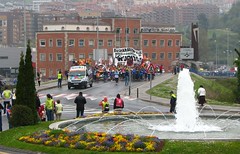
12/18/2006The popular race Korrika, organised by Basque language school net for adults AEK once every two years, will celebrate its 15th edition in 2007. Its main aim is to boost the language, but this edition will pay tribute to female speakers for their job protecting and passing on language and culture. Under the slogan "Heldu," the race will kick off on March 22 at the Carranza Valley, northwestern Basque Country, and finish in Pamplona/Iruña on April 1.
The 2007 edition was presented Monday by the manager of the event Edurne Brouard, AEK general coordinator Mertxe Mujika and Asier Amondo, member of AEK's National Commission.
The slogan of the current edition will be "Heldu," "mainly because it defines AEK's job very well, teaching adult learners, 'heldu' means that in Basque," as Brouard explained. "Heldu is a Basque word with several meanings, all of them positive. It means arrive, grasp, hold, maintain, grow up and mature."
Thus, Edurne Brouard defended Basque language "as an identity document" since "we make up the Basque Country when we speak in Basque." That is why "we can't waste what characterises us."
Likewise, Brouard believes that "everybody's compromise to claim that we are the country of the Basque language" is necessary. Korrika 15 bets for the work and collaboration of "all agents in the Basque Country," political parties, associations, unions and institutions that "overcome laws and measures that deny or limit the survival of the Basque language."
Saturday, December 02, 2006
Learn About Korrika
What is Korrika?
Organised by the Coordinator of Literacy and Basque promotion (AEK), the Korrika is a race throughout the Basque Country to support the Basque language.
Imagine a non-stop relay race throughout all the Basque Country to support the Basque language, hundreds of thousands of runners and several cultural events and celebrations in the whole Basque country as the race takes place. That is the korrika.
The objective of this race is to raise awareness of the Basque language and collect funds to carry out this work on a daily basis in the study centre of the coordinator.
The first race took place in 1980 from Oñati (Gipuzkoa) to Bilbao (Bizkaia). Since then, there have been 13 korrikas held over 24 years. This year the race will last 10 days and will cover 2150 km throughout Euskal Herria in which 600,000 people will participate, as in previous editions. During the race the runners carry a baton containing a message which will not be made public until the last day of the race.
Who organises the Korrika?
AEK, Coordinator of Literacy and Basque promotion is in charge of organising this event, with the objective of promoting the Basque language and recovering the language. To do this, the coordinator works in the field of adult literacy in the Basque language: research, creation of didactic materials, courses for teaching staff, organisation of cultural events and creation of awareness campaigns in favour of the Basque language.
Wednesday, January 26, 2005
Clamp Down on Batasuna
And after two years of "investigation" he backs up his hypothesis with theories, how professional of him.
Here is the note at Berria that depicts the last Garzonada:
Garzon charges 36 Batasuna members with being ETA members
In a 267-page indictment the judge confirms his hypothesis put forward in the 18/98 Case and includes all the organisations of the Basque National Liberation Movement within the armed organisation “in one way or another”
Aitziber Laskibar – BILBO
Baltasar Garzon, the Spanish National Criminal Court judge, issued his indictment yesterday on the 35/02 case relating to Batasuna and the Herriko Tabernas. In it Garzon pursues the same line of argument as in the legal proceedings instituted in the 18/98 Case and maintains that all the organisations within the Basque National Liberation Movement (ENAM) are, “in one way or another”, part of the armed organisation, On the basis of this argument Garzon has indicted 36 members of the HB, Euskal Herritarrok and Batasuna, accusing them of “being members of a terrorist organisation”. The indictment is 267 pages long and in it Garzon develops his arguments at length. The 36 people concerned have been summonsed to the Spanish National Criminal Court on Monday morning to have their charges read out to them.
Judge Garzon has also decided to maintain the precautionary measures which have hitherto been in place. So apart from the freezing of Batasuna’s accounts, the seizure of the Herriko Tabernas remains in force. The judge believes that the indictees committed crimes through the Herriko Tabernas, and that is why he deduces that they are ETA members.
The indictees also include members of the BAC-Basque Autonomous Community Parliament, but they cannot be indicted and tried by the National Criminal Court. So the Judge of the 5th Examining Court of the National Criminal Court has requested the High Court of the BAC to start proceedings against them.
Garzon has used two main arguments to say that Batasuna members are members of ETA: a political and an economic one. He says that in both these spheres all the organisations in the ENAM operate within “the same parameters” and that puts them all inside ETA. This argument begins with a sentence on the first pages of the indictment made public yesterday: “ETA has not only used HB, EH and Batasuna in the political and institutional sphere, it has also used them in the economic sphere for its funding.”
In the case against Batasuna, Garzon has included the same analysis that he made concerning the funding of the ENAM in the 18/98 Case, in the one against the Pro-Amnesty Committees (AAB), in the case against Haika and Segi (Basque nationalist left youth movements) and in the Udalbiltza case. He considers the AEK, the HB, the AAB and a number of companies to be “large companies” of the ENAM. He says that the stands (set up to sell refreshments during local fêtes), the sale of materials of the organisations, the membership fees and draws all constitute sources of funding for all of them.
Wednesday, December 15, 2004
Advancing Euskera in Nafarroa
Basque language activity representatives demand new law
Maitane Burusko – IRUÑEA (Pamplona)
Today it is 18 years since the Government of Navarre's charter law 15/1986, or law governing the Basque language was passed. However, it is no cause for celebration for the players in the field of Basque language activity. They have denounced “the division and the continual violation of linguistic rights,” which have resulted from cutting Navarre up into three linguistic zones.This was why a number of players involved in Basque language activity were keen to give a joint assessment yesterday to demand that, “on the basis of the conditions laid down in the Universal Declaration of Linguistic Rights, Basque should be given official status, that it should be treated as something that belongs to Navarre and that it should be given priority”. So the following bodies made a call for the repeal of the current Basque Language Law: Administrazioan Euskaraz (Organisation promoting Basque in the Administration), AEK, Behatokia, Euskal Herria Euskaraz, IKA (Association of centres teaching Basque and literacy in Basque to adults), Kontseilua, Oinarriak (Association of 15 organisations working for the standardisation of Basque in Navarre) and Sortzen-Ikasbatuaz (Association of Basque-speaking public schools).The representatives of organisations working in the field of Basque language activity who met together are basically saying that the Basque Language Law in Navarre lacks “the necessary foundations” to bring about the normalisation of the Basque language. On December 15, 1986 the Government of Navarre implemented the law, which governs the linguistic rights of Basque speakers in Navarre, according to where they live.Behatokia’s chairman Paul Bilbao explained that it was “a decision devoid of logic, “because it is inconceivable that the law itself should recognise that the language belongs to Navarre, while at the same time it divides up its official status on the basis of zones”. Bilbao added that over the last two decades people have not enjoyed any rights in the non-Basque speaking zone established by the law. As far as the mixed zone laid down by the law was concerned, the Behatokia chairman stressed that the law had contributed to the decline of the language in the institutions over the last few years.The Government of Navarre has in fact passed a number of decrees to reduce the use of Basque, for example decrees 37/2000 and 29/2003, which were blocked by the courts. Paul Bilbao said that even in the Basque-speaking zone the Government of Navarre had flouted the law; he pointed out that linguistic rights are systematically being infringed today. On behalf of the players involved in Basque language activity he added: “At the end of the day the Basque Language Law has contributed towards discrimination among the citizens of Navarre and towards making the language disappear.”
Sunday, October 19, 2003
Massive Response
A massive response once again
In a superb response to Kontseilua’s call, thousands of demonstrators filled the streets of Donostia to denounce the latest attack on Basque cultural activity and to demand freedom for the detainees
Eider Goenaga – DONOSTIA (San Sebastian)
For the second time in eight months thousands of Basque citizens heeded the call made by Kontseilua and expressed their anger in the streets of Donostia (San Sebastian) in a fitting response to the attack. They filled the streets to bursting yesterday by joining together under the banner of “Gora Euskal Herrri euskalduna. Bai euskarari!” (Long live the Basque-speaking Basque Country. Yes, to Euskara, the Basque language!) and pledging their allegiance to Basque cultural activity. They condemned the assault carried out on the Martin Ugalde Kultur Parkea just as they did so eight months ago to denounce the closing of Egunkaria . A request to support the Basque language and the organisations involved in Basque cultural activity was expressed by one and all.
Lined up behind the banner were four of the people detained in the previous operation: Joan Mari Torrealdai, Txema Auzmendi, Martxelo Otamendi and Fermin Lazkano. They were accompanied by the representatives of Kontseilua: Xabier Mendiguren, its secretary-general; Imanol Lazkano of the Bertsozale Elkartea (Extempore Basque verse-making enthusiasts’ association); Joxe Leon Otano of AEK (adult Basque teaching organisation); Ttitto Velvedere of the Euskal Konfederazioa (association working for the standardisation of Basque in the Northern Basque Country –under French jurisdiction); Gabi Basanez of the EHE (association demanding the Basque language in the Basque Country); Joxean Lizarribar and Ane Agirregomezkorta of the board of directors of EKT (the company that runs BERRIA), among others. The father of Mikel Sorozabal, the former managing director of Egunkaria, also held the banner on behalf of the relatives of the detainees.
The detainees were the main protagonists of the demonstration along with the call in favour of the Basque language. Behind the first banner, workers from the Martin Ugalde Kultur Parkea companies carried a second one demanding the release of the detainees: “Atxilotuak askatu. Euskalgintza aurrera!” (Free the detainees. Come on Basque cultural activity!). Behind them photos were carried of the detained colleagues along with those of Inaki Uria, Xabier Oleaga and Xabier Alegria, the people being held in prison in the wake of the February 20th operation.
Protesting the Assault on Basque Culture
Thousands protest against the assault on Basque cultural activity
Thousands of people in towns and cities responded to the call made by “Kontseilua” to call for the release of the detainees and demand that the Basque language be left in peace
Editorial Staff
Protests were held yesterday inside the Basque Country to condemn Thursday’s police operation and the attack on Basque cultural activity. For example, about one hundred teachers and students involved in the “Irale” study programme got together for a quarter of an hour in the Larratxo square of Donostia [San Sebastian] with the banner: “Euskalgintzaren aurkako erasorik ez” (No to the attack on Basque Cultural Activity). Between 14.00 and 15.00 hours workers from the Zabaltzen distribution company and the Euskalgintza Elkarlanean publishing house met together in front of the Zabaltzen premises in the Donostia suburb of Igaro. About fifty people lined up behind a banner that read “Atxilotuak askatu Euskal Herria aurrera” (Free the Detainees. Come on Basque Country!). They included Iñaki Sors, the brother of Jose Mari Sors, who is one of the detainees. Martxelo Otamendi [BERRIA’s Chief Editor] and Joxean Lizarribar, on behalf of the “Euskarazko Komunikazio Taldea” [the company that runs BERRIA], also took part.
One of the first protests in front of city and town halls called by “Kontseilua” was held in Baiona (Bayonne). Leading about 150 people Gexan Alfaro of the Elkarlanean publishing house denounced the operation as “state terrorism” and added that “the time has come for all Basque nationalists to unite and dispense with party politics”. Maixan Merkapide, chairman of the “Euskal Konfederazioa” called on the politicians to do something “to stop this.”
In Donostia over 1,000 people got together outside the city hall; Xabier Mendiguren, Kontseilua’s General Secretary, and Joan Mari Torrealdai, the Editor of the journal “Jakin”, were there along with the wives of the detainees Joxe Mari Sors, Mikel Arrizabalaga and Mikel Sorozabal. Representatives of political parties were also there: Luis Mari Bandres of the EAJ (Basque Nationalist Party), Josetxo Ibazeta of Batasuna, Iñaki Irazabalbeitia of Aralar. The ELA and LAB Basque trade unions were also represented, and Joxe Leon Otaño was there on behalf of the AEK (adult Basque teaching organisation).
About 2,000 people staged a protest in Bilbo, and approximately 1,000 in Gasteiz (Vitoria).
Thursday, April 24, 2003
Step by Step
Basque Country Step by Step
Information Service from Basque Country
Introduction
This is an information service focused on the struggle of the Basque Country for freedom and the respect of human rights included the right to self determination.
1.- Spain, a criminal state
On the 31st of March it was discovered that Cesid Spanish "intelligence" services was spying the quarters of the political party Herri Batasuna in the city of Gasteiz years before the banning. This spying had taken place for three years. During the last days of March of the present year former heads and agents of Cesid had been processed with the result of the last Director of Cesid being sentenced to three years in prison, a fine of 11,160 Euros and the inhabilitation to be employed in a public post for 8 years. The Spanish State has also being declared liable on this affair.
It has been know that the General Public Prosecutor if Spain pressured the public prosecutors of the Provincial Audience of Alava, so no penal charges would be imposed on the accused members of Cesid. The Spanish General Prosecutor is appealing the sentence.
2.- The Ikurriña banned
The Parliament of the Navarrese Autonomous Community debated on the 26th of March the new Symbol’s act. The votes of the governing conservative party, Union del Pueblo Navarro, plus the votes of the Socialist Party and conservative Convergencia Democratica approved the Draft of the Symbols’ Act that bans the use of the Ikurrina, Basque emblem, flag, in public institutions.
3.- Trade Union’s compromise with political rights
The majority of the Basque Trade Union movement in the Basque country facing the ilegalisation of Batasuna subscribed on the 5th of April a document titled "For the right to politically participate". The trade union movement claims the need "of ensuring all rights for all persons in the Basque country".
The Basque Trade Union movement hopes to build within and from the workers movement a solution to the political conflict at the Basque Country.
4.- Here comes Korrika
On the 4th of April Korrika began in the north of the Basque Country, in Maule. Korrika, meaning "running" in Basque, is one of the most important initiatives that takes place in favour of Euskara.
Aek and Korrika
The Korrika is an event organised by the Alfabetatze Euskalduntze Koordinakundea (AEK), the co-ordinating committee for promoting literacy and teaching Basque.
AEK is a popular movement that promotes literacy in Basque and teaches Basque to adults. This organisation has over a hundred centres and thousands of students throughout the Basque Country.
The Korrika is not a regular event, it is a giant race that crosses the whole Basque Country during 10 days, non-stop, night and day. It is not something that can be seen everyday: thousands of people from all walks of life and all ages taking part in this race and running over 2,100 kilometres.
Korrika, which happens every two years, has become a phenomenon that rouses Basque society. The number of people who take part in the race increases from one Korrika to the next. Thousands of people collaborate in the organisation of the Korrika in the committees formed in towns and neighbourhoods. While the campaign is on, hundreds of festivals and cultural acts are organised.
The movement created around the Korrika reflects the size of the effort that Basque society makes to recover its language. From the moment that the first Korrika crossed the Basque Country from Oñati to Bilbao in 1980, it has been one of the most highly participated events organised in support of the Basque language. Twelve Korrikas and more than 20 years have gone by since, but the success of the Korrika continue.
Korrika 13th, A nation carving its future
The work done at the Basque Country in order to recover its culture and language is not new.
During the end of the 60’s and the beginning of the 70’s Basque culture experienced a very important renaissance in all areas; music, literature and plastic arts amongst others. Ikastolak (primary schools where subjects are taught in Basque) and night schools (where adults are taught the Basque language) spread to many towns. A standardised Basque language was created (euskara batua). In music for instance, it is clear that the reason why we have a decent production level in respect of both quantity and quality, and a ‘normalised’ market today, is due to the effort made at that time.
In order to recover this spirit, the Korrika wants to pay tribute to the protagonists of this renaissance. Many people worked very hard at that time and they all deserve the tribute. Amongst them we find the cultural movement called ‘ez dok amairu’ (there is no thirteen).
This 13th Korrika wants to remember the enthusiasm and vitality of those who created ‘ez dok amairu’. Jorge Oteiza chose the name which he borrowed from a popular tale collected by Azkue in the Basque province of Bizkaia to show that Basque culture could break the spell of the unlucky number thirteen and continue to bloom.
Today the Korrika wants to tell society exactly the same thing; there is no thirteen, there is no curse. In the same way they managed to give Basque music and culture a big push during the inflexibility of the dictatorship, we also want to be able to carry on over all measures against Basque. We have to take Basque society through another period of renaissance because we are able to.
Euskal Herria, on the 15th of April, 2003.
Sunday, March 09, 2003
Broad Campaign Against Basque Society
The text you are about to read talks about this Apartheid-like campaign:
Many Basque organizations, businesses and media had been closed or prosecutedbefore
This is not the first time that a Basque newspaper has been closed by a Spanish judge. Since Aznar´s Popular Party came to power in 1996, many Basque political or cultural organizations, businesses and media have been closed, declared illegal or prosecuted due to alleged ties with terrorism. The vast majority of these cases lead nowhere, are never even brought to court, and serve only to publicly discredit pro-Basque organizations.
This is not by no means exhaustive of those actions:
a.. AEK (Organization that works in the field of Basque language teaching and adult literacy. They have taught the ancient Basque language to thousands of citizens.) AEK was accused in 1998 of being part of the ETA's alleged "business network". A report by the judge-appointed administrator concluded there were no irregularities in AEK's management, and that the accusations made by the judge Baltasar Garzón were unfounded. At the end of 2001, the judge was forced to desist in his attempts to prove a link between ETA and the organization AEK.
b.. Egin and Egin Irratia (newspaper and radio station of the independence movement) were accused by judge Baltasar Garzón in 1998 of being part of ETA and were closed without trial. In 2001, the Fourth Section of the Penal Court decided to drop the main charges of "membership in an armed organization"; without this accusation, the preventive closing of a media organization is not possible. Five years later, however, both media outlets are still closed pending trial.
c.. The EKIN case (movement for the independence of the Basque Country): in 2000 the judge Baltasar Garzón accused this movement and four other groups to be part of ETA and declared them illegal, arresting 20 people. However, by December 20001 all of the people that were arrested in this case had been released on bail. Moreover, the Fourth Circuit of the National Court issued a decree ruling that these people had been held in prison for a year without sufficient evidence, once again discrediting Garzón's investigative work.
d.. Ardi Beltza (A magazine specializing in investigative journalism). The judge Garzón decreed in 2001 the closure of the magazine and imprisonment of its editor Pepe Rei. But Garzón received another setback when the Spanish National Court decided to release the editor Pepe Rei. In spite of all, the magazine is still closed.
e.. Zabaltzen (Basque book and music distribution business): In 2001, Garzón issued warrants to search the main offices of the company. Some months later the judge had to abandon this investigation.
f.. Haika (Basque youth movement for independence): In 2001 it was declared illegal by judge Garzón.
g.. Askatasuna (Movement in support of the rights of Basque prisoners): In 2001 Garzón declared illegal this movement too, and arrested 13 people.
h.. Batasuna (Political Party supporting the independence of the Basque Country; they get about 15% of the votes in Basque polls and many mayors belong to this party): In 2002 the judge Garzón decreed the suspension of all their activities under the accusation of being part of ETA.
What we find behind all these actions is that the Spanish Government is trying to take advantage of the Spanish people's rejection of the so called terrorism of ETA. By linking the Basque political and cultural movement with violence, Mr. Aznar's Government usually obtains electoral benefits in Spain, since it projects an image of firmness against terrorism. Most of these cases are eventually abandoned due to a lack of legal foundations, but often the damage caused to the people and organizations involved is irreversible. Arrests and searches are usually accompanied by extensive media coverage, but when the detainees are subsequently released and the charges are dropped, there is usually no mention of this in the media.
Besides, these political/police/judicial operations do not usually happen by chance. They always take place just before an election, or when the Government intends to adopt an unpopular measure, such as the "medicamentazo" (a decree that eliminates government health-care coverage for a large number of prescription-drugs), the "decretazo" (a decree that eliminates some of the fundamental rights of workers, and makes dismissal easier and cheaper for employers). It is not just by chance, then, that the actions taken against Egunkaria have occurred just when the Government of the PP (Popular Party) is going through its most delicate moment since coming to power, with everyone's eyes set on the ecological disaster caused by the Prestige oil spill and on the Spain's support for the upcoming war on Iraq.
Regarding the former, most of the Spanish people think that the disaster of the Prestige could have been much smaller and that in fact it was aggravated by the Popular Party's negligence, as was shown by the massive demonstration organized by the Galician platform "Nunca Máis" that took the streets of Madrid on February 23rd. As to the war, an overwhelming majority of the Spanish people is against an attack on Iraq: organizations, political parties and media are pressing the Spanish Government relentlessly on this issue, and they have it on the defensive. On February 15th, the marches against the war organized in Madrid and Barcelona gathered one million people each.
International experts agree that the actions of the Spanish Government and the Spanish judges can hardly be tolerated in a democratic state. Former Italian president Francesco Cossiga, for example, has declared several times that "since Franco's dictatorship and the nazi regime, this is the first time that the Spanish authorities have created a situation like this" or that the "PP's actions are antidemocratic and violate people's rights".
We cannot forget that although Mr. Aznar's Popular Party tries to situate itself in the center, it is the political heir to the Franco regime. The party's president and founder, Mr. Manuel Fraga, was the Minister for Information and Tourism as well as Home Minister during the Franco dictatorship. In the PP's web page (web del PP ) you can read that a "group of people met with Mr. Manuel Fraga Iribarne, in the need to create and articulate a reformist and centrist organization, in order to offer an alternative after Franco's death". Even Mr. Aznar himself and many of his ministers and party leaders are members of well-known francoist families. To read more about this, please visit here.
With respect to the Egunkaria case, apart from the difficult moment the PP is going through right now, we should highlight the fact that the Home Ministry and the National Court published a joint press release to explain the operation taken against Egunkaria. This action is a clear violation of the principle of separation of powers, as has been denounced in several quarters. There are two other remarkable facts about the case against Egunkaria. On one hand, the decade-old documents upon which the accusation is based are the very same that were used to shut down the Egin daily, only now the judge interprets them to refer to Egunkaria and not to Egin. On the other hand, the judge Garzon previously abandoned the idea of taking judicial actions against Egunkaria, having considering groundless the same police report that judge Del Olmo now uses as the foundation of his case.
Friday, March 07, 2003
Social Initiatives in Support of Egunkaria
Several social initiatives on behalf of Egunkaria
Several social initiatives are taken place in the Basque Country on behalf of Egunkaria
Among them we can mentioned the one led by the university students of the UPV - EHU who after a long tradition of occupation to raise different issues, also squatted some university premises twice. The occupation started on the 4-3-03: loads of posters were made and put all over the campus of Leioa (Bilbo) and a free euskaltegi (Basque language school) operated during the day. On 5th March the infamous and feared Beltzas (The Black Ones- Basque regional anti-riot police) evicted the students locked -up in one of the university premises. They were evicted in the same way and for second time on the 7th March.
The Basque parliament has decide with the support of EA, PNV and IU to demand the reopening of the paper Egunkaria. Sozialista Abertzaleak (former Euskal Herritarrok) on the other hand demanded this, plus the end of exception state in Euskal Herria (Basque Country). The municipality representatives of EA and PNV are waiting for judge Del Olmo's decision to see how they help economically and technically Egunkaria to reopen.
Meanwhile the unions, Kontseilua (council of Basque language organizations: EHE, Emun, AEK, Elkar and Hika) and the workers of former Egunkaria have call to stop working for an hour on the 13th March. Among those unions: ELA-STV, LAB, EHNE, STEILAS, ESK-CUIS, ELB, HIRU and EGAS. Apart from the parties mentioned before, other parties like Aralar are backing this initiative. Sortzen-Ikasbatuaz is planning to launch support initiatives in all the schools of the basque Country too. University teachers have presented a communiqué too. A demo has been called for the 15th march on behalf of the self-determination.
On the 27th February, more than 300 solicitors from Bilbao positioned themselves against the closure of Egunkaria.
Outside the Basque Country , in Catalunya a platform has been created in support of Egunkaria (Plataforma per Egunkaria ). They have organised several acts like demos and talk with Martxelo Otamendi. The Catalonian regional government (Generalitat) decided to advertise itself in Egunkaria (now Egunero). The leader of the Catalonian socialists paqual Maragall has been scapegoat of the PP governemnt for asking that the tortures against Egunkaria's editor martxelo Otamendi should be investigated. This was also supported by the Catalonian union leader Joan Coscubiela and the basque socialist Odon Elorza.
Otherwise, the day before yesterday the workers of Egunkaria joined the dole office as staff sacked from a company. The paper's staff was 149, though the number of contributors, collumnists and freelance who'll be affected by this situation will be 300.