Showing posts with label Dispersion. Show all posts

Saturday, August 22, 2009

Dog Day in Bilbao

The Ertzaintza brutally charged against the relatives of the Basque political prisoners that for years have been carrying out a demonstration every Friday in front of Sabin Etxea (headquartes of the Basque Nationalist Party, the political formation that first proposed the dispersion of Basque political prisoners) in Bilbao. Right after the bus that takes some of the relatives to the jails in Andalucia departed, the Ertzaintza officers attacked against the crowd, arresting one person and sending the mother of a political prisoner to the ER. Those attacked did not even carry pictures of their loved ones, only one banner with the motto «errepresaliatu guztiak etxera» (bring home all victims of repression).

It is quite possible that, due to the dismal lack of knowledge and the preposterous bias deeply rooted in Madrid regarding the Basque reality, a judge may believe that the criticism against the dispersion policy is simply an "ETA/Ekin slogan". This was stated by the Audiencia Nacional judge Eloy Velasco, who earlier this week pressed charges for "apology of terrorism" against a number of food service employees using such argument.

But even a poorly informed person, with no access to any other version but the one portrayed on the police reports (with few facts but extensive guess work), should be able to set apart simply trues, like a father displaying the photograph of his daughter, sentenced to life in prison and serving her time in a jail thousands of miles away and enduring inhumane conditions, is not responding to a slogan but to his own conscience and dignity.

As a matter of fact, that reality can not hide that in Nabarra, thousands of people consider that the Basque political prisoners fight for legitimate ideals, even those who do not share their goals nor their methods.

The big issue here is that if the Spanish judges and politicians compare painting a graffiti in favor of ETA to a public demonstration in favor of the political prisoners' rights, the only result they will achieve is that the Basque dissidence will set up a barricade that will include the social base that supports the Basque Nationalist Party. This comparison established by the doctrine that "everything is ETA" even goes against the perception of reality by the majority of those who vote for the PSOE in the Basque Country. Despite the belligerent speech by the politicians and the wild verdicts by the judges, common sense prevails in Basque society.


.... ... .

Thursday, April 30, 2009

Arrests of Refugees and Dispersal

We received this text from our friends at the Irish Basque Committees:

Basque political refugees arrested in Belfast and Venezuela

At the request of the Spanish authorities Arturo “Benat” Villanueva was arrested last Wednesday by the Extraditions Team of the PSNI. The arrest happened at 8am at his home. The PSNI officers involved in the arrest were correct throughout the arrest and the custody at the Musgrave barracks.

40 people supported Benat inside and outside the Court buildings. After a hearing before Judge Burgess and having previously agreed with both the Crown prosecution and the PSNI Benat was released on a £5000 bail, curfew at home from 9pm to 7am, he has to remain within the six counties and has to sign at a barracks every day once. A full hearing will be held on the 13th of May at the Lagan Court in Belfast.

As we’ve reported many times Benat’s case is not an isolated one, it’s part of a broader pattern of repression against the Basque Country . Over the last decade newspapers, political parties, youth groups, cultural associations...have been banned and their members arrested.

Benat has been living and working openly in Belfast for the past 5 and half years. He said: “I’ve made this country my home, made many great friends and become a proud part of a very strong community. I’d like to take this opportunity to thank everybody for the welcome and support they’ve extended to myself and the Basque people over the years.”

Between Tuesday and Wednesday Basque political refugee Inaki Etxeberria was arrested in Venezuela. Very little information has come out surrounding this arrest.

The Basque pro-independence movement spoke out against the arrests and branded them as political and reflection of the overall political situation of repression in the Basque Country. The pro-independence movement asked other governments not to follow the Spanish authorities estrategy. Finally expressed their solidarity with the arrested and thanked those in Ireland, Venezuela and the rest of the world who have welcomed and supported Basque refugees along the years.

The Belfast Basque Solidarity Committee has stated that the arrest of a member of the Basque community , living in Belfast, is yet more evidence of the Spanish authorities attack on Basque Civil society.

Speaking on Wednesday a spokesperson for the group, Kevin Morrison, said:

“The arrest of a member of the Basque community, living in Belfast, Arturo “Benat” Villanueva, is yet more evidence of the continuation of attacks by the Spanish government on Basque civil society.

“The extradition warrant issued by the Spanish authorities is accusing Arturo Villanueva of membership of Segi, a youth organization banned in 2005 in a series of draconian clampdowns on Basque cultural and societal organizations.

“Since then newspapers and radio stations have been closed, human rights groups have been banned, and Batasuna, the Basque pro-independence party has been proscribed and its leadership arrested and imprisoned. All of these are blatant infringements of basic human rights and the freedom of speech within the European Union.

“This attitude of the Spanish government has recently been described by UN Rapporteur, Martin Scheinin as ‘too broad’ targeting ‘groups that have nothing to do with violence’.

“Benat has been living openly in Belfast for over five years and now has a life here.. We are a calling for immediate dropping of this case and an overall end to such repression of Basque civil society.”


20 years of dispersal policy

The EPPK/Basque Political Prisoners Collective released a statement on the 20th anniversary of the implementation of the dispersal policy by the Spanish government followed after by the French authorities. Since 1989 hundreds of Basque prisoners have been scattered in dozens of prisons across Spain and France. Nowadays 765 Basque political prisoners are imprisoned in 85 jails.

In the statement the EPPK says they won’t allow to be used to damage the Basque National Liberation Movement. They called upon Basque society to continue working against the dispersal policy.

The EPPK goes on to ask the French and Spanish government to take the prisons policies out of the confrontation lines and take the path of common sense.

.... ... .

Sunday, April 20, 2008

Report by EHW

This report comes to us thanks to Euskal Herria Watch:

33/01 Case against Gestoras Pro-Amnistia-Askatasuna

Description of the case

Repression against the Basque People, conducted by the Spanish State and - to a lesser degree- by the French State has been constant in recent years. It is easy to trace a continuous line throughout the last decades that can show us the persistence of torture, massive and arbitrary detentions, a penitentiary policy with terrible consequences, banned associations and organizations, closure of media, outlawing of political parties and total discrimination from public life against a section of the population. To sum up, an exceptional situation that has generated a dangerous scenario of suppression of the most basic political and civil rights, a scenario that can now be seen in all its brutality.

These circumstances have forced hundreds of Basque citizens to create a retaining wall, to confront repression and participate in different civic organisations, human rights organisations, and activist organisations in what has become known as the Amnesty Movement. Without such a movement, the lack of activation of the people and, therefore, of social opposition would have resulted in a total acceptance of the impunity of the structures of the Spanish State. That is why many and varied activities have been channelled through this Movement -conferences, demonstrations, public appeals, contacts with all kinds of political and social agents…- in order to demand a scenario of respect for basic democratic conditions, of enjoyment of basic civil and political rights.

In this context, the organisation Gestoras Pro Amnistía was born three decades ago as the main platform for solidarity with the people that suffered political repression and to campaign against the situation. This association carried out a process in 2002 to converge with the association Koordinaketa, made up of the committees that worked in solidarity with political prisoners in the North of the Basque Country, under French administration. Askatasuna emerged as a result of this process, to carry out these activities in the whole of the Basque Country. In other words: an organization that focuses its activity on the promotion and protection of the human rights of the victims of repression, that fights for the eradication of torture, for the rights of arrested or imprisoned Basque citizens and the overcoming of the causes that are at the origin of State violence.

This task has always been carried out completely within the law and with a continuous public expression of its activities –press conferences, peaceful demonstrations, organisation of debates, conferences, compilation of information and figures of repression, the diffusion of these through reports, publications, public exchange with other social agencies, political parties, trade unions…-. That is why Gestoras Pro Amnistía–Askatasuna have become a reference for the grassroots movement, with a reputation and social recognition and an important capacity for activating Basque society. We could say that this organisation is present in all cities and neighbourhoods throughout the Basque Country, with the participation in its activities of thousands of people.

Police operations

This task and goals mentioned were criminalized and, in fact, suspended after the police operation carried out by the judge at Central Investigation Court nº 5, Baltasar Garzón. On October 31st, 2001, 12 organizers or spokespeople of this organisation were arrested under the accusation of belonging to a terrorist organisation. Juan Mari Olano, its national coordinator was arrested some weeks later in Bayonne –North Basque Country, under French administration- and after a long process, extradited to the Spanish state. All those people were been in pre-trial imprisonment –remand in custody- for the maximum limit allowed by Spanish law in these cases, of four years awaiting trial. The right to be presumed innocent has disappeared; convictions are now served in advance, before any hearing at a trial. They were released under astronomical amounts of money as bail in May and June 2004.

In the context of this operation, a virulent campaign by the media and politicians was implemented against the professional activity of the lawyers that work on cases that can be labelled “political”, under the argument that these lawyers belong to the “prison front” of the armed organisation. Thus, on the morning of October 31st, as the premises and offices of the Gestoras Pro Amnistía were searched, the police entered the offices of lawyers which are registered in the Bar Association of Lawyers in Gipuzkoa and Pamplona respectively. It must be remarked that the judge Baltasar Garzón, who was leading the operation in Bilbao was personally warned of this situation. Nevertheless, the judge took no notice of that information and carried on with the search, with both offices being sealed off and computers and documents belonging to the twelve lawyers that worked there being seized.

The investigation judge later ordered the lifting of the sealing of both offices and the restitution of the confiscated material, after duplicating and copying all the content of the computers and the documents seized during the searches. This is a flagrant violation of the rights of the lawyers to professional secrecy, as well as other guaranties that must be observed in these cases. Lawyer Julen Arzuaga will be subjected to these proceedings because of this illegal action.

On February 5th 2003, in a new raid, five people that worked as spokespersons in the new association Askatasuna were arrested, their homes searched as well as the premises of the association of relatives of political prisoners Etxerat in Bilbao, Hernani and Gasteiz. On February 6th Central Court of Investigation nº 5 took the decision to merge the proceedings into Case 33/01.

These operations have a continuity in the present, as on September 11th 2007 Juan Maria Olano and on October 3rd 2007 Ohiana Agirre, also spokespersons of Askatasuna were been arrested and jailed for “reiteration in their public activity as representatives of Askatasuna”. Olano will be released in early March 2008. Meanwhile, Ohiana Agirre is in prison, under new proceedings opened by judge Baltasar Garzón against Askatasuna.

Charges

With these proceedings, the investigation judge Baltasar Garzón suspended the activity of Gestoras Pro Amnistía and Askatasuna, considering its public activity illegal from the point of view of the criminal law and accused the 17 that were in prison and other 10 of a crime of “belonging to an armed organisation”.

The judge reverts the process of the investigation, contrary to law and logic, as first, a conclusion is given out –that Gestoras belongs to the structure of ETA- and later, through interpretations and speculations they look for the evidence, the factual arguments to support that theory.

The alleged criminal actions of Gestoras would be:

1.- Exercising control over the collective of ETA prisoners, connecting and communicating with the members and representatives through their lawyers.

2. - Guaranteeing internal cohesion and obedience to the discipline imposed by this organization on the collective, avoiding any individual initiative in the course of their prison sentence and cancelling any possibility of dissent or breaking from the collective.

3.-Co-operating with and financing the maintenance of ETA prisoners and refugees.

4.- Co-ordinating and driving forms of struggle that complement those of ETA and support for the demonstrations of the prisoners’ collective.

5. - Gathering important information for ETA’s internal security, taking this from the penal processes that members are involved in, and passed on by some of their lawyers, greatly exceeding the right to defence.

6. - Pointing out who they believe are responsible for the situation and condition of ETA prisoners, turning them into possible targets for that organization; or against persons or institutions that don’t back the demonstrations called in support for and solidarity with ETA prisoners.

7.- Taking advantage of the sensitivity caused by the supposed violation of the rights of ETA prisoners to induce volunteers and regenerate the operational structure of ETA.

8.- The setting up and development of the project named Alde Hemendik .

9.- Co-ordinating and directing the so-called “X and Y struggles” Kale borroka (urban struggle) and “days of struggle” that are carried out in support of ETA members or due the death of a member, or other contingent circumstances.

10. - The initiative and decision on when the ETA prisoners collective begin a hunger strike or cell lock- in and other actions.

11.- Publishing the magazine ZOHARDIA, directed by Mikel Korta Carrión, who was included in the Indictment 18/98 for his membership of ETA-Ekin.

All these activities are carried out by Gestoras, under the control and direction of ETA-KAS and ETA-Ekin, through the corresponding instruments developed by those detained and others accused”.

In the following points of the indictment he goes over each one of the detainees and assigns them greater responsibility in one or another of the activities above, in an attempt to justify their supposed “criminal” activity. Amongst the elements of accusation in the indictment is the fact of having belonged in the past to other student, youth or social organizations, to be connected emotionally with a prisoner or a political refugee, participation in acts of homage to prisoners, campaigning, calling demonstrations, attending meetings, developing projects...

These activities, in any case, were publicly carried out by this organisation and in no way could be understood to constitute a crime, as is proven by the fact that they have never been accused of other minor crimes such as “glorifying terrorism”.

In the case of other activities that have are criminal and are may lead to the charge of belonging to a terrorist organisation, they is no way to prove these charges, as no rational evidence of criminality has been presented, no reference to damage against any juridical good protected by the criminal legislation. Again, the charges are generic, brought against groups of people, collectively, in a clear breach of the individuality and precision that must be the basis of any criminal charges.

Conclusions

In the face of these charges and in these circumstances, the trial against these 27 colleagues from the Amnesty Movement will begin on April 21st, 2008, with a petition from the public prosecutor of 10 years in prison.

In view of all the above, we wwould like to make the point that the participation of these people in different areas and organizations of the broad Amnesty Movement has always been open and transparent and has always been known to the public. The connection of this social activity and the actions committed by ETA is absolutely unacceptable and is based on arguments and interpretations lacking any kind of factual or rational basis.

We are aware, nevertheless, that this extensive application of anti-terrorist definitions to public and transparent actions has a long history in the Spanish justice system, hence the Supreme Court in the case of Haika-Segi and the subsequent Audiencia Nacional verdict in reference to Case 18/98, which only makes the position of our colleagues facing this trial worse.

This process is simply a smoke curtain that attempts to discredit a social organization and tries to criminalize the work of denouncing the vulnerability of the rights of Basque prisoners, refugees and deportees and also tries to avoid the social expressions of solidarity with this collective. The r3emand in custody for four years of 13 of these colleagues, released on millionaire bails, the suspension of the activities of these organizations, have generated a total block of freedom of expression and of the right of association and peaceful petition, because the mobilizations and demonstrations organized by this movement have been consistently forbidden by court, suspended administratively and violently attacked by the State Security Forces.

This trial is a further landmark on the road to criminalize, with no legal basis, solidarity with political prisoners, opposition to repression and to state violence and mobilization in defence of human rights. The states, convinced of their strategy of maintaining the repression against increasingly broader sections of the population, require higher levels of impunity.

The way of doing things of the Audiencia Nacional as an instrument for the application of special antiterrorist laws, a vivid example of the “law for an enemy” shows us the impossibility of receiving a fair trial in front of this exceptional tribunal. Furthermore, keeping in mind the events mentioned above, we believe that the trial will be a mere masquerade designed without content to administer a previously written political verdict. We are not expecting, hence, justice from this court. Nevertheless, we are expecting an opportunity to explain to Basque and international society who we are and what we are seeking.

This type of political-judicial trials moves us further away from the aims we share with Basque society: ending the repression and seeking the definitive resolution of the Basque conflict.


.... ... .

Saturday, December 29, 2007

Garzon Bans Rallies

This note comes to prove that Spain is far from being a democracy. In the wake of Natividad Junko's death the clown judge has decided to ban the rallies called by human rights' organization Etxerat to demand an end to the Dispersion Policy that Madrid applies only against Basque political prisoners in a clear example of political apartheid.

One would think that a judge would side with those who demand justice and equal respect for the civil liberties of all citizens, instead, Garzon adds insult to injury by banning the rallies just because some obscure extreme-right organization requested it, showing just how close Garzon is to the fascist minded politicians in Spain.

Here you have the note appeared at EITb:

Politics

Spanish High Court

Spanish judge Garzón bans Etxerat rallies

12/28/2007

A ruling by the Spanish High Court judge, considering the demand by the right-wing organization Dignidad y Justicia, bans the rallies of the Etxerat organization.

Spanish High Court judge Baltasar Garzón decided on Friday to ban several rallies called by the Basque organization Etxerat to protest against the death of Natividad Junko in a car accident.

Natividad Junko, mother in law of the Basque inmate Unai González, was killed in a car accident when she was going to visit his son-in-law.

The High Court ruling follows a demand by the right-wing organization Dignidad y Justicia to ban the rallies, official sources reported.

The banned rallies were called by Etxerat, a Basque organization in defense of the rights of the Basque prisoners, to protest against the death of Natividad Junko.


What's next?

The people will respond to Etxerat's call and the state will send the police force against them which will in turn create confrontations that will render a new wave of arrests, meaning, more political prisoners whose rights will be trampled by the Spanish government. That is Spain today.

~ ~ ~

Wednesday, June 06, 2007

De Juana Back in Jail

The Spanish political class is enraged by ETA's decision to put an end to a masquerade that was leading nowhere. The Spaniards decided to torpedo the peace process and continue their violent repression of the Basque right to self determination. So now, the Spaniards are hitting anyone they can put their hands on, in this particular case, Basque political prisoner Iñaki de Juana.

This article was published by EITb:

ETA prisoner De Juana returns to jail out of Basque Country

The Basque prisoner was removed Wednesday from the hospital in the Basque city of San Sebastian where he had been recovering from a 114-day hunger strike. He was taken to Aranjuez prison, just south of Madrid.

The inmate Iñaki de Juana Chaos has been declared healthy again and was removed Wednesday from the hospital in the Basque city of San Sebastian where he had been recovering from a 114-day hunger strike. He was taken to Aranjuez prison, just south of Madrid.

On Tuesday, Interior minister Alfredo Perez Rubalcaba said De Juana Chaos, released from prison on March 1 after a hunger strike that left him gravely ill, will be sent back to jail, not home, to serve out the rest of his prison term under police surveillance, a possibility that had initially been raised.

He has already served 18 years after being convicted in 25 deaths in a series of ETA attacks and now faces the last 14 months of a separate, three-year term for newspaper articles that were deemed to be terrorist threats. He is being sent to another prison but officials will not say where.

Perez Rubalcaba said in a radio interview that when he first agreed to move de Juana Chaos back in March, he did so out of humanitarian reasons. But with the ETA cease-fire over, he said, sending de Juana Chaos home is out of the question. "It is evident that circumstances have changed with respect to that moment. The state has to be firm and intelligent, dealing with the new circumstances," Rubalcaba said.

.... ... .

Friday, March 02, 2007

Reduced Punishment for Iñaki

The Spanish regime on Thursday reduced the severity of the sentence for Iñaki de Juana Chaos, the Basque political prisoner who has been on a four-month hunger strike. The decision allowed Iñak de Juana to finish his remaining term in a Basque Country hospital and, if he recovers, at home.

Spanish Interior Minister Alfredo Perez Rubalcaba told the parliament that he made the decision out of "legal and humanitarian reasons" as doctors say that De Janua Chaos would die within weeks in an attempt to reduce the heat from the Partido Popular members although we all know he did not mean it because if it was up to him he would have Iñaki put in a dungeon.

De Janua Chaos, who was convicted by a fascist court of making terrorist threats and incitement to terrorism, will be under watch with a long-distance monitoring device and only be able to leave home with the permission of the Basque Country prison authorities.

The member of the pro-independence group ETA was jailed in 1987 for more than 3,000 years on counts of 25 murder cases, but had his sentence reduced to 18 years after appealing. Just before the end of his term, he received a new sentence of 12 years as a result of two articles he wrote for the Basque daily Gara, which judges ruled contained threats directed at jail administrators.

An appeal helped ease this second sentence to three years, of which he has served two. He halted his first hunger strike a few days before his appeal hearing, but resumed after the deliverance of the final verdict. He is now being held at Madrid's Oct. 12 Hospital, where doctors are force-feeding him via a tube running in through his nose and down to his stomach.

.... ... .

Tuesday, January 09, 2007

The Ceasefire Stands

A young boy plays with the letters of graffiti from the Basque separatist group ETA that reads, 'It's Necessary To Make the Basque Country', in Alsasuna, Spain, Tuesday, Jan. 9, 2007. ETA claimed responsibility Tuesday for a powerful car bombing that killed two people, but insisted a ''permanent'' cease-fire it called in March remained in force and said the fatalities were unintentional. (AP Photo/Alvaro Barrientos)

For those who do not understand, is actually quite easy, the Spanish government never once gave up on their violence and repression against the Basque people, meaning, they did not live up to their part in the truce, they have no honor.

To all the little people that thinks this is a turn for the worst, show me in your blogs a post were you demanded a halt to the dispersion policy or to the rampant practice of torture against Basque political prisoners.

Once.

See?

~ ~ ~

Saturday, October 07, 2006

Supporting the Basque Political Prisoners

There is no way around it, Spain's repressive measures must come to an end.

Today, thousands marched to show their support towards the collective of Basque political prisoners in a demonstration called by the Ibaeta Forum, here is the note according to EITb:

Thousands of people have demonstrated in Donostia-San Sebastian in favour of Basque prisoners. Many leaders of banned Batasuna, leftist Aralar and Basque trade unions LAB and ELA have attended the rally summoned by the Ibaeta Forum.

The demonstration has begun at 05:00 pm at the tunnel of the Antiguo neighbourhood. The protest was opened by a banner demanding "Euskal presoak Euskal Herrira. Dagokien eskubide guztiek jabe" (Basque Prisoners to the Basque Country. In Control of all Their Rights), which was carried among others by secretary general of Basque trade union ELA Jose Elorrieta; Batasuna leaders Joseba Permach, Pernando Barrena and Joseba Alvarez; secretary general of Basque trade union LAB Rafa Diez; and leader of leftist Aralar Mikel Basabe. Juan Mari Olano, spokesman of political prisoner and exile support organisation Askatasuna; and lawyer Iñigo Iruin have also taken part at the event.

Relatives of Basque prisoners were at the head of the rally carrying photos of the inmates while the banner followed them. The attendants have chanted several slogans, such as "De Juana askatu" (Release De Juana), "Presoak Etxera" (Bring Prisoners Home), "Pakerik ez amnistiarik gabe" (No Peace without Amnesty) and "Independentzia" (Independence). A photo of Basque prisoner De Juana Chaos recalled his 62 days on hunger strike. Signatures to request his release have been collected at the event.

At the end of the rally, the spokesman of the Basque prisoners’ platform Ibaeta Forum has read a communiqué in Boulevard Street, demanding Spanish and French governments to move Basque prisoners to Basque country jails and to release “six ill prisoners and other 126 that have already served sentence”.

Batasuna

Leader of Batasuna Jone Goirizelaia has requested Spain’s government to end with its policy regarding ETA prisoners, because it is “unacceptable, even more when we are dealing with a peace process”.


~ ~ ~

Friday, September 29, 2006

Oliver Stoned

I have not seen the last Oliver Stone movie, I simply refuse to donate any of my pesos to perpetuating the September 11 lie.

Plus, the last Oliver Stone flick was a complete disappointment, and it has nothing to do with Alexander the Great being portrayed in all his homosexuality, no, the movie is bad, period.

But then today thanks to a right-wing blog I learned that Oliver Stone went to a Basque city to take part in a film festival and he took his turn at the microphone as an opportunity to... insult the Basques.

Here you have the note about how in a rather clumsy way he mixes some Bush bashing with the disrespectful generalization that the Basques are terrorists, all the Basques. Check it out:

By CIARAN GILES, Associated Press WriterThu Sep 28, 8:33 PM ET

Filmmaker Oliver Stone blasted President Bush Thursday, saying he has "set America back 10 years." Stone added that he is "ashamed for my country" over the war in Iraq and the U.S. policies in response to the attacks of Sept. 11.

"We have destroyed the world in the name of security," Stone told journalists at the San Sebastian International Film Festival prior to a screening of his latest movie, "World Trade Center." The film tells the true story of the survival and rescue of two policemen who were trapped in the rubble of the World Trade Center on September 11, 2001, after they went to help people escape.

"From Sept. 12 on, the incident (the attacks) was politicized and it has polarized the entire world," said Stone. "It is a shame because it is a waste of energy to see that the entire world five years later is still convulsed in the grip of 9/11.

"It's a waste of energy away from things that do matter which is poverty, death, disease, the planet itself and fixing things in our own homes rather than fighting wars with others. Mr. Bush has set America back 10 years, maybe more."

The director of blockbusters such as "Platoon," and "JFK" said the U.S. reaction to the attacks was out of proportion.

"If there had been a better sense of preparation, if we had a leadership that was more mature," he said. "We did not fight back in the same way that the British fought the IRA or the Spanish government fought the Basques here. Terrorism is a manageable action. It can be lived with," said Stone.

So now Oliver congratulates the Spanish government for hanging on to its colonial past. Oliver tells the world that unlike the US, Madrid's approach to the issue of the Basque drive for self determination is more mature, I guess he refers to how well placed the repressive machinery is in Euskal Herria.

The arbitrary detentions, the torture, the preventive prison, the dispersion, the life term sentences, the fascist laws that make political parties illegal, the closing down of newspapers and elementary schools, the makeshift extraditions, it all has to do with a better sense of preparation.

And he said it in the home town of Iñaki de Juana, the home town of two of Mexico's six.

Well Mr. Stone, thanks for reminding us that the Basques are between the rock and the hard place. On one side the right-wingers hate us because we opposed Franco and Aznar, and on the other side, the left hates us because damn it, the main stram media says so.

Oh, by the way, congratulations to the organizers of the event for inviting this moron.

~ ~ ~

Thursday, September 28, 2006

Useless Blaming Game

First, I would like for you to read this note by EITb:

The Justice minister, Juan Fernando López Aguilar, wondered why "it's possible" that a "grotesque, anachronistic and unacceptable act" was held last Saturday as three armed, hooded men spoke on the "Basque Fighter Day," and noted the Basque Government should give the explanations on that event.

"This show is within the field of the Interior Department, so Basque Government's competence. That is why it should give explanations on the events," López Aguilar said in statements for the Spanish radio station Onda Cero.

Asked about street violence events within the last few weeks, the minister admitted that those responsible for the incidents are hindering the path to peace, but he highlighted that the Government is working "hard" to reach the coveted aim.

Balza asks Aguilar to rectify

The Interior councillor of the Basque Government, Javier Balza, answered firmly to Juan Fernando López Aguilar's statements in an interview in Radio Euskadi.

According to Balza, it's "ridiculous" that the Interior Ministry requests explanations from the Basque Government when in his opinion, controlling such acts as ETA's last appearance "is everyone's responsibility."

"It was an act of pure terrorism and it's everyone's responsibility. The central Government must not slip away," he said. That is why he asked Aguilar to correct his statements and assume responsibilities.

According to the councillor, the Basque Government has been working with "absolute loyalty" to the Spanish Government in the fight against terrorism for months.


When you read notes like this one you realize why it is that it has taken so long for peace to arrive to the Basque Country.

First you have the ludicrous statement by López Aguilar regarding how hard the Madrid stablishment has worked to "reach the coveted aim".

Yes but...what exactly is the coveted aim.

What we saw from the Spanish government so far is an escalation of the repressive measures against the Basque society. More arbitrary detentions, more outlandish accusations from the likes of Garzón and Grande-Marlaska, no end to the dispersion policy and now, life terms to Basque political prisoners.

So, one could say that the "coveted aim" is to torpedo the peace process, in the end, Spain seems more at ease when destroying or suffocating a different culture.

But no, what López Aguilar means is that allegedly, the PSOE has been working towards a peaceful resolution of the Basque Country. Oh well.

But if that was not bad enough, then you have the declarations by Balza, the Basque governement official in charge of torturing Basque citizens. First he uses the "T" word as if he was taking his cues from Aznar himself. Then he claims that the Basque government has been working with "absolute loyalty" to the Spanish government.

Whoa, an official from the government that some identify as the only internationally recognized Basque political institution says that it works with "absolute loyalty" towards the occupying government. This is just sad.

One would think that the Basque government would only work with "absolute loyalty" towards the Basque people.

No wonder why torture is rampant at the Ertzaintza quarters, or why is it that the men in red-and-black are always looking for ways to use excesive force against those who participate in the different self-determination demos around the Basque Autonomous Community.

Balza, you are a shame.

~ ~ ~

Tuesday, September 26, 2006

Taking Their Time

They can care less about a peace process, they feel more comfortable when violence rules the front pages of the news papers.

They have done nothing to improve the situation in order to create a better atmosphere to surround the alleged peace negotiations. In fact, if anything, the situation is worst now than before ETA's call for a ceasefire. The dispersion continues, the arbitrary detentions continue, the allegations of torture are still being dismissed, but a new element of repression has been added, the Basque political prisoners are now in clear and present danger of facing virtual life sentences.

And this is all what Rodriguez Zapatero's socialists have to say:

Socialist party in the European parliament will propose a debate on the Basque peace process in the October 23rd parliamentary session, spokesman for the socialist party Enrique Barón crespo reported.

The debate aims to get an announcement of the European Parliament similar to the one by the Spanish Parliament May 2005, according to Barón.

European Socialists leader Martin Schulz will propose the debate in this Thursday's meeting of the leaders of the political parties to decide the schedule of the parliamentary session.

In a parallel initiative, the Spanish socialists members of the European Parliament will send a letter to the rest of parliament members enclosing the Spanish Parliament's offer of talks to ETA May 2005 in order to "avoid confusion," socialist Euro MP Elena Valenciano explained.

Spanish Parliament endorsed 17th May 2005 a plan for talks with the armed Basque group ETA if ETA gave up violence. The plan was approved by all the parties but opposition conservative PP.

This initiative has the support of all the Spanish members of the European Parliament but for the members of the PP.


And then, one has to wonder why is the PP so adamant about their rejection when the PSOE is taking the repression against the Basque society to a whole new level.

~ ~ ~

Sunday, September 24, 2006

What Concerns?

Ok, before we go into it, read the note that appeared at Yahoo News:

Spain's Basque separatist group ETA has said it will not give up its weapons until independence for the Basque region is won, fuelling concerns over the future of a six-month-old ceasefire.

Three masked ETA members read out a statement on Saturday night that said the group "confirms its commitment to continue to fight, weapons in hand, until independence and socialism for the Basque country is won," witnesses told AFP.

"Our blood is ready for that. We shall succeed," the three told a crowd of around 1,000 people gathered in a forest in the Basque region in northern Spain to pay homage to slain members of the group.

They interrupted the celebrations to fire seven shots into the air.

Without referring to the statement directly, Spain's left-wing Prime Minister Jose Luis Rodriguez Zapatero said on Sunday that his government would "continue to work solidly towards an end to violence" in the Basque region.

But an organisation representing the victims of ETA attacks, the Association of Victims of Terrorism (AVT), said the Basque separatists' statement showed the group could not be trusted.

ETA intended to continue "submitting Spaniards to a process of blackmail, because it has not given up its arms or its objectives," AVT President Francisco Jose Alvarez told the Europa Press news agency.

He added that the current peace process would soon "break down as others have done and will not be as speedy and imminent" as Zapatero promises.

The AVT, which is politically close to Spain's right-wing opposition Popular Party, is organising a major demonstration on October 1 in the southern city of Seville to protest against the idea of direct talks between the government and ETA.

ETA declared a permanent ceasefire in March -- exactly six months ago -- after an armed separatist campaign that lasted 38 years and left almost 850 people dead.

But the Spanish government is only cautiously moving towards all-party talks on the future of the northern region straddling the Pyrenees, amid fierce opposition from the conservative Popular Party.

The lack of progress has sparked frustration among Basques, prompting demonstrations and violence and raising fears that the ceasefire could be abandoned.

Since late August there has been a renewal of urban violence in the Spanish Basque country, with young, radical ETA sympathisers blamed for burning buses and throwing Molotov cocktails.

The head of the Basque regional government, Juan Jose Ibarretxe, said on Friday that he was "worried" about the "evident obstacles to progress and consolidation of the (peace) process."

ETA's political wing Batasuna believes that the peace process is currently in a "particularly serious situation".

The conservative daily ABC, meanwhile, cited "absolutely reliable sources" as saying on Friday that ETA's ceasefire could be jeopardised if there was no significant progress by mid-October.

Anyone who gets a reading that ceasefire is running out of time when learning about the statment sorely needs to increase his or her IQ.

ETA is not saying that they will fall for the traps and obstacles that Madrid is placing on the road to a solution for the Basque conflict. What ETA is saying is simple, once independence is achieved there will be no need for them to keep their weapons, because in a free and sovereign Basque nation no one will have to defend himself of herself from the attacks by the Spanish or French armed forces, that simple.

And to those who see this action by ETA as a return to their alleged violent ways I would like to remind you that Madrid never renounced to their state sponsored terrorism during the last six months, evidence of this situation are the rash of arbitrary detentions, the virtual life sentences handed down to at least ten Basques political prisoners and the refusal by Madrid to end the dispersion.

So, there you have it, it is Madrid the one that feels at ease with violence, wether the one that occupies the post of Prime Minister comes from the PP or the PSOE.

~ ~ ~

Sunday, August 06, 2006

Basque Prisoners Back Home

This note comes to us via EITb:

Basque prisoners

Etxerat demands prisoners to be closer to home

08/06/2006

Relatives of Basque prisoners have reported that prisoners' dispersal aims at "causing the death and increasing the suffering of captives and relatives".

Relatives of Basque prisoners summoned by Etxerat have rallied on several Basque beaches in order to demand that their family members would be moved to jails in the Basque Country.

In Donostia-San Sebastian, around 50 people have attended the meeting. They have gathered next to the Kursaal Palace and soon later, they have walked to the Zurriola, carrying two banners.

Association of Basque prisoners' relatives Etxerat has claimed that prisoners accused of belonging to armed group ETA are suffering "exceptional" prison measures that, according to them, aim at "causing the death and increasing the suffering of prisoners, family members and friends".

"22 captives and 16 relatives and friends have died because of this prison policy", their statement says. According to it, most of Basque society supports the idea that Basque prisoners should take part in the process to solve the conflict.


.... ... .

Tuesday, April 04, 2006

Too Late Patxi

After losing the election to lehendakari of the BAC mainly because he was unable to show himself as an statitian, finally Patxi Lopez decides to say something fair and balanced.

Here you have it as EITb published it:

Bringing inmate to Basque jails may help process - socialist leader

The secretary general of socialist PSE-EE, Patxi López, has affirmed that when the absence of violence is verified, "there could be measures that favour dumping arms" by ETA. Likewise, he thinks that bringing Basque prisoners to Basque jails "could be one of them." He has affirmed that claiming "remembrance, dignity and justice" for terrorism victims "is not incompatible" with "a dialogue with the terrorist band to reach a peace scenario."

In an interview for ETB, López has said that transferring Basque prisoners to Basque jails is not a "political price" the Government pays for peace.

Now Patxi, you can start by demanding that Madrid stops considering groups like Presoak, Gurasoak and Etxerat as part of ETA's entorno.

.... ... .

Sunday, March 26, 2006

Today in Biarritz

Parents of Basque prisoners and members of the Basque association 'Etxerat' (Return at Home) during an extraordinary general meeting in Biarritz, southwestern France, Sunday, March 26, 2006. Etxerat called on the French authorities to respond in a positive way to the new situation after ETA declared a permanent cease-fire. (AP Photo/Bob Edme)

.... ... .

Saturday, March 25, 2006

Ikurriña and Presoak

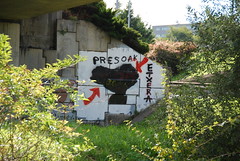
A man walks by a mural of the Basque flag, left, and a pro-ETA mural reading 'Basque prisoners back home', in Alsasua, Spain, Saturday, March 25, 2006. ETA, blamed for more than 800 killings since launching a campaign for Basque independence in 1968, on Wednesday announced a permanent cease-fire that took effect midnight Thursday. (AP Photo/Daniel Ochoa de Olza)

.... ... .

Friday, March 24, 2006

Etxerat Speaks Out

Intza Aldana, left, daughter of exiled Spanish Basque activist and Stanilas Etxeburu member of 'Etxerat' (Return at Home) Basque association during a press conference in Bayonne, southwestern France, Friday, March 24, 2006. Etxerat calls on the French authorities to respond in a positive way to the new situation after ETA declared a permanent cease-fire. The poster behind shows pictures of members of the Basque separatist group ETA currently in prison in Spain and France and reads 'We want prisoners and exiled to come back home'. (AP Photo/Bob Edme)

.... ... .

Thursday, March 09, 2006

Demonstration in Donostia


Hundreds of Basque radical protesters demonstrate in San Sebastian March 9, 2006. Batasuna, a separatist party outlawed for its links to ETA, called for a regional general strike to protest against the Basque government's ban on people publicly paying tribute to two ETA members who died in jail last week. The banner reads 'No to dispersion of Basque prisoners. Basque people must take to the streets.' REUTERS/Pablo Sanchez

Maybe some needs to tell Pablo Sanchez that to this date, Madrid has been unable to prove any links between Batasuna and ETA, or between ETA and any other Basque group accused of belonging to the so called entorno for that matter.
Other little details you can observe in this lazy piece of photojournalism:
a) It was thousands of Basques, not hundreds of Basque radicals.
b) The demonstration was against the brutal practice known as "dispersión", a legal mongrel that applies only to Basque prisoners in which against Spain's own constitution, Basque political prisoners are incarcerated as far away from Euskal Herria as possible, a repressive measure that punishes the families and friends of those in jail.
Jeez, just about anyone can be a reporter in Spain, is obvious that Pablo Sanchez keeps a picture of the Generalísimo Francisco Franco in his wallet, right next to the nice euro-pesetas that someone in the Partido Popular makes sure to put there.

.... ... .

Sunday, February 26, 2006

Presoak Is Not ETA

There is nothing I hate more than lazy reporting by so called photo-journalists.
Check the text that goes with this picture:


Villarreal's goalkeeper Javier Lopez Vallejo saves a penalty during a Spanish league soccer match against Athletic Bilbao at the San Mames stadium in Bilbao, Spain, Sunday Feb. 26, 2006. The game ended 1-1. Athletic Bilbao fans in background can be seen with banners supporting the Basque separatist group ETA, urging the return of all ETA prisoners to the Basque country. (AP Photo/Juan Manuel Serrano)
No matter what Juan Manuel Serrano wants to say, Presoak is not ETA.
Presoak is a human rights organization working in behalf of the must basic rights of all the Basque citizens jailed in Spanish prisons. What they do is to demand from Madrid to stick to Spain's own laws which dictate that prisoners must remain in jails nearby their towns as to ensure that their relatives, friends and loved ones are not taxed with extra expenses when it comes to visiting them in jail, which is one more of their rights.
Every year dozens of Basques are involved in traffic accidents up and down the Spanish geography in their attempt to visit those in jail. Many deaths have been caused in these accidents.
The policy of dispersion practiced by the Spanish judiciary represents a form of state sponsored violence. It is also a clear example of the state of exception aimed at the Basque society. Laws and regulations that apply to the Spaniards, do not apply to the Basques. Such thing is a violation of the UN's Human Rights Charter.
And I haven't even mentioned that many of those Basques jailed in Spain are political prisoners that have never been part nor ever supported ETA, they are in prison for the sole crime of being Basques and loving their ethnic and cultural identity.
Which comes to prove just how wrong this individual Juan Manuel Serrano is when he says that the Athletic de Bilbao fans are displaying banners in support of ETA.
Which begs the question, is he in the pay roll of the Francoists and Falangists that form the Partido Popular?
I think you know the answer.

.... ... .