Friday, August 11, 2006

St. James : From Gernika to Bilbo

Today I spent the day at Kortezubi in the vicinity of Gernika, this note I present to you was published by EITb:

Route of oaths

Way of St. James in the Basque Country: From Gernika to Bilbao (I)

08/11/2006

Our itinerary will eventually coincide, as we have already said, with the Route of Oaths, where the Spanish king swore the Bizkaians that he would maintain and guard their fuero, or charter.

We leave Gernika-Lumo and continue on our way towards Bilbao along the so-called Route of Oaths. The parish church of Muxika, San Vicente, is one of the few still to contain Romanesque remains on our territory. These remains take the shape of a double, round-arched window on the north wall, and a tympanum containing a window in the shape of a cross. The mullion is fluted.

The Gerekiz or Morga Pass was once used by the Romans, a fact which wouldseem to have been proved by findings of different gravestones dating from this period in the hermitage of San Esteban. This area is found on the watershed of the Oca and Butrón valleys.

Well worth a mention in the church of San Martín de Morga, although somewhat out of the way, is the sculpture of Andra Mari, dating from the 14th century, and the Saint James at the Battle of Clavijo on the altarpiece. It is said that this church was founded in the 10th century, and that it shelters the remains of Lord Manso López, who died in 920 at the hands of his son, whom he had besieged.

Our route continues towards the hermitage of San Salvador, in Aretxabalagana. This is a simple temple which nevertheless contains one of the most important artistic elements in Bizkaia, a monolithic stone window, with one square and two circular perforations divided by a small mullion-like column which stylistically corresponds to the first moments of Bizkaian Christian architecture, closely related to the Mozarabic style; it dates from before the 11th century, possibly the 10th.

Our itinerary will eventually coincide, as we have already said, with the Route of Oaths. This event was celebrated for the second time, after Bilbao, in San Emeterio and San Celedonio. The claimant had to kneel before a priest and swear to the Bizkaians that he would maintain and guard their fuero, or charter. From here, in the opposite direction from the one we are following, they would climb up to Aretxabalagana where, at the top of the hill, they would be kissed on the hand by the noblemen of Biscay who would accompany them to Gernika. The last known king to have carried out this ritual was Ferdinand the Catholic, in 1478.


.... ... .

Thursday, August 10, 2006

Gernika

One of the highlights of my present trip throughout Euskal Herria has been the chance to visit Gernika. Usually when I post information about this iconic town I do it referring to the brutal bombing ordered by the Spaniards to punish the Basque dream of freedom.

This time, thanks to EITb, here you have some tips in case you have the chance to visit this beautiful town:

On route

Way of St. James in Basque Country: Coastal road - Gernika-Lumo

08/10/2006

Gernika-Lumo was the place where the Lords of Bizkaia would meet, beneath the oak tree, in order to come and pledge to abide by their privileges.

Gernika-Lumo is especially relevant on this route. In the first place because its was here that travellers joined the road on coming from Bermeo, through Mundaka, Axpe-Busturia and Forua, having started their journey by sea and landed at this port. These travellers followed the remains of the old Roman road communicating the town of Forua (a site which has been undergoing excavation for a number of years) with the more romanized lands of the Mediterranean catchment area.In the second place, Gernika-Lumo is important because it has been considered as the cradle of freedom of the Basque people since time immemorial.

Located in the Bizkaian anticlinal, this town stands at the centre of the River Oca valley, at the birth of the Mundaka Estuary and beneath the rocky outline of the bordering mountains, with the outstanding Mount Sollube (663 m.) to the NW. This peak is recognised as one of the horn-blowing mountains of the Seignioralty, that is, from which horns were blown to tell people from the surrounding area when meetings were going to be held or warn them of imminent danger.

Formerly a parish, and later a town, founded by Don Tello in 1366 with a privilege signed in Orduña and granting it the Fuero, or charter of Logroño, Gernika-Lumo was the place where the freemen of Bizkaia would meet, beneath the oak tree, in order to go about governing the area according to their traditions and customs. It was to this spot that the Lords of Bizkaia would come and pledge to abide by their privileges.

Today the Casa de Juntas (Provincial Council Building), serves as the institutional headquarters of the Bizkaia General Assemblies, archive and museum. This complex centres around two basic buildings, the meeting room with its different offices, built in a Neo-classical style during the 19th century, and the atrium with the oak tree and hermitage of Nuestra Señora la Antigua, also Neo-classical, which is obviously not the one re-built in 1410 by Gonzalo Moro, the first mayor to be appointed in Bizkaia. According to a document from 1454, this building used to have an adjoining hospital.

The church of Santa María, started in the 14th century, and finished in 1715, has a large staircase leading to the atrium and to the Gothic splayed doorway, with a mullion and sculptures, as well as an outstanding statue of the Virgin Mary. The rectangular interior of this church has three naves covered with typical vaults.


.... ... .

Sunday, August 06, 2006

Basque Prisoners Back Home

This note comes to us via EITb:

Basque prisoners

Etxerat demands prisoners to be closer to home

08/06/2006

Relatives of Basque prisoners have reported that prisoners' dispersal aims at "causing the death and increasing the suffering of captives and relatives".

Relatives of Basque prisoners summoned by Etxerat have rallied on several Basque beaches in order to demand that their family members would be moved to jails in the Basque Country.

In Donostia-San Sebastian, around 50 people have attended the meeting. They have gathered next to the Kursaal Palace and soon later, they have walked to the Zurriola, carrying two banners.

Association of Basque prisoners' relatives Etxerat has claimed that prisoners accused of belonging to armed group ETA are suffering "exceptional" prison measures that, according to them, aim at "causing the death and increasing the suffering of prisoners, family members and friends".

"22 captives and 16 relatives and friends have died because of this prison policy", their statement says. According to it, most of Basque society supports the idea that Basque prisoners should take part in the process to solve the conflict.


.... ... .

Saturday, August 05, 2006

Idi Probak

I write these lines from Durango in Bizkaia, I hope I get to witness one of the rural sports' events mentioned in this article appeared at EITb:

Fiestas and traditions

Stone dragging, competition among oxen

08/05/2006

Stone dragging is only maintained in some rural areas of the Basque Country and it must be celebrated on special squares, called probaderos.

The ‘idi probak’, or events of oxen dragging stones, are one of the typical varieties of Basque Rural Sport. Their origin should be searched in the bets made by different farmhouses in order to settle which one had the best pair of oxen. In this type of events, two oxen joined by a yoke, by turns, must drag a huge stone the maximum number of times in a given time. In the case of Gatika, the stone weighs 1,780 kilos and the oxen must slide it along the probadero during half an hour.

Stone dragging is only maintained in some rural areas of the Basque Country and it must be celebrated on special squares, called probaderos, whose floor is formed by round boulders to make the movement easier. Besides the animals’ strength, the ability of the boyero (the ox herd, who guides the oxen) and the arreadores (who help the oxen by pulling the stone from behind) that accompany him is also important in order to balance the oxen’s rhythm and to guide them correctly while they come and go.

The ‘idi probak’, with a simple mechanism, arouse passion especially in the veteran baserritarras, who bet on one or another pair of oxen in a very lively atmosphere. This variety has a long-lasting tradition in Gatika, which has been vibrating with the oxen for 64 years.


.... ... .

Friday, August 04, 2006

In Favour Of The Political Prisoners

Is good to be in Euskal Herria visiting friends, but what makes it even better is to learn that the Basque society has a positive outlook regarding the Basque political prisoners.

This note appeared today at EITb:

University research

Favourable opinion on Basque prisoners' reintegration rises

08/04/2006

A research points out that a 41 percent of citizens is in favour or prisoners' reinsertion into society, while the percentage in 1996 was of the 33 percent.

The number of Basques who support ETA's prisoners completing their sentences has been reduced to the half in ten years, while the favourable opinion for reintegration into society has risen, also for those who have committed violent crimes.

A periodic research on Basque public opinion carried out by the University of the Basque Country and gathered by Europa Press has analysed the period between 1996-2006. Taking into account the data from May this year, once the cease-fire was declared, a 41 percent of Basque citizens shown their favourable stance to the reinsertion into society of Basque prisoners who have committed no violent crimes if the armed band dumps arms. In turn, a 40 percent shares that opinion but for all ETA prisoners, without exclusion.

As a contrast, the 9 percent of citizens favour the full compliance of sentences, a stance that the 18 percent of Basque society defended ten years ago, in 1996. In turn, from 1996 to 2006 the citizens' support to prisoners' reinsertion increased ten points provided that they have committed no violent crimes.

The stance of those who believe reinsertion must be for every one without exclusion has also risen, since a 33 percent of citizens defended that in 1996, and this year a 40 percent does so.

In the last semester of this year there has been a nine-point advance among those who believe that ETA members who regret what they did and voice their decision to dump arms should benefit from measures of reinsertion into society.

The opinion of those who think these measures should only be applied for those inmates who have committed no violent crimes has also increased two points. Among those who favour the full compliance of sentences there was a nine-point recession within the last six months.


.... ... .

Silvio in Euskal Herria

Ok, so, these are my first hours in Euskal Herria and I am trying to adapt to the jet lag and the difference of seven hours with Mexico. Reading the news I found out that Silvio Rodríguez will be touring Euskal Herria, but not until next month!

Here you have the note appeared at EITb:

Music

Silvio Rodríguez on tour around the Basque Country in September

08/04/2006

The tour of the singer and songwriter will visit the cities of Barakaldo, Pamplona/Iruña and Donostia-San Sebastián. His new album, Érase que era, will be on sale this week.

Cuban singer and songwriter Silvio Rodríguez will perform on September 2 in the Bilbao Exhibition Centre of Barakaldo, Bizkaia. This concert is within his tour around the Spanish State, and, as his recording company has confirmed, he will also visit Pamplona/Iruña on September 4 and Donostia-San Sebastián on September 6 and 7.

The Cuban singer and songwriter will visit many cities of the Spanish State during the months of August and September in a tour that will start in Galicia's A Coruña to finish in Madrid.

On this occasion, Rodríguez has decided to perform on small stages, except for the concerts in the Bilbao Exhibition Centre and Seville's Auditorium, trying to feel closer from the audience.

Niurka González's flute and clarinet, Oliver Valdés' percussion and Tríos Trovarroco (Rachid López, Maikel Elizalde and César Bacaró) will accompany him in his performances, as they did in the concerts he offered a few months ago in the Dominican Republic.

Silvio's new album, Érase que era, will be released this week, and it's the basis of the tour. The new work includes songs composed between 1968 and 1970, the most prolific moment of his musical life, as he says. "I always had the debt of many old songs," he says, and affirms that his new work "is for updating, but acknowledging that "that debt can't be paid off because previous songs always come out."

One of the greatest exponents of the New Cuban Verse, movement that embraces such musicians as Pablo Milanés and Amaury Pérez, he has searched a sound lacking "devices" and "fashions" to make "a document that puts forwards most truthfully and straightforwardly" each song.

Dang, I wish I could stay a couple of more weeks.

.... ... .

Catalonia Is Not Spain

I had a lot of fun while reading this article appeared at The Harvard Crimson, specially the last part, here you have it:

Catalán, Anyone?

Spain is far from melting the pot

Published On Friday, August 04, 2006 12:21 AM
By STEVEN A. MCDONALD

BARCELONA—Before leaving for Spain, I brushed up on my Spanish by reviewing the nuances of idiomatic expressions and practicing my accent, hoping for a shot at being mistaken for a local, or at least, a Spanish speaker. My preparation however, fell far short of my goal. To fool the locals here would require learning an entirely different language—Catalán.

At first there was no problem: The hospital staff with whom I worked always spoke Castellan—Iberian Spanish—and the patients would in turn respond in Castellan. Everyone accommodated and willingly put aside their Catalán when I was within earshot. While my American accent did not convince anyone that I was a local and my occasional lapse of grammar or vocabulary made my origin even more obvious, I could still understand and be understood. That is until I had Catalán to contend with.

After two weeks, I worked with a different doctor. The first patient entered and fifteen minutes of Catalán conversation ensued. Afterward, I politely asked the doctor if he would please speak Castellan since I have not learned any Catalán. “That is your own disability” he replied. Weeks later, in a meeting, everyone obligingly spoke Castellan until one doctor accidentally lapsed into Catalán. When asked to return to Castellan, he replied: “You’re not in Spain. You’re in Catalonia.”

I discovered the views of these particular doctors were not unique in Barcelona. Within my first week, the ubiquitous graffiti and even official state propaganda made the Catalán position clear as day. “Catalunya mereix mes” (Catalonia is worth more), “Els Cataláns no sorn espanyols” (The Cataláns are not Spanish), and “Catalunya is not Spain!” are common messages to see scribbled on walls, benches, or emblazoned on buses traveling throughout the city.

The contention between the two languages actually peaked just after my arrival. Within minutes after stepping off the plane large posters, some saying “Sí” and other saying “No” were difficult to ignore. I figured that the Spanish government was not offering a Spanish language crash course to foreigners, but if not that, then what could these signs refer to?

The answer came a day later in Spanish newspapers. The headlines all shared one word: “L’estatut.” After asking some people at work and a friend in a contemporary Spanish government class, I learned how the Si’s and No’s related to this statute. “L’estatut” determines Catalonia’s level of autonomy—who controls the taxes, the languages spoken and taught in school, immigration into the region, and its relationship with Spain, among other issues.

The “Sí” posters encouraged voters to vote yes to “L’estatut,” giving Catalonia, and thus Barcelona, its capital, more autonomy and control over how Spain’s policies affect the region. The “No” posters were the propaganda of a liberal extremist party, which seeks nothing short of secession. They believe Catalonia deserves more than “L’estatut” permits, and backing instead an all-or-nothing policy, they wanted to turn it down.

June 18th, the day of the referendum, saw an overwhelming “Sí” to the proposal. Just like the last vote on the statute, this one will most likely jettison Catalonia into a future even more divorced from the rest of Spain, culturally and otherwise. The newfound Catalonian autonomy eliminates classes taught in Castellan. All classes in public institutions, from elementary school through college, will be conducted in Catalán. Castellan, the national language will be treated as a foreign language and given one period a day, just like English. Catalonia, one of the richest provinces in Spain, will actually give less tax money to the rest of Spain. Additionally, Catalonia will gain more control over immigration into the region from outside Spain. Reforms upon reforms are leading the region down the path toward independence. And Catalonia’s inhabitants already have a sense of deeply rooted nationalism, despite not being an independent state.

One night here, I escaped Catalán in a local bar filled half with foreigners and half with locals. I sought to get away from the ubiquitous language, and actually work on my Spanish. Upon finding a non-Catalán at the bar I immediately began to air my woes: All I wanted was to speak Spanish for a day, to read a newspaper in Spanish, to actually embrace Spanish culture without confronting Catalonian pride.

He quickly replied: “The Cataláns are weak” and then lectured me on how a region truly achieves independence. He was an extremist reporter from the Basque Country, which he declared to be its own country, though Madrid would say otherwise. I sighed. I might have been able to escape Catalán, but Spain was a step ahead of me with its four distinct languages. It is simply impossible to tell who is a “Spaniard” and who is not, revealing their whole modus operandi for integration was wrong from the outset.


Well, what are the odds that an US citizen obsessed with downplaying the Catalan national identity and dream of self-determination will run into a Basque?

The message is clear Catalunya IS NOT Spain, nor Euskal Herria, nor Galiza, nor the Canary Islands.

.... ... .

Day One: Durango's Rain

As I was saying, last night when we finally arrived in Durango it was raining. Not storming or nothing like that, just that constant light rain that drenches everything.

But that was not going to stop Juan from showing me the church of Santa María at night, because it is really worth it to see it let me tell you.

One of the main reasons for a member of the Basque diaspora to wish to visit Durango is that although everyone knows about the bombing of Gernika by the Nazi Luftwaffe, it was Durango the first city targeted by Francisco Franco in his effort to destroy the recently created Republic of Euskadi.

This is how the town's website describe the event:

During the dictatorship of Primo of Rivera, the actual dictator came to Durango and opened the food market. On 31st March 1937, during the Spanish civil war (1936-1939), Durango suffered an undiscriminating and systematic bombing against the civilian population. Such an event had never happened in any part of the world before this time. More than 500 people died in the bombing and the occurrences the following days.


The church called Santa María sustained heavy damage the day of the attack, many of the victims tried to find refuge in its interior not knowing just how powerful the bombs used against them were.

Hence, the importance of visiting the city to pay a silent hommage.

Also, I would like to point out to something that Wikipedia mentions about Durango:

Durango is a historic city, home of conquistadors like Francisco de Ibarra, and as a result there are more Durangos in America named after the Basque original one, not least of which is a state in Mexico called Durango, the principal city of which is called Durango.


Now, you have to excuse me, I need to be in Bilbo in an hour.

~ ~ ~

Day One: Bilbo at Night

And so it is that the "Ongi Etorri" bilboard sign told me that I was entering Araba. I was then able to soak in the Basque landscape. The flight delay was a nuisance, yes, but at least my entrance to Euskal Herria was quite improved thanks to the sunset I got to enjoy.

The sun light was almost gone when a sign on the side of the road told me that I was now in Bizkaia. It wouldn't be too long before the bus made its entrance into the urban sprawl known as Bilbo. Once at the bus station I was so excited to be there that I forgot to retrieve the piece of luggage I checked in when I got in the bus in Madrid.

Anyway, I made a phone call to try to locate Juan who volunteered to pick me up in Bilbo, and then I realized my mistake. As soon as I was done with the call I went back to the bay were my bus was parked, and there he was, the bus driver, not knowing what to do because his office was closed. So, we were both happy I noticed my backpack's absence.

Then, when I took a seat to wait for Juan I noticed I had forgotten to retreive my phone card from the pay phone I used to call his house.

Oh well.

Anyway, so Juan got there and he decided to show me the night life in Bilbo's old quarters, known as Zazpi Kaleak, the seven streets. I finally got to engage in the famous Basque tradition called txikiteo, which is quite simple, you do not stay for a long time at the same bar, you actually have one drink and then you move on to the next one, what in the USA is known as bar-hoping.

Around 1:00 am all places started to shut down, so we went back to the car in order to get to Durango, Juan's town.

When we arrived here, it was raining.


~ ~ ~

Thursday, August 03, 2006

Day One: Cancun - Madrid

Every trip has a departure point, which in this case is Cancun, in the Mexican state of Quintana Roo. A reknown touristic destination and the possible reason why you can find cheap flights between America and Europe. Now, when I arrived to the airport I was informed that my flight was slightly delayed. Minutes went by and then hours, yes, it was delayed almost three hours, nice way to start a one month trip.

I finally got on the plane and when I saw the table with newspapers I must have had a startled look on my face because the flight attendant offered me a couple of options: El Páis or ABC. I kindly refused explaining to her that I would actually prefer to read the news. She gave me a look that told me that she agreed with me and that was it for the newspapers. Besides, I had a book with me which I chose for the long hours on board of the plane, Cartas a Elizabeth by Antonio Velasco Piña.

Since it was past 10:00pm when we took off I waited for dinner to be served and then, since I was all by myself (there was no one seating next to me) I simply proceeded to get as comfortable as I could to be able to endure the flight to Madrid.

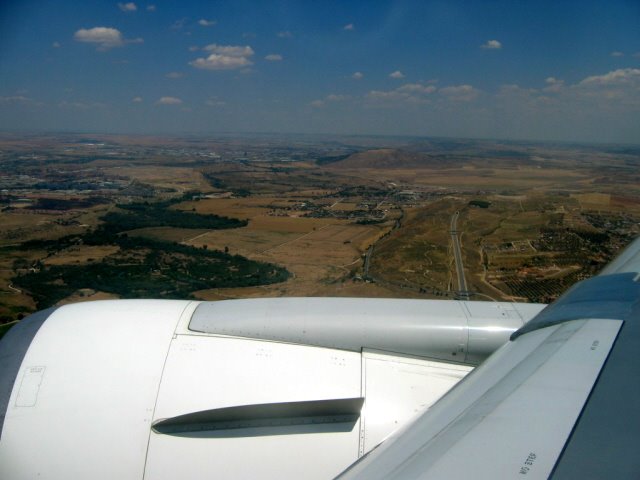
It was around 7:00 am my time when we arrived to the Barajas airport, then I had to wait in line for little over an hour to go through immigration. I finally got to the bus stop outside the airport since I needed to go to the bus station at a place everyone called "Las Américas". I finally got there and I was lucky enough to find a ticket for a bus that would depart for Bilbo (Bilbao) in just twenty minutes.

I tried to enjoy the view during the road trip from Madrid to Bilbo, but it is so arid and boring that I fell asleep until we got to Lerma, a city right next to a river by the name Arlanza.

I liked what I could see of the town from the bus stop and I snapped a couple of pictures. I grabbed a bite and a coke and then we continued on our way. I fell asleep again but somehow I managed to open my eyes right when a big sign on the side of the road said "Ongi Etorri".

Finally, I was in Euskal Herria, the Basque Country.

And here I am.

~ ~ ~