Wednesday, January 28, 2009

Gernika's Lessons

Remember a few years back when George W. Bush, Tony Blair and José María Aznar were weaving their web of lies and deception in order to bully the international community into backing up their holly crusade in Irak?

There was a pivotal moment in which then Secretary of State Colin Powel was forced by Bush's hawks to lie before the UN Assembly, we can all remember how he moved around a small vial containing a white powder but few of us recall the blue drape behind him. That blue drape was put there to conceal Picasso's Guernica replica from the world's view for the painting was a stark reminded of what war really means.

Well, it did not matter, soon after Bush's USA went to war and now that very same replica will be touring Tony Blair's England, maybe because Aznar's Spain decided to abduct the original as an excuse for preventing the painting to be shown in Euskal Herria.

This note comes to us via The Independent:

Guernica in Britain: The art of war

No artwork left its mark on the 20th century as emphatically as Guernica. And Picasso's monumental painting remains as controversial as ever. As the UN's famous replica comes to Britain, Gijs van Hensbergen dissects its awe-inspiring power

Wednesday, 28 January 2009

On 3 November 1998, Kofi Annan, Secretary-General of the United Nations, stood up to address the International Council of New York's Museum of Modern Art (Moma): a world élite of tastemakers and guardians of culture. Referring to the Guernica tapestry, a copy of Picasso's original painting, that was hanging in the corridor outside the Security Council chamber room, Annan declared: "The world has changed a great deal since Picasso painted that first political masterpiece, but it has not necessarily grown easier. We are near the end of a tumultuous century that has witnessed both the best and worst of human endeavour. Peace spreads in one region as genocidal fury rages in another. Unprecedented wealth coexists with terrible deprivation, as a quarter of the world's people remain mired in poverty."

It was a grimly realistic analysis of how far the world had progressed since 1937, when Picasso reacted so powerfully to the catastrophe of the bombing of the Basques' spiritual capital, but also of how far we were from achieving that elusive goal of the UN mandate for enduring world peace. Annan's statement to Moma's International Council also recognised Guernica's unique position in the history of art, elevated as it had been to the status of moral exemplar; a universal icon, warning that unless we studied its lessons, history was doomed to repeat itself.

Just over four years later, in the last week of January 2003, in the wake of the twin towers tragedy, a blue shroud was thrown over the Picasso tapestry to hide it from public view.

Considering the central role Guernica had played in the UN's education programme, it was a strange and highly symbolic decision. According to Fred Eckhard, a UN spokesman who had been given the impossible task of playing down the significance of the action, it was merely that blue was a more appropriate colour as a backdrop for television cameras, in contrast to Picasso's visually confusing mixture of blacks and whites and greys. Other observers, however, were quick to draw their own conclusions. It wasn't colour or shape that was the problem; what the picture showed up was the embarrassing contradiction of presuming to take the moral high ground while simultaneously campaigning for war.

On 5 February, the US Secretary of State, Colin Powell, shadowed by George Tenet, director of the CIA, had been scheduled to brief the United Nations Security Council in a last-ditch attempt to win UN approval for the war with Iraq that would start, according to military analysts, with a massive aerial bombardment of Baghdad that was to receive the chilling codename "Shock and Awe".

That same week, Hans Blix was expected to report back on either the discovery, or, as seemed more likely, the lack, of any concrete evidence proving that Saddam Hussein had been stockpiling weapons of mass destruction. On an almost daily basis, John Negroponte, US ambassador to the UN, had come out into the corridor to brief the world's press, while hovering in the background over his shoulder, the viewer could easily make out the mutilated bodies and screaming women of Picasso's painting. The presence of Picasso's Guernica was, it seemed, confusing the viewer. Painted as a passionate protest against senseless violence, it was once again succeeding only too well, illustrating perfectly the truism that we never seem to learn from our own mistakes.

Defiantly, in response to the cover-up of the painting, Laurie Brereton, a UN delegate representing Australia, pointed out: "Throughout the debate on Iraq, there has been a remarkable degree of obfuscation, evasion and denial, and never more so than when it comes to the grim realities of military action. We may well live in the age of the so-called 'smart bomb', but the horror on the ground will be just the same as that visited upon the villagers of Gernika [the Basque spelling of the town]... And it won't be possible to pull a curtain over that."

***

It was obvious that from the day of its creation, Guernica has never lost its power to shock. Even when reproduced, in tapestry, or in poster form, it still continues to mirror the horror of war and throw a harsh spotlight on our propensity for cruelty. Subtly, over the years, Guernica has reinvented itself and changed from being a painting born out of war to one that speaks of reconciliation and the hope for an enduring world peace.

In 1937, on Monday 26 April, as Franco's Nationalist forces pushed north to cut off Bilbao and take control of the Basque Country, the decision was taken to crush resistance with an overwhelming show of force. At 4pm, and for the next three hours, 60 Italian and German planes rained incendiary bombs down on Gernika, reducing it to a burning wreck. Nothing like this had been seen in Europe before. And no single act was so prescient of what the world would soon come to understand as the appalling reality of total war, where innocent people are bombed indiscriminately, or strafed by machine-gun fire as they escape from the carnage in towns up into the hills. The newspapers reported graphically on the tragedy, and the shockwaves circled the globe.

In Paris, on 1 May, Pablo Picasso, who was by then the world's most famous living artist, started to give concrete form to his powerful sense of revulsion, jotting down at lightning speed some initial ideas. Over the next fortnight, preparatory sketches, drawings, and paintings poured out with a feverish passion.

By late June 1937, Picasso was ready to put the finishing touches to a painting that had been executed on such a scale that he had been forced to jam it in at an angle in his enormous studio on rue des Grands Augustins. The canvas, which had acquired the title Guernica, was covered with what at first sight seems a chaotic jumble of animals and contorted human bodies drawn out in an austere palette of blacks, whites and scumbled greys.

Photographs taken by Picasso's new lover, Dora Maar, show the artist reaching forward from the top rung of a stepladder, stretching out to make a quick addition at the top of the canvas. Sweating, almost manically absorbed, Picasso paces up and down the painting's length, feeling and reading its almost palpable presence and testing out, again and again, the suffocating pressure of its interior space. Torn paper was pasted on to the canvas to try out possible changes and then quickly removed. Ideas and doodles were torn out of the ether, built up and overlayered, one on top of the other, as they were drawn into the painting's creative vortex and hammered into shape. Desperately short of time, Picasso had covered the almost 30 square metres of canvas in little less than six weeks. By any standards, it was an extraordinary achievement.

Out of the chaos, Picasso had managed to give shape to an arresting and profoundly disturbing image. There was nothing that specifically alluded to Gernika, or the terror that rained down from the skies. Instead, Picasso had resorted to employing images whose simplicity and meaning could travel across every cultural divide. At the base of the painting, decapitated, splintered and crushed, lies the corpse of a dead warrior, strangely reminiscent of a classical bust. Above him the weight of a horse, contorted with pain and clearly in its death throes, threatens to collapse to the ground.

On the right of the picture, three women in various states of distress look in upon the scene. In the background, barely discernible at first, a cockerel is crowing up at the skies from the top of a table. Most poignant of all, at the extreme left edge, the picture is anchored and framed by the tragic image of a mother with the limp body of her dead child held in her arms, who in turn is overshadowed by an impassive bull. Only the ghost of a wind blows across the canvas to lift the beast's tail.

At first sight, there seems to be no clear relationship between cause and effect. There is no easy way in to read the story or discover exactly at what point we have joined the narrative. But among the shattered walls, blind doorways and roofs, we come to a growing realisation that something terrible has happened here.

***

When first shown at the Paris Exposition in 1937, the painting's reception was strangely muted. In fact, considering the coolness with which it was initially received, particularly by the official Basque delegation, it would have been reasonable to assume that Guernica might end up rolled and stored in the back of Picasso's Paris studio, like Les Demoiselles d'Avignon; left to collect dust and haunt those who had seen it with ever fainter echoes of a drama that had long since played itself out. Awkward and difficult to transport, this was perhaps the most likely outcome. After all, in the remaining Republican strongholds of Madrid, Barcelona and Valencia, the most obvious venues for showing the work, it would have served only to demoralise the militiamen who were witnessing daily what was painted out so graphically across Picasso's large backdrop.

During the Second World War, however, and particularly after the bombing of Pearl Harbor, Guernica's imagery became more recognisable, indeed painfully familiar. City after city in Europe was bombed. Finally the catastrophic lessons of Hiroshima and Nagasaki brought the stark realisation that the world would never be the same again. With no hint of irony, the President of the United States, Harry S Truman, announced sombrely: "I fear that machines are ahead of morals by some centuries, and when morals catch up, there'll be no need for any of it.' Guernica had been horribly prescient. What it depicts is modern mass slaughter only faintly disguised behind the ancient rituals of death. Every community in the world that has suffered an appalling atrocity has become synonymous with Guernica the painting and Gernika the town, the brutalised spiritual heartland of the beleaguered Basques.

As the prolonged sound of air-raid sirens boom out across a threatened city somewhere far away, each new conflict, each new bombing, each act of total devastation, begs the question: shall this be the Gernika of our age? Warsaw, Coventry, Dresden, Rotterdam, Hamburg, Stalingrad, Hiroshima, Stalin's Gulag Archipelago, Pol Pot's Cambodia and, closer to us today, Rwanda, southern Sudan and Srebrenica. Iraqi Kurdistan has its Halabja. Recently, during the Balkan crisis in Kosovo, Serbs attempted to liquidate the Kosova Liberation Army. Each and every example has been cited as the Gernika of its day.

On 23 September 1998 in Washington, DC, Senator John McCain took to the Senate floor, declaring: "We have not lacked for rhetoric, but we have proven woefully inadequate at backing up our words with resolute action... Mr President, prominently displayed in the United Nations building in New York is Picasso's famous and haunting Guernica. That painting symbolised for the artist the carnage, the human suffering on an enormous scale, that resulted from the Spanish Civil War as a prelude to the Second World War. Perhaps it is too abstract for those countries in the United Nations that oppose the use of force to stop the atrocities that have come to symbolise the former Yugoslavia, or that believe the war in Kosovo is the internal business of Serbia."

Just as Anne Frank's story has become symbolic of all the Jewish children lost in the extermination camps, and Auschwitz shorthand for the apocalyptic horror of the Holocaust, Guernica has become synonymous with indiscriminate slaughter in whatever corner of the world such tragedy takes place.

On any given day, somewhere in the world, in parliaments, council chambers and in open debate, Guernica is cited to add a sense of moral suasion and urgency to the argument. Picasso's Guernica is the image that draws our constant attention to the proximity of catastrophe. Reproduced by the million, copied by other artists, reinterpreted by even more, Guernica remains, nonetheless, inviolate and unspoilt.

***

The extraordinary thing about Guernica is that it refuses to yield and drown under the weight of its own ubiquity. It is still an image that can awaken the nightmares of our historical past while painting a terrifying scenario of what has yet to come. Despite the marketing and the myriad psychological, sociological, historical and art-historical interpretations – enough to fill a library – it can still be guaranteed to stun the viewer into silence as he witnesses it afresh. Guernica has, and this is even more unusual, the capacity to speak intimately to the individual while also remaining a universal symbol that is understood by all.

From Paris in 1937 to the United Nations today, much of the painting's meaning has lain beyond Picasso's reach and control. Guernica has its own life, forging a relationship with its audience that has often been entirely separate from the life of the genius who brought it into our world. Over the years, that audience and historical circumstances have continued to change. And Guernica, as is inevitable, has become stylistically dated.

But while the fabric of the painting has become increasingly fragile, as a work of art it has nevertheless been ageing well. It has never lost its relevance, nor its magnetic, almost haunting appeal. From its first showing in Paris to its arrival in Spain 44 years later, it has witnessed and helped to define a century. That its lessons have still not been heeded or learnt makes it as relevant and iconic today as it ever was. Guernica, for better or for worse, more than any other image in history has helped to shape the way that we see.

Extracted from 'Guernica: The Biography of a Twentieth-Century Icon', by Gijs van Hensbergen, published by Bloomsbury (£10.99). To order a copy for the special price of £9.89, plus free post & packing, call Independent Books Direct on 0870 079 8897. The Guernica Tapestry will be on display at the Whitechapel Gallery, London E1, from 5 April 2009 to 18 April 2010 (www.whitechapel.org )

'While I work, I leave my body outside the door'

For art historians keen to search out Guernica's ancestors in art, the painting has proved a minefield. Picasso had often stressed the need for the modern artist to be a visual kleptomaniac, and with Guernica he didn't disappoint.

He had raided the store cupboard of art history and drawn from myriad sources: from Roman funerary sculpture to David's Oath of the Horatii; from the 10th-century St Sever Apocalypse in the Beatus de Liébana codex, to Catalan primitive art; from the classical Winged Victory of Samothrace to Bartholdi's Statue of Liberty; from Grunewald's Isenheim Altarpiece to Delacroix's Massacre at Chios; from Gericault's Raft of the Medusa to Rubens's Horror of War in Florence's Pitti Palace; from Guido Reni to Poussin; from Pierre Paul Prud'hon to press photographs in L'Humanité and Ce Soir; from Rogier van der Weyden's Descent from the Cross to Goya's Third of May and his horrific Desastres prints. One recent theory suggests inspiration also came from an anonymous Catalan fresco, The Triumph of Death, in Palermo's Palazzo Abatellis.

All these were absorbed, metamorphosed and transformed. Picasso also used his own earlier motifs; in Guernica we find passages from Songe et Mensonge and Minotauromachy, of course, but the Crucifixion, Three Dancers, Vollard Suite, early bullfight juvenilia and hundreds of other echoes, faintly remembered gestures, similar compositions and the employment of his habitual techniques are there too.

It mattered little that Picasso sourced so readily from elsewhere; what mattered was his capacity to come up with something shocking and new. He had performed a kind of visual alchemy in which the immediate power of the propaganda poster sits side by side with something as ancient and atavistic as the Altamira bull. On 12 July 1937, the Paris Exposition's Spanish Pavilion opened and the public could study Guernica and decide for themselves.

Few artists in history, excepting Goya, whose Second and Third of May were produced in just two months, have been capable of imagining and bringing to resolution such a complex and ultimately convincing work in such a short time. Physically, as well as intellectually, it was a remarkable feat.

Françoise Gilot, continually surprised by Picasso's extraordinary stamina, wondered at the physical cost of such an obsessive drive. "I asked him if it didn't tire him to stand so long in one spot. He shook his head. 'No,' he said. 'That's why painters live so long. While I work I leave my body outside the door, the way Muslims take off their shoes before entering the mosque.'" GvH

The Spanish Civil War: 1936 to 1939

Fighting broke out after a group of Spanish army generals, Franco among them, rebelled against the government of the Second Spanish Republic, which came to power in 1931 following the abdication of King Alfonso XII.

The conflict attracted worldwide attention as a struggle between left and right, with the elected Republicanos, or Popular Front, backed by the Communist Soviet Union, and Franco's Falangistas supported by Fascist Germany and Italy.

The military coup began in mid-July 1936. In early November, the Republican government fled Madrid for Valencia. Germany and Italy recognised the new regime and sent support before the year was out.

In addition to the civilian casualties of the horrific bombing raids that inspired 'Guernica', historians estimate that up to 50,000 people were executed on both sides, including the poet and dramatist Federico García Lorca.

The Falangistas won the war in 1939, and Franco began his bloody 36-year rule. Over the next 12 years, his supporters murdered at least 100,000 Spanish citizens. Republicans were subjected to constant persecution.

Although photographers and reporters had covered earlier wars, the Spanish Civil War attracted an unprecedented level of foreign attention because of developments in media and communications. Ernest Hemingway, Martha Gellhorn and George Orwell famously wrote dispatches from Madrid and a variety of front lines, illustrating the human cost of war.

The photographer Robert Capa covered the war with his partner, Gerda Taro. His 'Falling Soldier' picture, alongside 'Guernica', is the most memorable representation of the war. Purported to depict the moment a Republican soldier took a fatal bullet, 'Falling Soldier' is held up as an example of how propagandistic photography can shape the image of a war internationally. Capa went on to found the Magnum photographic agency. He was killed by a landmine while covering the war in Indochina in 1954. Sophie Morris
.... ... .

Eusko Flickr : Orrua


orrua
Originally uploaded by auzokoa

Monday, January 26, 2009

Spain Jails Basque Activists

This article concerning the fascist clampdown on Basque political parties and against Basque activists was published at World War 4:

Spain expands crackdown on Basque political parties

About a dozen members of the new leadership of the Basque political opposition were arrested in several towns across Spain's País Vasco Jan. 23. The arrests follow a court order by the Spanish High Court magistrate Baltasar Garzón, who claims that 3DM and Askatasuna, two new parties fielding candidates in the forthcoming local elections, are fronts for the outlawed Batasuna party.

Spain's Supreme Court banned Batasuna in 2003 on the grounds that it was a front for the armed organization ETA, closing down its offices and barring it from all political activity. Prior to its prohibition, Batasuna used to garner some 12% of the vote in Basque Country elections. According to Spanish news agencies, the police are gathering evidence of links between the outlawed Batasuna and the new parties 3DM and Askatasuna. Police also reportedly carried out searches on the homes of several prominent Basque militants, including Tasio Erkizia, Mariné Pueyo, Santi Kiroga and Joxerra Etxebarria. None were arrested. (EiTB, Bilbao, Jan. 23)

This operation and the incarceration of eight Basque activists ordered by inquisitor Baltasar Garzón brings the number of Basque political prisoners close to 800, a figure that surpasses the all time high during Francisco Franco's murderous regime. Which pretty much means that Spain IS NOT a democratic state.

.... ... .

Sunday, January 25, 2009

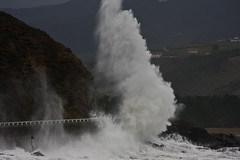
Weather Punishes Euskal Herria

The reports about the storm that hit Western Europe keep mentioning Spain and France, well, as it happens, Euskal Herria is wedged between these two states so yes, the storm did created some havoc in the land of the Basques.

Here you have this note from Google News:

Hurricane-force winds kill 15 in Spain, France

BARCELONA, Spain (AFP) — Hurricane-force winds lashed Spain and France Saturday, killing at least 15 people including four children when part of a sports hall collapsed, while over a million were left without power.

High winds, gusting up to 150 kilometres an hour (95 miles per hour) in northern Spain, brought down part of a sports hall in Sant Boi de Llobregat, near Barcelona, a regional government spokeswoman said, killing the four children and injuring nine.

Spanish media reported the children had been playing baseball outside but took shelter in the building.

"It seems that the roof shifted and brought down part of the wall," the spokeswoman said.

Meanwhile French forecasters warned the storms could be as ferocious as the tempest in 1999, which uprooted millions of trees, although over a "more limited geographical area."

They reported record-breaking winds, reaching 184 kilometres an hour at Perpignan, and sounded a red alert across nine departments for the first time, though they reduced it to one later in the day.

The winds caused widespread disruption in both countries, with some 1.3 million homes experiencing power cuts in France, according to electricity grid operator ERDF, and tens of thousands in Spain also without power as high voltage lines were brought down.

The weather also wreaked havoc on the roads, with fallen trees hampering engineers struggling to restore power. French Interior Minister Michele Alliot-Marie said 715 additional staff had been sent to the region to assist.

"It's the apocalypse," said Peio Poueyts, in the tourism office in the French city of Biarritz on the Atlantic coast, where 135 kilometre-per-hour winds were reported.

Train, bus and rail transportation were cancelled and many of Biarritz's stores were shuttered up.

French President Nicolas Sarkozy announced he would visit the region on Sunday.

Apart from the children in the Spanish sports hall, a 52-year-old woman died in Barcelona late on Friday night when she was crushed by a collapsed wall. Another woman died Saturday in the northern Castilla-Leone region when a door, lifted by the winds, crashed into her.

In Galicia, in northwestern Spain, a civil guard sergeant was killed by a falling tree as he was directing traffic.

In the southeastern Spanish province of Alicante, a 51-year-old man was also killed by a collapsing wall, while one of six seamen rescued from their Portuguese cargo ship by helicopter off Galicia died, media reported.

The death toll also included a municipal employee near Barcelona and a 60-year-old man in Spain's Catalonia province.

Four people died in southwestern France, including two drivers who were killed by falling trees in the Landes department. A 78-year-old also died when he was hit by flying debris outside his home, local authorities said.

Meanwhile, a 73-year-old women died in the southwestern Gironde department when the storm cut electricity powering her breathing machine.

In Spain's northern Basque country, waves as high as 21.5 metres (70 feet) were recorded off Cape Matxitxako, according to a spokesman for the regional interior ministry. Dozens of people had to be evacuated from the area after wind blew the roofs from their homes.

Some 14,000 people were also evacuated in the Alicante region due to a forest fire apparently touched off by a downed cable.

Flights were disrupted across northern Spain from Bilbao in the Basque Country to Ibiza in the Balearic Islands, while train travel was also disrupted.

Most ski stations in the Pyrenees mountains closed due to the risk of avalanches.

Air France cancelled domestic flights passing through the affected zone, and all rail traffic was halted in the Midi-Pyrenees region, mainly because of fallen trees on the tracks.

Authorities said Bordeaux airport and the Aquitaine bridge across the Gironde river were closed, and flights were also suspended at Toulouse airport, though they resumed later Saturday.

However rail operator SNCF said there would be no trains in the region before Sunday.

Separately, avalanches in Scotland and France killed five people with three other lives seriously endangered in the French Alps.

.... ... .

Surf in Biarritz

Miarritze is redefining itself according to this article that comes to us via Irish Times:

Surf's up, m'lord

BIARRITZ: Once the preserve of royalty and the superwealthy, Biarritz has been reinventing itself as the destination of choice for avid windsurfers, writes Peter Cluskey

IF EVERY grand-but-fading seaside resort dreams of reinventing itself to meet the quick-fire demands of the 21st century, they have a role model: Biarritz.

For centuries it was the glamorous spa town of choice for the crowned heads of Europe. Today its award-winning beaches are regarded as some of the best windsurfing coastline in the world – and its wealthier regulars mix quite happily with an international parade of,well, beach bums.

It has been an extraordinary transformation. Perched at the southernmost point of France’s Atlantic coast, on the border with Spain, Biarritz first appeared on the radar of Europe’s elite in 1854, when Empress Eugénie, wife of Napoleon III, built a magnificent white palace on cliffs just outside the town.

The British royal family, including Queen Victoria and Edward VII, were regular visitors. So were Alfonso XIII of Spain, Leopold II of Belgium and even Germany’s Iron Chancellor, Otto Von Bismark. But republic replaced empire, and in a sign of the times Villa Eugénie, as it was dubbed by les Biarrots, was bought by Banque Parisienne and reopened as Hôtel du Palais Imperial Resort Spa in 1893.

The clientele changed but the hotel’s cachet remained unassailable. A new royalty replaced the old – the shah of Persia, Frank Sinatra, Jayne Mansfield, Bing Crosby, Hemingway, Chaplin and Stravinsky – although the duke and duchess of Windsor remained loyal to the end. And while some of the glamour of Biarritz was usurped over the years by the Côte d’Azur, and Saint Tropez in particular during the 1960s, the town remained a byword for high-end leisure and sophistication.

Why does the history matter? Because it’s what has made Biarritz the charming, relaxed and welcoming place it is today. The ancient split-windscreen VW campers with fading anti-nuclear stickers may outnumber Rolls-Royce Silver Shadows; more holidaymakers may arrive by no-frills airline than by private jet; more waitresses may be speaking French with distinctly Aussie accents, but Biarritz is more vibrant than ever. It has made the journey from chic to cool. And the celebs are coming back: the iconic designer Karl Lagerfeld bought a holiday home here last year.

Place Georges Clemenceau, in the centre of town, is where you’ll find yourself as you get your bearings. Almost everyone starts by taking a walk along the promenade, Quai de la Grande Plage, which gives a magnificent view of the crescent of apartments, hotels and restaurants overlooking the bay.

At one end you’ll find the Hôtel du Palais, still the reserve of those with five-star budgets. At the other there’s the less-than-exclusive Casino Municipal, where you can choose between an informal section with slot machines and a more elegant section with table games.

By day, if you fancy your chances, there are numerous surf schools on the Grande Plage. Given the town’s elite background, golf is popular, with five top-class courses within an hour’s drive. Biarritz’s Basque heritage is most evident in the food and in the souvenir shops, which sell intricately-sewn Basque tablecloths, antiques, jewellery and handmade sandals.

To spoil yourself, there are a a number of famous local chocolatiers and one or two still-demure tea rooms. Or, for something healthier, there’s thalassotherapy at the Thalassa Institute, at Hôtel Miramar, and thermal seawater baths on Rue de Madrid.

When the sun goes down, relax in a deckchair with a cocktail at Côte 57, nibble some tapas at Le Bistroye or head to Chez Albert for some memorable local seafood. And while you tuck into the house speciality – steak de thon rouge aux saveurs douces, confitures d’oignons au vinaigre balsamique et croustillant de pommes de terre aux pieds de porc – remember the old Basque saying “To know how to eat is to know enough.”

Where to stay, eat and go

5 places to stay

Hôtel du Palais . 1 Avenue de l’Impératrice, 00-33-559- 416400, www.hotel-du-palais. com. If you need to ask how much it costs, you can’t afford to stay here. But we all have special occasions – and it is one of the world’s historic hotels.

Sofitel Thalassa Miramar . 13 Rue Louison Bobet, 00-33-559-413000, www.sofitel.com. A luxury hotel incorporating the Institute of Thalassotherapy (sea-water spa treatment), and with a golf course just a stone’s throw away. High-season rates for a double room go as high as €544, with breakfast €27.

Radisson SAS Biarritz. 1 Carrefour Hélianthe, 00-33-559-011313, www.biarritz.radissonsas.com. It may not be the Hôtel du Palais, but it’s luxurious nonetheless, and only a short walk from the centre. Rates begin at about €350 for a double standard room with an ocean view.

Hôtel Mercure Thalassa Régina et Golf. 52 Avenue de l’Impératrice, 00-33-559-413300, www.mercure.com. The thalassotherapy centre is very popular here. High-season rates for a double are around €240.

Hôtel Centre-Biarritz . 7 Rue de Gascogne, 00-33-559- 223654, www.hotel-centre biarritz.com. This is a nice quiet hotel just two minutes’ walk from the centre. The high-season rate for a double room is about €72.

5 places to eat

Hôtel du Palais. 1 Avenue de l’Impératrice, 00-33-559- 416400, www.hotel-du- palais.com. The hotel has three restaurants: La Rotonde, overlooking the ocean; Hippocampe, by the pool; and Villa Eugénie, for foodies.

Chez Albert. Allée Port des Pecheurs, 00-33-559-244384, www.chezalbert.fr. Bright, colourful, buzzing seafood restaurant with large outside terrace and Basque specialities.

Café de Paris . 5 Place Bellevue, 00-33-559-241953. If you fancy eating well, with the ocean and the Grand Plage spread out below you, this is the place to soak up the atmosphere.

Le Bistroye . 6 Rue Jean Bart, 00-33-559-220102. If you’re looking for fresh, authentic Basque cuisine in a friendly atmosphere, this is the place to go.

Bar Jean . 5 Rue des Halles, 00-33-559-248038. A relaxed bistro atmosphere with excellent tapas – after all, Spain is just 35km away – and grilled langoustines.

5 places to go

Russian Orthodox Church, 8 Avenue de l’Impératrice. Located right next door, this extraordinary church was built for Russian aristocrats who visited Hôtel du Palais before the 1917 revolution.

Chocolate museum (Planète Musée du Chocolat). 14 Avenue Beaurivage, 00-33-559-232772, www.planetemuseeduchocolat.com. The history of chocolate, how it’s made, and best of all, a hot-chocolate tasting. Pretend it’s for the kids.

Rocher de la Vierge (Rock of the Virgin). On the outskirts of the town, this outcrop, which you reached over an old iron footbridge, is topped with a celebrated statue of the Virgin Mary. It’s a popular stroll, with great views right along the Basque coast.

Asiatica Museum of Oriental Art, 1 Rue Guy Petit, 00-33-559-227878, www.museeasiatica.com. This is reputed to be one of the best oriental art collections in all of Europe. Don’t miss it.

Créations Jean-Vier, 58 Avenue Edouard VII and 25 rue Mazagran, 00-33-559-222936, www.jean-vier.com. Basque linen has a big reputation in France, and Jean-Vier is where the renowned Parisian chef Alain Ducasse buys his table linen.

.... ... .

Saturday, January 24, 2009

Eusko Flickr : Arantza Arkupeak


Arantza arkupeak 1jpg
Originally uploaded by etxega

Cyclone to Hit Euskal Herria

This note comes to us via EITb:

Alert

Powerful cyclone to hit Basque coast

The cyclone is expected to make landfall at dawn Saturday and could bring winds of up to 150 kph and 14-meter waves.

Basque Government officials say a powerful cyclone is to hit the coast of the Basque Country at dawn Saturday, bringing winds of up to 150 kph and 14-meter waves.

Authorities urged residents in areas near the coast to remain vigilant as the cyclone battering the coast might bring above average tides and minor flooding.

.... ... .

Thursday, January 22, 2009

Spain's New Attack on Language Diversity

Spain is plotting against the Basque, Catalan and Galician languages at the European Parliament, this is why they sent an envoy (a Portuguese by the name of Vasco!) to present the overtly racist "language manifest" put forward by Fernando Savater and a few other Spanish extreme right supporters.

This issue has been reported at Eurolang:

New European Parliament Report on Multilingualism

Brussel - Bruxelles, Thursday, 22 January 2009 by Davyth Hicks

The Culture Committee met on Tuesday, 20th January, to discuss the Commission's Communication on Multilingualism with Mr Graca Moura's (EPP) report.

While the Communication has already been voted on at the EU Council rendering the 'own initiative' report somewhat redundant, some MEPs suggested in the Committee’s December meeting that non-official languages be excluded from Commission multilingualism policies. The report “insists on the need for recognition of parity between the EU's official languages”, thereby excluding all European unofficial languages.

Mr Graca Moura also backs the arguments of the pro-Spanish language lobby 'Manifiesto en Defensa de la Lengua Común', which sees Spanish as being “endangered” by Basque, Catalan, and Galician. To this end, Mr Moura has inserted the clause stressing the “vital importance of preserving the possibility for parents and guardians of choosing the official language in which their children are to be educated in countries with more than one official or regional language”. However, it fails to consider that, in the Basque Country for example, it is the lack of parental demand for the Spanish-medium only model which has led to it almost disappearing from schools.

Mr Csaba Sogor MEP (EPP) has drafted the Employment Committee’s contribution to the Report. It strongly counters Graca Moura’s proposals in favour of constitutional and regional languages and calls on all member states to ratify the ECRML.

EBLUL will be tabling amendments with Culture Committee MEPs, the deadline is Tuesday 27th January. (Eurolang 2009)

EBLUL is the European Bureau for Lesser-Used Languages and it is a democratically governed NGO promoting languages and linguistic diversity. It is based on a network of Member State Committees (MSCs) in all the ‘old' 15 EU Member States and many of the new Member States that joined the EU in May 2004. In several occasions EBLUL has issued documents in which it reports Spain's lack of commitment towards the implementation on policies that will strenghten the use of Euskara, Catalan and Galician.

.... ... .

Monday, January 19, 2009

Football and Politics

In this article published at Goal the author takes the act of courage and solidarity towards the Palestinians by Frederic Kanouté to go deeper into the (awkward) relationship between politics and sports in Francoist minded Spain:

Spanish Debate: The Politics Of Football In Spain

Cyrus C. Malek looks at the interplay between politics and sport in Spain - something that has seemingly always been the case and forever will be...

Celebrating a well-taken goal against Deportivo La Coruña in a Copa del Rey match, Sevilla's Frederic Kanouté lifted his club's shirt to reveal a second shirt with the Spanish 'Palestina' and the Arabic, 'Phillistine' (فلسطين) emblazoned across the chest in a public cry of protest against the atrocities being committed in Gaza. While the Spanish Football Federation fined the player a hefty 3,000 euros, Kanouté, a native of Mali and a follower of Islam, has won much praise from many quarters for using his position on the pitch as a stage for socio-political commentary. The Palestinian Embassy released a statement thanking the striker for providing an inspiration for Palestinian children, Barcelona's Pep Guardiola has publicly condemned the fine as excessive and voiced his own condemnation of the massacre, and Iranian first division club Zob Ahan Isfahan has even offered to pay the player's fine as a tribute to the cause.

Politics is no stranger to Spanish football. Throughout its lifetime on the Iberian Peninsula, football has been inexorably linked to the political events of the era. No saga more infamous, of course, than the politically-charged rift between Barcelona and Real Madrid.

The Spanish Civil War, Generalissimo Francisco Franco's rise to power, and Spain's eventual transition to democracy (or more precisely, a constitutional monarchy) are marked by the blood rivalry -in the very real sense of the expression- between Real Madrid CF and FC Barcelona. During the first month of the Spanish Civil war, Barça's politically left-leaning president, Josep Sunyol, was murdered by the Falangistas (the Nationalist military movement) and Spanish football became a symbolic forum for the political ideologies of the day.

Barcelona, which was already the ensign for the progressive movements of fashion, food, architecture, and art, became the symbol for progressive politics—the resistance against the oppression of dictatorial government. With the banning of the Catalán, Gallego (Galician), and Euskera (Basque) languages under the fascist regime, one of the few places that Catalán could be spoken freely (and safely) was in the Barça stadium. Adopting the Catalán motto, 'Més que un club', FC Barcelona became 'more than a club' in its encounters against Real Madrid, the club associated with the oppressive rule of the capitol government.

How close the ties between the Madrid club and Franco's fascist government were in actuality remains ambiguous to say the very least, but the arrival of Madrid legend Alfredo Di Stéfano at the Bernabéu remains a near-undisputed instance of political influence. Wholly left out of the Marshall Plan to rebuild Europe, a war-torn and impoverished Spain was under Franco's all but total control. Had Di Stéfano signed for Barcelona, the public attention would have shifted toward Spain's gateway to free-thinking democratic ideals and thus the necessary strings were pulled to have Di Stéfano, a player of unmatched talent, call the Spanish capital home.

While some (perhaps not completely unwarranted) claims are made that the government played a more direct role in footballing affairs by influencing referees to favour Madrid in domestic matches, one cannot deny the unsurpassed superiority of Di Stéfano's Madrid that won 5 consecutive titles on the European stage—beyond the scope of Franco's "influence". Nonetheless, the stigma remained throughout the latter half of the 20th century and footballing great Johan Cruyff chose Barça over Real Madrid stating that he could not play for a club associated with Franco.

Since the years of fascism, the historical rivalry between Real Madrid and Barcelona has assumed a less dual role with respect to political implications. But the sphere of politics still envelops Spain's football clubs in regional disputes. The issues of political/social autonomy from the central government and distribution of resources (e.g. high speed trains) across the Spanish country remain contentious talking points, especially for the Galician, Basque, and Catalunyan provinces. Where Catalán, Gallego, and Euskera were once banned under Franco, now the first language taught in schools are those of their respective provinces. As a result, Spanish is taught for only a few hours a week and the children of Spanish-speakers in these provinces have limited options of studying Castilian Spanish. These tensions lend a distinctly political flavour to matches featuring Barça, the Galician Deportivo La Coruña, or the Basque Athletic Bilbao.

Of course the famous Athletic Bilbao have taken the devotion to their unique situation a step further by only employing Basque players (it is worth noting that the ethno-political ties run so deep, that Athletic captain, Joseba Etxeberria has pledged to forego his wages and play next season, his last as a professional, for free). While the all-Basque roster has seen a few exceptions to the rule (now players of any origin can play for Athletic, just as long as they acquired their skills in the Basque Country), one can imagine the sort of tension that might have surrounded a match during the 90s when the Basque militant group ETA was at at its height. As an aside, there is something to be said for Athletic Bilbao's impressive feat of having remained contentious in La Primera for so long despite such a limited talent pool from which to fish.

Back in Madrid, the country's two main political parties, the conservative Partido Popular (PP) and the socialist Partido Socialista Obrero Español (PSOE), have footballing connections as well. PSOE leader and Spanish Prime Minister José Luis Zapatero is an ardent Barcelona supporter and makes public predictions for El Clásico while his predecessor, José María Aznar of the PP, has even been linked to the Real Madrid presidency in the upcoming summer elections. On the northern edge of Madrid, the regional disputes between the central government and the semi-autonomous provinces make their home at the royal governing body of football, the Real Federación Española de Fútbol (RFEF) where debates are periodically held on whether Catalunya and the other provinces should be able to compete in international competitions as separate entities from La Roja, the Spanish national team. And not so far away from the Bernabéu, Spanish sports daily Marca, a publication first printed as an iconic form of propaganda for Franco's Falange, now exposes the obstruction of democratic principles as Ramón Calderón was forced to resign in a scandal involving the rigging of votes at Real Madrid's general Assembly.

One of the greatest beauties of Spanish football lies in the fact that its purview is not solely limited to a vessel of entertainment. In a country with a tumultuous history, where language itself was oppressed and women could not open a bank account until 1975, the sport transcends sport, serving as both an implicit and explicit conduit for political and cultural expression. As more foreign players bring their diversity of backgrounds and political views to La Liga, it seems fitting that the political debate would take the next step to the global stage. In the case of Freddy Kanouté's gesture, one can only speculate how the act contributed in raising awareness and mobilizing over 250,000 Spaniards at the midweek, from Madrid to Málaga, to take part in the largest pro-Palestinian demonstration in Europe. The beautiful game, indeed.

Something to point out; the children of Spanish speaking families have absolutely no problem getting their education in Spanish (Castillian), for public education in the part of the Basque Country occupied by Spain is in Spanish. That misconception has been making the rounds in the mean stream media ever since a "journalist" by the name of Keith Johnson who happens to be in the payroll of José María Aznar published an extensive article against the teaching of Euskara (Basque language) in Euskal Herria. The truth is, there is plenty of public schools where education is in Spanish, even more, most of the ikastolak (Basque schools) are private so Basque parents have to pay an extra amount to get their kids to receive their education in Euskara, as opposed to the public schools which are free of charge.

One more thing, in 1998, Aitor Zabaleta, a Basque follower of Donostia's Real Sociedad football team was murdered after an Spanish police officer tricked him into entering a bar full of Atletico de Madrid followers.

.... ... .