Tuesday, May 23, 2006

No Christians in Foro de Ermua

This is a note that appeared to day at some Catholic news page:

Spanish bishops' president urges victims, ETA to reconcile

Posted on May 23, 2006

The president of the Spanish bishops' conference said the Basque separatist group ETA should ask for forgiveness - and its victims should grant it - in order to achieve a lasting peace in Spain's Basque region. Speaking at a forum for political and business leaders in Madrid May 17, Bishop Ricardo Blazquez Perez of Bilbao said that achieving peace in the Basque region is difficult "because there are a lot of wounds there, because a lot of people died there and families have lost their loved ones." Bishop Blazquez, whose diocese is in the Basque region, said he appreciated the courage of the victims of terrorism, especially "the many who have already forgiven." He also called on ETA, which is classified by the United States and European Union as a terrorist organization, to bring a permanent end to the violence.

He said ETA must "definitively stop killing and extorting; definitively lay down its weapons; and no one should ever feel threatened" by them if peace is to be achieved. Although officials have expressed doubt about ETA's announcement of a cease-fire in March, Bishop Blazquez had expressed "feelings of relief and hope" at the cease-fire announcement. He added that the church is available if needed as a mediator in future negotiations. Mikel Buesa, president of a victims' organization, called for Bishop Blazquez's resignation as president of the bishops' conference and as bishop of Bilbao, according to the Madrid daily ABC. Buesa said Bishop Blazquez's comments that victims should pardon members of ETA "totally disqualifies him from serving as a pastor of souls," the paper reported.


Blazquez is right, a lot of wounds need some mending.

But he is plain wrong de moment he demands the first move from ETA, allow me to explain.

He asks for the members of ETA to ask for forgiveness from the victims of violence, that is, ETA's violence.

But let us remember here that ETA's violence was never the cause, but an effect.

In today's Spain, there is an issue that needs to be addressed as soon as possible, and that is the scars that Franco's regime left in the Spanish society. ETA was pushed to their violent ways by Franco's genocidal regime first, and by the unability by "democratic" Spain to tackle important issues later.

So, the right thing to do is to demand for the living members of the Franco regime and their heirs within the Partido Popular (PP) to ask for forgiveness from the Spanish society. Blazquez should also demand from the Partido Socialista Obrero Español (PSOE) and from the Partido Popular to ask for forgiveness from the Basque society for their actions against the Basques, including all the victims of state sponsored terrorism with its most virulent expressions in the Grupos Armados de Liberación (GAL) and all the para-military groups operating in Euskal Herria, including the repressive operatives by the Guardia Civil.

Then, and only then, and with quite a few Spaniards involved in state sponsored acts of terrorism in jail, should Blazquez demand for ETA to ask for forgiveness from the families of victims of ETA's violence, many of whom are actually active members within the Partido Popular and other Spanish state repressive institutions; like the military, the Guardia Civil and the corrupt justice system.

But in the end, Blazquez opinion did bring something important to light, the backwards and vindicative position by these so called victims of terrorism. All we need to do is to read what the Buesa individual exressed:

Buesa said Bishop Blazquez's comments that victims should pardon members of ETA "totally disqualifies him from serving as a pastor of souls,"...


This tells you just how much Buesa and his minions hate the Basques (Blazquez is Basque) and how little understanding they have of the religion they profess, Catholicism. If not, go ahead and recite the "Our Father", there is a part there that talks about asking for forgivness the way we forgive those who trespass against us, or something like that.

And before I go, who can forget the role that the Pope and the Catholic Church had in Franco's raise to power?

Not forgotten, and not forgiven

.... ... .

Monday, May 22, 2006

The Lauburu Revisited

This information about the Lauburu appeared today at EITB:

Basque symbols

The Lauburu

05/22/2006

Lauburu stands for "four heads" (lau buru) and is considered to be an ancient indo-european symbol.

The lauburu is an ancient symbol common to many cultures from the East of Asia, to some islands in the Pacific Ocean and center Europe. Some theories say Basque legionnaires brought it from the Roman army after some campaigns in the Celtic countries. However, most theories say it represents the sun and is a symbol commonly found in many European cultures.

Some say its vertical heads, sometimes called sunset, represent female expression (emotional and perceptual) or the elements of fire and water. The horizontal heads, sometimes called sunrise, represent male energy (mental and physical) or the elements air and earth. Often this symbol was the apparatus used prehistorically to make fire and thus represents sacred fire, living flame, and productive power, later to be considered as the Pre-Christian Basque Cross.

It seems that the lauburu shares the characteristics of other swastikas, which have been employed for thousands of years as religious signs and decorative emblems. There are swastikas with the arms pointing either clockwise or counterclockwise, and with more than four arms. Swastikas appeared in ancient China, Egypt and India.

Anyway, swastikas have also been found on Greek coins, pre-Christian Celtic and Scandinavian artefacts, in the catacombs of the early Christians at Rome, and in Byzantine buildings. Swastikas were also widely used by American Indians. It seems that they represented the sun and infinity. The nazis, mistaking its origins, regarded swastikas as an "aryan" symbol and linked it to the notion of their "racial superiority."

In Basques' prehistoric religion, Jose Miguel Barandiaran saw some signs pointing to an indoeuropean influence in the cult of the sun (e.g., the orientation of the dolmens). This and other coincidences point to some common grounds of the basque and other indoeuropean paganisms, basques having been less isolated and impermeable to foreign influences than we have always been told.


.... ... .

Montenegro and Europe

Remember what I said a couple of days ago in my comment-post to something published at the blog called Hugin that I titled Montenegro?

Here it is:

And by the way, my theory is that Javier Solana is placing all this roadblocks on the Montenegrin road to independence because as an Spaniard, he is making sure that he won't make things easier for the Basques, the Catalans and the Galizans.


Well, Javier Solana, the Spanish Inquisidor has proven me right. Please, read this note about the reactions in Europe to Montenegro's yes to independence, at the very end you will be able to enjoy a bit of Solana's commitment to fascism.

The article was published by EITb:

Montenegro's independence

Reactions in Europes to Montenegro's Referendum

05/22/2006

The European Union on Monday commended the conduct of Montenegro's independence referendum, and said it would begin talks on trade and financial assistance deals with the tiny republic once the results are confirmed.

"We will fully respect the result of the referendum,'' said EU foreign policy chief Javier Solana. He called on supporters and opponents of independence to honor the outcome of Sunday's vote to secede from Serbia and form a separate state.

Solana, who was instrumental in pressuring Montenegro to remain united with Serbia after the breakup of Yugoslavia, said it was too early to "be precise'' about when the EU might open talks on possible EU membership for Montenegro.

In arguing for independence, the Montenegrin government had repeatedly complained that the union with much bigger Serbia was blocking its efforts to join the 25-nation EU. Preparatory talks with Serbia-Montenegro were frozen earlier this month over Belgrade's failure to deliver top war crimes suspects to the U.N. tribunal in The Hague, Netherlands.

"I cannot tell you exactly when we will start talking to them,'' Solana told reporters. "It is more important that they now talk between themselves.''

NATO Secretary-General Jaap de Hoop Scheffer echoed Solana's statement, saying the alliance had not considered Montenegro's possible membership. The authorities in Podgorica have said they would seek NATO membership after providing support for the alliance's bombing campaign against Serbia in 1999.

Paving the way for Catalonia and Basque Country?

Solana played down suggestions that Montenegro's referendum _ which went ahead after the EU imposed some rules on the percentage of votes needed for it to succeed _ would open the way for other independence referendums in Europe.

Asked whether Spain's Catalonia and Basque regions _ which dispatched delegations to monitor the Montenegro vote _ could hold plebiscites under the same conditions, Solana answered: "This is not a precedent for anyone, it's just for the situation in the Balkans.'' "Anyone who compares Catalonia and the Basque Country with Montenegro is suffering from delirium tremens,'' he said.

EU spokesman Amadeu Altafaj Tardio said the European Commission was still awaiting final confirmation from international vote observers, but said in an initial reaction that the EU welcomed that the referendum "was carried out in a calm manner and with high turnout, which is important for the legitimacy of the vote.''

He said EU Enlargement Commissioner Olli Rehn called on "all Montenegrin parties and citizens to preserve their unity and to build a consensus on the unity of the republic, on the basis of European values and standards.'' Altafaj Tardio said that once the results of the independence vote had been confirmed, the commission would move to draft a proposal to start talks on a separate aid-and-trade pact with Montenegro.


.... ... .

Ibarretxe and Montenegro

This is what the Lehendakari from the Basque Autonomous Community, which along with Nafarroa (Navarre) and the provinces of Lapurdi (Labourd), Behenafarroa (Basse-Navarre) and Zuberoa (Soule) conform Euskal Herria, the Basque Country, has to say about what took place in Montenegro.

And this is exactly what Javier Solana and his pro-colonialist camp were afraid of.

Here you have the note:

Ibarretxe looks to Montenegro as a model for Basque country

Basque regional premier Juan Jose Ibarretxe said yesterday that Montenegro's referendum on self-determination should be a model for Spain, while a Basque official delegation observing the vote in Podgorica declared, "Today in Europe, it is possible to democratically decide the political future of a country and solve a political confluct of historical origins."

The delegation reported that Montenegrin foreign minister Miodrag Vlahovic showed "his great knowledge of Basque reality, and expressed his gratitude for the presence of this delegation at a historic moment for this country." It stressed "the high citizen participation at the ballot boxes and the atmosphere of serenity."

The Montenegro referendum has become the Basque government's reference for carrying out the breakup of Spain, which was officially expressed when the pro-independence Ibarretxe Plan was passed by the Basque parliament. Ibarretxe himself has said several times that Montenegro is the model to follow. "What we're saying is that when Zapatero claims that the right to decide does not exist in Europe, it is not true."


Note, this note appeared at the Spain Herald, which you won't see me linking that often due to their fascist and anti-independentist editorial slant.

.... ... .

Solana Weathers His Defeat

European Union Foreign Affairs and Security Chief Policy Javier Solana gestures while speaking to the media about the referendum in Montenegro following a meeting of the EU Foreign Affairs and Defense Ministers held at the EU Council building in Brussels, Monday May 22, 2006. (AP Photo/Thierry Charlier)

.... ... .

Montenegro's Independence

Javier Solana is not a happy man today.

He orchestrated a campaign to deprive the Montenegrins from achieving their independence. That is because Javier Solana does not believe in democracy and the right of each nation to its self determination.

Why?

Javier Solana is a Spaniard, and as a Spaniard he could forsee that an eventual triumph by the pro-independence Montenegrins could provide other occupied nations within Europe with the legal frame to demand their own independence from the mega-nations that today occupy their territories depriving millions of Europeans with the right to be what they want to be.

Solana operates in favor of countries that cling to their "glorious" colonialist past. His own Spain, France and England, to mention some examples, keep nations like Corsica, Euskal Herria, Scotland et al from reaching a statehood that would give them full representation in the international arena.

Montenegro's brave push for independence also debunks the myth that self determination only takes place in backwards continents like Latin America, Africa and Asia, not in enlightened and sofisticated Europe.

The montenegrinos demolished the lie by many nay-sayers from the USA and Europe that the status quo is to be honored to ensure peace and stability. Them, the ones that say no to the dream of entire nations to become what they want to be, say that there is no practical reasons for small nations to demand statehood, that they are better off as part of a larger nation.

Too bad freedom can not be kidnapped with the fake promise of economic benefits.

Yesterday was a great day for humankind, a great day for the Europeans that still believe in true democracy and freedom.

Too bad Milosevid was not around to see the Montenegrins choose freedom and independence.

Hopefully José María Aznar will be around to see a free Euskal Herria, an independent Catalunya and a Galiza allowed to obtain its self determination. Hopefully the pocket-francoist will see this from a prison cell in The Hague, for his crimes against the Basque people.

Congratulations Montenegro!

Here you have a note regarding this great day:

Montenegrins back independence in referendum

By Ellie Tzortzi

Mon May 22, 8:57 AM ET

Montenegrins have voted for independence in a wafer-thin referendum victory that will sever an almost century-old union with Serbia and close the final chapter in the story of Yugoslavia.

The referendum commission said on Monday 55.4 percent of Sunday's votes were in favor of ending union with Serbia, according to a preliminary count. The EU had set a target of 55 percent for recognition. Turnout was 86.3 percent.

The early projections triggered a wave of celebration in the capital Podgorica -- flags, fireworks and the occasional semi-automatic weapons fire -- that continued all night.

European Union foreign policy chief Javier Solana welcomed the "successful" referendum, saying the EU would respect the outcome. "It seems that the process was orderly and we have to congratulate everybody for that," Solana said, adding that the turnout confirmed the referendum's legitimacy.

The mountainous republic on the Adriatic Sea has about 650,000 people.

Independence advocates say it has a better chance of development and EU membership on its own than in a dysfunctional union with Serbia, which has a population 7.5 million.

Montenegrin Prime Minister Milo Djukanovic claimed victory for his independence drive in the early hours of the morning.

"By a majority decision of the citizens of Montenegro, the independence of the country has been renewed," he told supporters cheering the climax of his decade-long campaign to restore the independence Montenegro last enjoyed in 1918.

"We've got our state," he said.

PROJECT YUGOSLAVIA

Analysts say the moribund union could hardly be any looser. The two republics already have different laws and currencies and their joint parliament hardly ever meets.

The result will close the final chapter in the story of Yugoslavia, which fell apart in the early 1990s. Slovenia, Croatia and Bosnia all fought to be free. Only Macedonia left without a shot fired.

"Yesterday we witnessed the end of project Yugoslavia, which was formed at the time with good intentions," said Macedonian Prime Minister Vlado Buckovski. "I think it will have a sobering effect on Belgrade and make Serbia turn toward European integration."

Neither the Serb nor the Montenegrin government divulged its plans for the day after the referendum. There is no clear plan of how the practical details of separation will be sorted out.

Fears of unrest proved unfounded. The night was calm even in ethnic Serb areas that massively supported the union, although the pro-union camp complained that pollsters had jumped the gun with early unofficial projections.

Less than an hour after polls closed, the Center for Free Elections and Democracy (CESID) said the "Yes" camp had scored 56.3 percent. Two hours later, CESID chief Zoran Lucic, looking uncomfortable, said the projection had shrunk to 55.3 percent.

There was grudging acceptance and a hint of suspicion in Serbia as media reported the victory.

Headlines read: "Breakaway!" and "It's over."

"Milo's majority questionable," said the Belgrade daily Politika. "One can conclude that the sovereigntists won, but no one can tell by how many votes," it commented.

Aleksandar Simic, adviser to Serbian Prime Minister Vojislav Kostunica, was quoted as saying he would "not be surprised if someone today filed criminal charges" against the pollsters.

"What they did was in the best tradition of separatist scenarios," Simic said.

The vote leaves Serbia alone to deal with more pressing issues, such as United Nations-led talks on potential independence for its breakaway Kosovo province, and the future of EU aspirations now in limbo due to its failure to deliver Bosnian Serb war crimes fugitive Ratko Mladic.

But the best title for an article regarding Montenegro's independence goes to Yahoo Asia:

Monday May 22, 8:59 PM

Proud Montenegro reclaims lost sovereignty

PODGORICA, Serbia and Montenegro (Reuters) - Brooding mountains, rushing rivers and a sparkling Adriatic coast give the world's newest independent state an operatic landscape, to match political antics that have at times verged on the comic.

With the population of a medium-sized city and plenty of forests, and bays to go around, Montenegro is betting that a tourism boom coupled with European Union membership will banish any suspicion that it is no more than an eccentric backwater.

In a referendum with a turnout of over 85 percent, the ancient Balkan principality broke with Serbia after nearly a century in its shadow, once more rejigging the map in Europe's most turbulent corner.

Sunday evening television was interrupted barely half an hour after polls closed, with the breathless prediction that the 'Yes' camp had won hands down -- a forecast later reeled back to a more sober prediction.

The streets of this sleepy capital erupted in a riot of celebration that included gunfire, de rigeur in the Balkans. At two in the morning, after a suitably theatrical pause, hero-of-the-hour Prime Minister Milo Djukanovic greeted his delirious supporters.


.... ... .

Sunday, May 21, 2006

Zapatero and ETA

Without any fresh ideas and without having done anything to reduce the repressive measures against the Basque society since the announcement by ETA to a cesasefire, Rodríguez Zapatero has announced his government will talk to ETA come June.

Of course, the Francoist vermin from the Partido Popular attacked both Rodríguez Zapatero and peace with the statement you will read on the note about this issue same that I reproduce here.

The note appeared at Yahoo News via the AP:

Sun May 21, 7:36 AM ET

Spain's prime minister said Sunday he will seek to open peace talks with the armed Basque separatist group ETA, which declared a permanent cease-fire in March.

Jose Luis Rodriguez Zapatero said he will go before Parliament next month to announce "the start of the process of dialogue to achieve the end of violence with ETA."

He spoke in the Basque town of Barakaldo, near Bilbao, at a rally of his governing Socialist Party during his first visit to the region since ETA announced what it called a permanent cease-fire on March 22.

Zapatero, accused by conservatives of rushing into a peace process with ETA and ignoring victims of the group's violence, also said he would propose including a mention of them in the preamble of the Spanish constitution.

ETA has killed more than 800 people since the late 1960s in its battle for an independent Basque homeland in northern Spain and southwest France.

The government says the group has been decimated by more than 200 arrests of suspected members in recent years.

ETA is also seen as stymied by the 2004 terror attacks by Islamic militants in Madrid, which killed 191 people and caused nationwide revulsion over terrorism, even among Basque nationalists who support ETA's goals of independence if not its methods.

ETA has not staged a fatal attack since May 2003 when a car bomb killed two policemen in the northern town of Sanguesa.

When it announced the cease-fire, ETA said it wanted a negotiated solution to the decades-old conflict.

.... ... .

I Stand Corrected (Sort Of)

As it happens, our week's Basque-phobe, Colin Davis, is not an US citizen, he is a Brit.

That is what he tells us in his most recent post.

Sorry, I was taken by surprise by his ignorance on the Basque Country and by his openly hatred towards the Basques, which got me thinking that he was a product of the USA's poor educational system.

Anyway, same difference, he is our week's Basque-phobe, no matter where he comes from.

And before he deletes it, this is what he tells me:

6. Alexsu has confirmed his long-standing [and deeply-felt] view on the constitution of the Basque country, though he’s not yet answered my question as to whether he lives there or [as I suspect] in the USA he purports to despise. Incidentally, I don’t want to lose a reader but my impression is that Alexsu’s concept of nationality is so strong he would have been with Hitler on the question of the Sudetenland Germans. But perhaps I do him a disservice. Doubtless he will let me know. If you are going to respond, Alexsu, please also tell me why we shouldn’t return to the 11th century Kingdom of Leon, the 6th century Visigoth Iberian kingdom or the even earlier Roman empire. I suppose it would be because the Basques weren’t any more independent under any of these than they are now as a ‘Castilian colony’.


Uh oh!

He spouses Francoist points of view, but then he casts the "Hitler" thing against me. I guess he is too ignorant to know who installed Francisco Franco in Spain, or that the Basques fought the Nazis from 1937 all the way through 1945.

But then he answers to a comment left in his previous post by a person that also acknowledges Navarre as the Basque Country which I reproduce here:

Anonymous said...

zazpiat bat - - the seven are one. The seven seperate provinces are one , the Basque Country. Yes, Navarra is part of the equation, as are Lapurdi, Behe Nafaroa and Zuberoa, or what is known in French as Labourd, Basse Navarre and the Soule. Add these to Alaba, Guipuzkua and Biskaia, the seven are one. Because of their history, Navarricos are fiercely independent and say they are not Basque nor Spanish, but Navarrans, yet the many many people I know from Navarre go to all the Basque festivals, Basque cultural centers, and, what do you know...they speak Basque and display both the Navarrese and Basque flags on their car bumper! If it looks like a cat and sounds like a cat and acts like a cat, well then, it must be.....a dog???

With this:

7. To the anonymous reader who says everyone in Navarra walks and talks like a Basque so must be a Basque, I can only say I didn’t see much evidence of this when I visited Vitoria [Gasteiz] and Pamplona [Iruña ], especially the former. And would attending a Basque festival really make me a Basque? Finally, would the Basque nationalists accord to parts of Euskadi the same right to opt out that they demand of Spain? I suspect not but would be happy to be disabused of any misconception.


That question he asks is one more of the obstacle the fascist scumbags from the Partido Popular place on the Basque road to self-determination, which proves my statement that Colin spends way too much time with the colonialist minded people.

And once again, before he deletes my new comment, here you have it.

So, you are a Brit, like Lenox.

Sorry, but your complete ignorance about the Basque Country had me thinking that you were an American and that your endemic hatred towards the Basques was a result of the poor educational system in that country.

As it happens, you dislike the Basques because as a Brit you share the old inclination by the Spaniards to cling to your colonialist past.

Too bad.

And as long as you continue to spouse the Francoist points of view on the matter, like your mention of the some obscure kingdoms in the history of the Iberian peninsula, I will continue to point it out to you and your drone-like visitors.

Navarre was an independent kingdom for over a thousand years, ergo, you lie when you say that the Basques were never independent.

And before Navarre, at the fall of the Roman Empire, the first people in the Iberian peninsula to regain their indepdendence was the commonwealth of Basques provinces.

But you are not going to find that information in your Francoist library, that one was designed to perpetuate the lies you so merrily quote in your blog.

And no, I do not live in the USA.


I bet there will be more on this issue, Basque-phobes are known for their obsessive quest against the right to the nations without statehood to achive such international recognition.

.... ... .

Saturday, May 20, 2006

Montenegro

The case about Montenegro's upcoming referendum on independence has been attracting some attention within the international community.

Hugin, in his excellent post "The European Union and Montenegro" gives his point of view in what seems to be a blatant double standard being applied on the people of Montenegro and their dream of self determination.

He starts out with some background information:

On Sunday, Montenegro's population will vote on whether to become independent or not. However, the European Union has demanded that at least 55% votes in favour, or it will not recognize Montenegro's independence. What is going to happen if the result of the referendum is between 50% and 55% remains unclear.


Then, he quotes Spaniard Javier Solana:

This is not a referendum on whether people can smoke in a pub. Independence is a question you ask only once. You have to ensure that the outcome is solid enough to guarantee stability.


Which sets him up to render this poignant comment on European hipocrisy:

This is a very interesting statement, because it shows that a referendum on independence differs on at least two points substantially from the referendums on the so-called European Constituion: a majority of 55% instead of 50%, and no second referendum. After the French Non and the Dutch Neen, the European has been playing with the idea to organize at second referendum in both countries, so that the population can get another chance to come up with the correct answer. For those with a bad understanding, that should be a Oui and a Ja, not the real opinion of course. In fact, there is even a third point, because it leaves no doubt that the European Union would have preferred that the Constitution would be adopted by the parliaments of the Member-States rather than by referendum. Sure, the populations would still have had their say in the next parliamentarian elections, wbut then it would be too late. Anyway, the European Union has an internal practice that is completely different from what it now demands from Montenegro.


He does not stop there, he then puts the ball on the European pro mega-nation crowd's court:

The conclusion can therefore be nothing else than that the European Union doesn't approve of a people's right to self-determination, and in effect acts like a state-nationalistic mother-in-law against peoples that want independence. Why doesn't Javier Solana turn things around, and demands a majority of 55% to continue the union with Serbia? For the European Union, stability seems to work only in one direction. Montenegro's neighbours, the Kosovars, should remember this for the future.


Hugin the demolishes the "there is not enough of you" argument that many Spaniards and US citizens use against the Basques:

It would also be interesting to know the positions of some of the Member-States of the European Union on this matter. What's for example the position of the Baltic states, the Czech Republic and Slovakia? Does Slovenia share the opinion of Javier Solana? And what do Cyprus (776,000 inhabitants), Luxemburg (463,000 inhabitants) and Malta (397,000 inhabitants) say about the argument that Montenegro (678,000 inhabitants) is too small to become independent?


Finally, he shines some light on what is known as realpolitiks:

Furthermore, this case is directly relevant for quite a few people inside and outside the European Union aspiring independence, like for example the Kurds, the Catalans and the Basques, the Scottish and the Welsh, and the Flemish. To take the Flemisch case: in theory, the Vlaams Belang, N-VA, SPIRIT and CD&V have a majority in the Flemish Parliament to declare Flemish independence. It looks though like the European Union may require a referendum to be held before it will recognize Flemish independence. On the other hand, there is also something called Realpolitik, and the European Union may not want to start an open conflict with a Member-State that would be the 14th largest measured by population number, and the 11th by GNP. And there is also the geographical factor: Brussels is an island in the middle of Flanders, that is, if Brussels doesn't choose to join Flanders. This doesn't make things better though, because it would only show that the EU is not afraid to use double (or triple?) standards depending on the situation. But one thing is very clear: the European Union's position on Montenegro's independence cannot exactly be described as being the most sympathetic and consequent one.


So, there you have it, a post that is a fine example that Europes is not a avant garde and liberal as many think.

And by the way, my theory is that Javier Solana is placing all this roadblocks on the Montenegrin road to independence because as an Spaniard, he is making sure that he won't make things easier for the Basques, the Catalans and the Galizans.

.... ... .

Friday, May 19, 2006

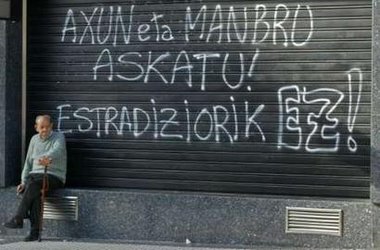
Support for the Six in Donostia

Elderly man sits next to grafitti against extradition of six suspected ETA members from Mexico in San Sebastian May 19, 2006. Six Spaniards arrested for suspected links to Basque separatist group ETA left Mexico in a Spanish air force plane on Thursday after losing a three-year battle against extradition. Grafitti reads in Basque language 'Release Axun (Maria Asuncion Gorrochategui) and Manbru (Juan Carlos Artola Diaz). No to extradition'. REUTERS/Pablo Sanchez

.... ... .