Thursday, July 09, 2009

The Other Red Wine Cocktail

Slowly but surely a Basque concoction is becoming the favorite party drink around the world. Its name? Kalimotxo.

Here you have some info from Austin 360:

Calimochos (The other red wine cocktail)

Addie Broyles

Sangria might be the king of exported Spanish drinks, but calimochos — a drink that originated in the Basque region that combines red wine, Coke and lemon juice — are just as beloved. Calimochos are cheap, easy (no cutting up of fruits) and contain ingredients you can get a convenience store.

The combination of red wine and cola sounds disgusting, I know, but in the five years since I lived in Alicante, Spain, I've introduced hundreds of people to this drink and few have turned me down for seconds.

There are endless regional variations throughout Europe of drinks involving wine and other beverages (pink wine and lemonade, white wine and Sprite, etc.), but this is the only one I continue to drink.

The recipe is simple: Half cola, half red wine, with a squeeze of lemon and plenty of ice. Cheap wine works best, as does a bottle of wine that's been open for a few days. As with all drink recipes, tweak the proportions to your taste.


Funny thing, Alicante is not in the Basque Country.

.... ... .

Wednesday, July 08, 2009

Sanfermines : Time Magazine 1932

Because of its historic value we thank Time Magazine for publishing this article about the Sanfermines in Iruñea from back in 1932:

Animals: Pamplona's Encierros

Monday, Jul. 11, 1932

For 51 weeks of the year the capital of Navarra is a sleepy little Spanish city where half-naked children play in the narrow streets and café waiters doze under the arcades of the broad, quiet Plaza de la Constitucíon. But in the second week of July, Pamplona becomes bull-mad, its streets and plaza are full of snuffing, rushing bulls. Hotels and rooming houses overflow with visitors from Madrid, Bilbao, San Sebastian, with tourists from St. Jean-de-Luz, Biarritz and Paris. Peasants from miles around sleep in wagons, in the fields, or do not sleep at all. For four days from 6 a. m. until long after midnight sleep is next to impossible while Pamplona celebrates the Fiesta of San Fermín, its patron saint. There are bullfights, street dancing, parades of huge grotesque figures, much drinking of strong Spanish wine. But by far the most exciting ceremony—one which takes place only at Pamplona—is the encierro (driving of the bulls).

Soon after dawn the first day of the fiesta this week, hundreds of youths gathered at the edge of town near the railroad station. Men climbed upon six big cages, reached down and opened them. Out walked six bulls, blinking in the sunlight. They were strong, lithe, handsome, each branded with the mark of Don Ernesto Blanco. They looked around, uncertain what to do, until from the crowd of youths came a yell: "Hah! Hah! . . . Toro!" The bulls lowered their heads, charged the crowd. The crowd took to its heels, the bulls stampeding in pursuit.

Through the narrow streets rushed the yelling rabble of boys and young men, while women cheered from the safety of windows. From every doorway came male recruits to swell the throng. Across the city they ran, the foremost bull not three paces behind the last man. At the plaza the path of the encierro is marked by fences, behind which hundreds of tourists and visitors watched. A few, carried away by the excitement, vaulted the fence, joined the runners. Occasionally a runner fell, lay still while the bulls, their eyes on the moving mass, pounded over them. From the plaza the chase poured into another small street, then men & bulls made one mad rush for the entrance of the bull ring.

The gate is far too small to let all through at once. Those who could not get in fell to the ground. Men piled upon men, bulls leaped over a human wall and charged snorting into the ring. There they found men waving coats, shirts, rags—anything that remotely resembled a matador's cape. The bulls charged here & there. Sometimes a novice held his bull's attention, executed several passes. Sometimes he went down with a horn wound in his leg.

Into this bedlam now trotted a bunch of steers. The bulls charged, goring the steers at first but gradually making friends with them, quieting down in the company of fellow cattle. Then the steers led the bulls out to pens under the arena.


The failed to mention anything regarding the Basque identity of this tradition, but at least they did mention Navarra and not just Spain.

.... ... .

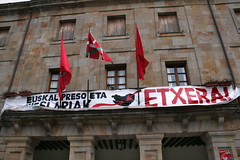
Eusko Flickr : Ajuntament Etxarri


AJUNTAMENT ETXARRI
Originally uploaded by Dani Morell

Tuesday, July 07, 2009

Bulls and Hemingway

In this article published by Time Magazine you will get some basic information about the main festivity in Euskal Herria, the Sanfermines in Iruñea:

The Running of the Bulls

Randy James

As they have each July for centuries, the narrow, cobblestone streets of Pamplona, Spain, are thundering with the sound of charging bulls. The weeklong annual celebration originated as a religious festival to honor St. Fermin, the patron saint of this small city in Spain's northern Basque region. Today the festival attracts hundreds of thousands of visitors from around the world, many of whom are drawn to its world-famous encierro, or running of the bulls, which begins July 7 and was made famous outside Spain by Ernest Hemingway's 1926 classic The Sun Also Rises.

The running of the bulls began as a way to move bulls from Pamplona's corral to its bullfighting ring. The animals would run the roughly half-mile stretch as children and adults herded them with shouts and sticks. The practice may date back as far as the 13th century, but it is known to have continued virtually uninterrupted since 1592, when the festival was moved from September to July. People are thought to have joined the herd sometime in the 1800s.

Nowadays, thousands of participants from around the world dash through Pamplona's streets trailed by charging bulls. Thousands more watch from safe nooks and balconies along the route, and spectators can also follow the events on national TV. Every morning from July 7 to 14, hordes of daredevils gather in a historic section of the city, many dressed in traditional garb and carrying rolled-up newspapers to swat the bulls if necessary. They sing a traditional homage to St. Fermin, asking him to guide them through the run. After two small rockets are fired, six bulls are released (along with a herd of steers), and the chase is on. The event generally takes just a few minutes.

As one might imagine, running with an angry, half-ton bull on your heels is not a particularly safe pastime. Since 1924, 14 people have been killed at the St. Fermin festival; the last to be fatally gored was a 22-year-old American, Matthew Tassio, in 1995. Witnesses said Tassio was knocked to the ground by a bull, then got up again and was struck by a second animal — a violation of the axiom that runners should remain on the ground if they get knocked down. Many people are injured each year, by both the animals and the crush of sprinters frantically making their way to the bullfighting arena on slippery cobblestones. Observers say foreigners — especially, for some reason, Americans — are most likely to be injured. "Americans come here with the image of The Sun Also Rises and just don't realize how dangerous it is and how easy it is to trip up," Daniel Ross, an American vice consul in Spain, told the New York Times after Tassio's accident.

Another factor fueling injuries in Pamplona is alcohol. As Hemingway chronicled, the festival is awash in wine and sangria, and runners partake copiously during long nights of partying. Participating in the run while tipsy is against the festival's rules, but violations are common. Another oft broken requirement is that all runners be at least 18 years of age. Many Spaniards were outraged to see televised images of a smiling 10-year-old boy dashing through the streets of Pamplona in 2007. The boy's mother was horrified as well; her ex-husband, who took the youngster to the festival, lost his visitation rights and was fined $200.


.... ... .

Saturday, July 04, 2009

Thursday, July 02, 2009

Solidarity With Etxeberria in Venezuela

This article was published at VHeadline:

AD thugs attack solidarity with the Basques activists outside Supreme Court

Patrick J. O'Donoghue

The Solidarity with The Basque People has organized another rally in front of the Supreme Tribunal of Justice (TSJ) in Caracas protesting against the possible extradition of Inaki Etxeberria to Spain.

According to a spokesperson, Etxeberria has been living legally in Venezuela for more than 12 years and the group accuses the State of illegally arresting Inaki in Valencia, Carabobo on April 21.

According to Venezuelan law, the case should have been declared proscribed because of the 15 years and four months that had passed since Etxeberria was charged in Spain for assassination.

The arrest warrant issued by Interpol, the spokesperson adds, contains contradictions in stating the actual terms surrounding charges.

The TSJ has not ruled on the matter, a spokesman comments, despite the fact that the Attorney General has declared that the case does not merit extradition.

However, it emerges that the protesters were attacked by opposition sectors that turned up outside the building accompanying Metropolitan Mayor Antonio Ledezma and opposition hardliner, Oscar Perez.

According to a report published by Aporrea.org, those supporting the Basque revolutionary were attacked with sticks and fists by Accion Democratica (AD) thugs.

Organizers complain that the Metropolitan Police (PM) not only failed to provide any protection, even though the anti-extradition group was there first but also forced them aside with tear gas to allow Ledezma, Perez and followers through to the TSJ building.


.... ... .

Strasbourg Upholds Spain's Apartheid

This article was published at Easy Bourse:

Court Ruling On Spain's Batasuna Ban "Bad News" - Leader

SAN SEBASTIAN, Spain (AFP)--A ruling by the European Court of Human Rights upholding Spain's decision to ban the Basque separatist organization Batasuna is "very bad news," the group's leader said Wednesday.

Conceding that Spain had won a political battle, Arnaldo Otegi told a press conference in the northern Spanish city of San Sebastian that it was also a "serious mistake."

"It gives political cover to the state of apartheid in the Basque Country," he said.

In three rulings, the Strasbourg court rejected all the petitions of the Herri Batasuna and Batasuna organizations, which had tried to register as political parties in 2001 but were declared unconstitutional by the Spanish government and disbanded in March 2003.

The groups had appealed to the court on the grounds that their rights to freedom of association and expression had been violated.

But the court said disbanding the parties was a response "to a pressing social need," given their ties to Basque militant group ETA, listed as a terrorist organization by the European Union and the U.S.

"Given the situation in Spain for several years regarding terrorist attacks, these ties can be considered objectively as a threat to democracy," said the court, backing the position of the Spanish authorities.

The judges said the Basque parties "contradicted the concept of a 'democratic society' and presented a major danger to Spain's democracy."

Otegi said the ruling smacked of the "war on terror" declared by former U.S. president George W. Bush," adding that Batasuna's demand for negotiations with Spain leading to the right of self-determination for the Basques was unaltered.


.... ... .

Wednesday, July 01, 2009

Extreme Basqueness

This article and recipes come to you courtesy of Canton Rep:

Extreme surroundings yield extreme cuisine

Jim Hillibish

Imagine living in rugged mountain territory isolated from the 21st Century. Your land spreads over two vastly different nations.

As with many things Basque, cooking reflects their culture. These are tough sheepherders and fishermen along the Pyrenees separating France and Spain. Their isolation has allowed their culture to grow. They are accustomed to doing things their own way and protect this freedom from the outside.

The result is a cuisine drawing from the countries it touches. Then the Basque Way is applied — supercharging with strong ingredients, getting the absolute most flavor out of everything. This is not subtle stuff. Your own most flavorful American recipe would be considered way bland here.

They use strong olive oil in almost everything, and garlic to the point of tears.

Stews and soups simmer for hours. A Basque cook shakes the pan violently where we would stir. He (men often do the cooking) produces dishes ahead, knowing that flavors increase with advance preparation.

Spanish tapas, the appetizers so popular in bars worldwide, started with the Basques. Now we know why they are flavor-packed. Chorizo is another Basque contribution, a dried or semi-cured sausage of potent power from heavy and heady use of pepper and hot paprika.

Basques have endured a number of scatterings as their people seek better lives in new countries. A million of them live in Chile. There are major concentrations in Mexico. The few who have made it to the United States seek territory similar to their home country, many in Idaho. Boise has a sizable Basque population, and the restaurants to prove it.

Chorizo in wine is simple but hearty enough to be consumed only with homemade bread. Basque pot roast features the flavors of bacon, pork and garlic all melded together in a powerful mix. This is classic Basque technique.


CHORIZO IN WINE

1 pound chorizo, the softer semi-cured instead of the dried hard-cured
1 tablespoon olive oil
1 cup dry white wine
1 baby leaf
1/4 teaspoon red pepper flakes

Slice the chorizo into inch-long rounds. Brown in oil and drain off the fat. Add wine and boil. Add bay leaf and pepper flakes, reduce to low, cover and simmer 45 minutes.

Serves four with a loaf of homemade bread and butter.


BASQUE PORK ROAST

4 slices bacon, thick cut and peppered, diced
3 pounds boneless pork roast, fat included
3 cloves garlic, sliced
1 tablespoon olive oil
Salt
Pepper
1 large red onion, sliced
1 large green pepper, seeded and sliced
1 small jar pimento
1/4 cup white wine

Wash and dry roast. Pierce meat with a knife in several places and insert slices of garlic. Rub with salt and pepper.

Place bacon in a heavy pot and fry until crisp. Remove bacon and add roast. Brown on all sides. Add onion, green pepper and pimento. Add wine and cover, baking slowly at 325 degrees for three hours. Drippings may be converted to gravy by heating and whisking in a tablespoon of cornstarch.

Serves 6 to 8.

Note: Lamb or venison may be substituted for pork.


.... ... .

Anchovy Veto to Continue

This may sound like bad news to many but we agree that the stock needs to be replenished to make sure we do not really regret it in the future:

Anchovy veto gets year's extension on Gulf of Biscay

Staff

Before the ruling of the committed, the ban - which was due to be in force until 30th June 2009 - will be automatically extended. Basque fishermen say the decision represents "a massive blow for the fleet."

The EU's Scientific, Technical and Economic Committee for Fisheries confirmed on Monday the recent report by The International Council for the Exploration of the Sea which recommended that the current ban on anchovy-fishing currently in force in the Cantabrian Sea be maintained for another year, taking it up to July 2010.

In line with the ruling of the committee, which supports the view that there are still insufficient numbers of anchovies in the sea, the veto - originally in force until the end of June 2009 - will be automatically extended.

"According to the scientific verdict, the current bio-mass of anchovies is at 21,270 tonnes," in other words, at a level inferior to 24,000 tonnes, the minimum quantity at which the European Commission considers fishing to be permissible.

"As a consequence, the ban on anchovy fishing should remain until further reports indicate that the bio-mass has once again risen above the 24,000 mark."

Sources indicate that the next scientific report on the state of the fishing-ground will be published in June 2010.

Basque fishermen

Basque fishermen confirmed that the decision represented "a massive blow for the fleet" which were hoping to be able to go out fishing. Secretary for the Biscay Brotherhood Federation, Aurelio Bilbao, reiterated that the veto is already in its fifth year and was now becoming intolerable.


The note was published at EiTB.

.... ... .

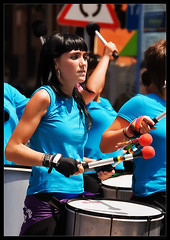
Eusko Flickr : Neska


Neska
Originally uploaded by Soniko